The Ultimate Career Guide to Digital Marketing Specialization
Contents
For over a decade, MySarkariNaukri.com has tracked the evolution of the Indian job market. While traditional “Sarkari” roles provide stability, the digital economy has created a parallel “Private-Sarkari” ecosystem—roles in top-tier marketing agencies and MNCs that offer equivalent security, high-pay structures, and structured promotion paths.
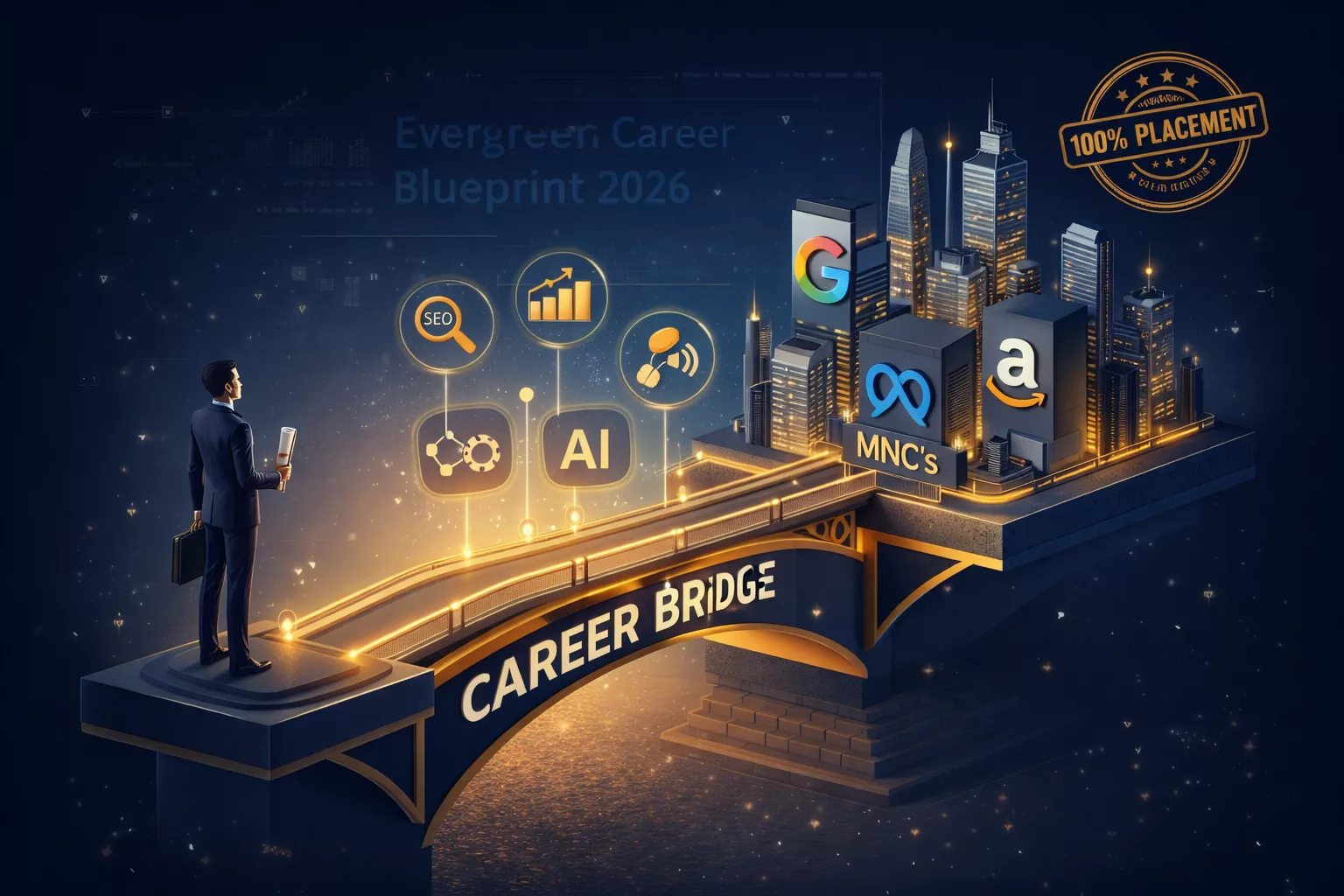
As of 2026, the digital advertising market in India has breached the ₹60,000 crore mark. This guide breaks down the institutionalized pathways for graduates to enter this high-growth sector through elite training programs that offer 100% placement guarantees.
The Standard Recruitment Ecosystem
In the digital marketing domain, “100% Placement” is not a marketing gimmick but a structured recruitment funnel. Most premium institutes follow a permanent four-stage selection and deployment cycle:
- Aptitude Screening: Testing logical reasoning, creative writing, and basic data interpretation.
- Foundational CBT (Computer Based Test): An assessment of digital literacy and platform awareness.
- Institutional Training: 3 to 6 months of rigorous, tool-based instruction (SEMrush, Meta Business Suite, Google Analytics 4).
- The Internship “Probation”: A mandatory 2–3 month paid internship (stipends usually range from ₹15,000 to ₹25,000) which serves as the final gateway to a permanent role.
Eligibility Standards & Entry Gateways (Evergreen)
Unlike government exams with rigid age bars, digital marketing gateways focus on “skill-competency” but maintain standard academic thresholds for MNC hiring:
- Academic Qualification: A Bachelor’s Degree in any stream (Arts, Commerce, Science, or Engineering). Most high-tier placements require at least 50% aggregate marks.
- Age Limit: Generally 18–30 years for freshers, though specialized “Executive Programs” have no upper age limit.
- Documentation Readiness: To secure placement in MNCs, candidates must have valid identity proofs, and for those seeking reserved category benefits in specific PSU marketing roles, EWS or OBC-NCL certificates must be updated as per the current financial year.
The “Sarkari” Career Path: A 10-Year Growth Map
The progression in digital marketing is now as structured as any government cadre. Below is the standard promotion milestone chart:
- Year 0–1: Digital Marketing Trainee / Executive
- Focus: Execution of SEO tasks, social media posting, and basic reporting.
- Year 2–4: Senior Specialist / Assistant Manager
- Focus: Managing independent budgets, strategy for specific channels (e.g., Performance Marketing).
- Year 5–7: Marketing Manager / Digital Strategist
- Focus: Team leadership, cross-channel integration, and ROI accountability.
- Year 10+: Head of Digital / VP of Marketing
- Focus: Institutional vision, multi-crore budget allocation, and brand architecture.
Financial Anatomy (2026 Standard)
In line with 2026 economic benchmarks, salaries in top-tier digital roles are calculated using base pay plus allowances. For graduates placed through “100% Placement” programs, the following structure applies in Tier-X (Metros), Tier-Y, and Tier-Z cities.
| Experience Level | Designation | Annual CTC (Avg) | HRA Category (X/Y/Z) |
| Fresher | Executive | ₹4,50,000 – ₹6,50,000 | 30% / 20% / 10% |
| 3-5 Years | Manager | ₹10,00,000 – ₹18,00,000 | 30% / 20% / 10% |
| 8+ Years | Director / VP | ₹25,00,000 – ₹50,00,000+ | 30% / 20% / 10% |
Note: Top performers in Performance Marketing often receive “Performance Bonuses” ranging from 10% to 25% of their annual CTC, similar to the Variable Pay structures in corporate banking.
Top 5 Institutions with 100% Placement Records
The following institutes are recognized for their “Industry-First” curriculum and high placement reliability:
- Kraftshala (Marketing Launchpad): Known for its “Accountability” model where they refund tuition fees if a job paying above ₹4.5 LPA is not secured.
- IIDE (Indian Institute of Digital Education): Features a specialized 11-month PG program with mandatory internships in top agencies like Schbang and Publicis.
- Digital Vidya: One of the oldest players with a focus on “Certified Digital Marketing Master” (CDMM) courses and a vast alumni network in MNCs.
- UpGrad (in association with MICA): Best for graduates seeking a “Brand Name” on their resume, focusing heavily on strategic management.
- NIIT Digital Marketing: A legacy institution that provides a “GenAI-Integrated” curriculum, ensuring graduates are ready for the 2026 AI-driven market.
Competency Matrix Table
| Subject Domain | Weightage in Exams/Interviews | Key Tools to Master |
| Search Engine Optimization (SEO) | 25% | SEMrush, Ahrefs, Google Search Console |
| Performance Marketing (Ads) | 30% | Google Ads, Meta Business Suite |
| Data Analytics & GA4 | 20% | Google Analytics, Looker Studio |
| Content & AI Strategy | 15% | ChatGPT-Plus, Midjourney, Jasper |
| Email & CRM Automation | 10% | HubSpot, Mailchimp, Salesforce |
Expert “Masterclass” Tips
- Document Hygiene: Ensure your degree certificates and category certificates (if applicable) are digitized. Many top companies now use Automated Reference Checks.
- The Portfolio Rule: Never apply with just a resume. Create a “Live Project Portfolio” (even if it’s for a dummy brand) to demonstrate your ability to spend budgets and generate leads.
- AI Adaptability: By 2026, manual keyword research is obsolete. Focus on learning Generative Engine Optimization (GEO) to stay ahead of 90% of other applicants.
Frequently Asked Questions (FAQs)
While the courses themselves don’t have bonds, many hiring companies may require a 1-year “Continuity Commitment” to recover the costs of your specialized training.
Yes. Organizations like NSDC, BECIL, and various State IT Cells frequently hire Digital Consultants on a contractual or permanent basis (Level-10 equivalent).
The standard is 6 months. During this period, your performance is tracked via KPIs (Key Performance Indicators) before you are “confirmed” as a permanent employee.
Most institutes provide placements in Tier-1 (X) cities. However, with the rise of remote work, many graduates are now placed in “Permanent Remote” roles with Tier-Y (20% HRA) salary structures.
No. These are “Professional Certifications.” For permanent government roles, you still need your basic Graduation degree as the primary eligibility criterion.
Most premium institutes offer “Remedial Batches.” You are typically given two additional attempts to clear the competency benchmark before the placement support is revoked.
Absolutely not. Digital marketing is 70% psychology and data analysis, and 30% tool management. No coding knowledge is required for 90% of the roles.
In large agencies (like Dentsu or GroupM), you can request an “Internal Job Post” (IJP) transfer to different city branches after completing 18 months of service.