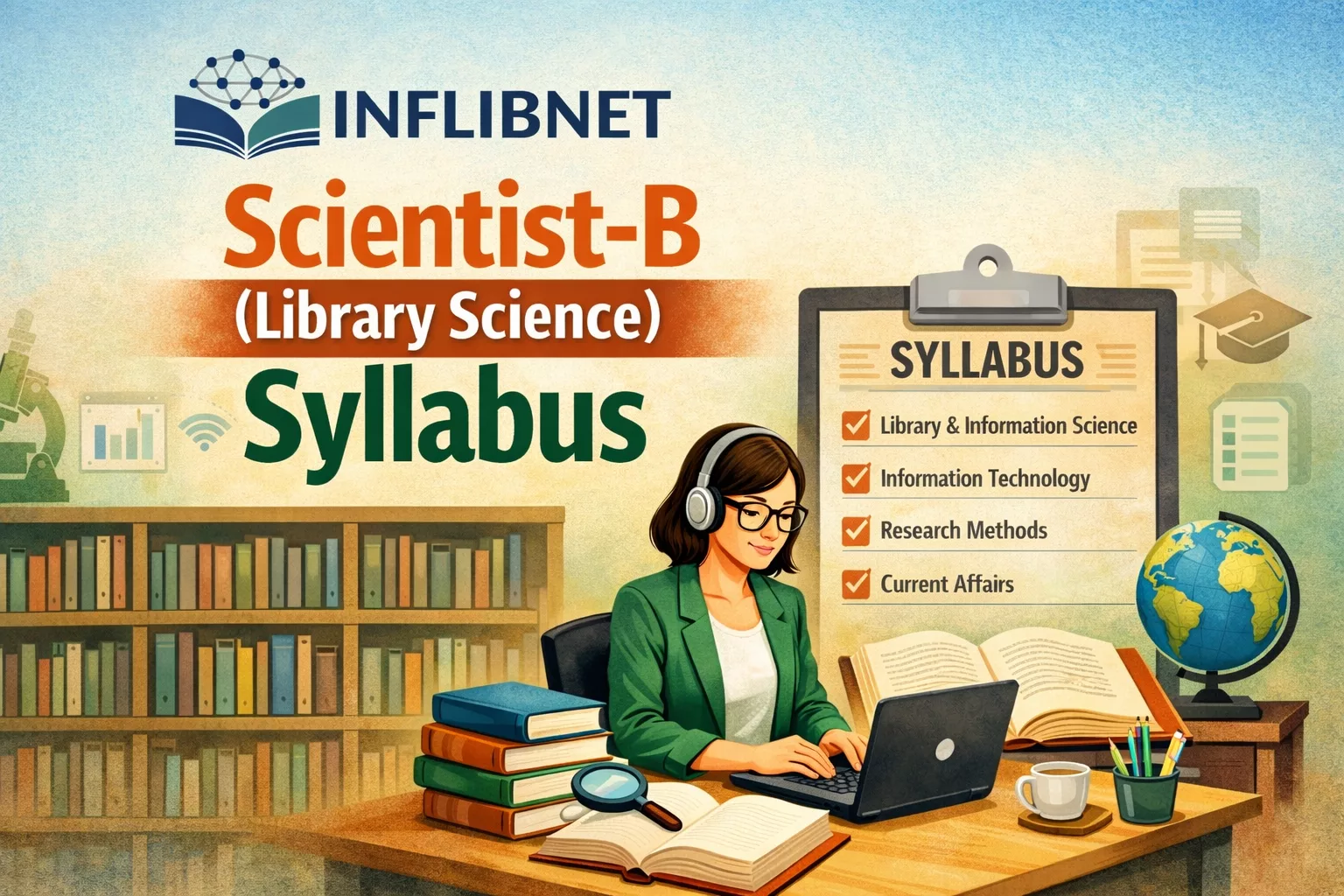
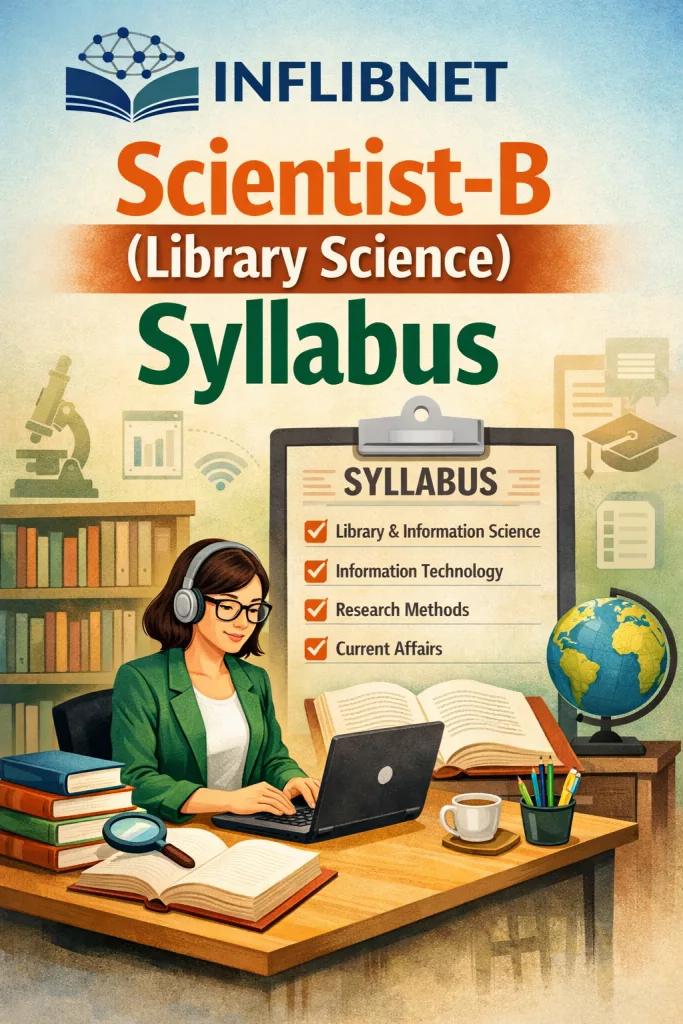
INFORMATION AND LIBRARY NETWORK CENTRE Scientist-B (Library Science) Syllabus: A Comprehensive Guide (2026)
Contents
- 1 Overview of the INFLIBNET Scientist-B Exam
- 2 1. Foundations of Library & Information Science (5%)
- 3 2. Information Concepts, Communication & Legal Frameworks (5%)
- 4 3. Information Sources, Systems & National/International Networks (15%)
- 5 4. User Services, Reference & Emerging Technologies (10%)
- 6 5. Knowledge Organization & Cataloguing Standards (15%)
- 7 6. Computer Technology, Internet & Emerging Digital Trends (15%)
- 8 7. Library Automation, Digitization & Digital Libraries (10%)
- 9 8. Research Methods & Metrics in LIS (15%)
- 10 9. General Aptitude & INFLIBNET Awareness (10%)
- 11 Preparation Strategy & Resources
- 12 Conclusion
The Information and Library Network Centre (INFLIBNET) plays a pivotal role in advancing library and information science (LIS) infrastructure across India. As part of its recruitment process for the position of Scientist-B (Library Science), INFLIBNET conducts a Screening Test based on a well-structured and indicative syllabus designed to assess candidates’ depth of knowledge, analytical ability, and awareness of contemporary trends in the LIS field.
This detailed article provides a thorough breakdown of the INFLIBNET Scientist-B (Library Science) syllabus, including topic-wise coverage, weightage distribution, key concepts, and strategic insights to help aspirants prepare effectively for the examination.
Overview of the INFLIBNET Scientist-B Exam
The Scientist-B (Library Science) position is a technical and professional role that demands expertise in modern library systems, digital resource management, research methodologies, and national/international information networks. The screening test evaluates candidates across nine core domains, with a total weightage of 100% distributed as follows:
| S.No. | Topic Area | Weightage (%) |
|---|---|---|
| 1 | Foundations of Library & Information Science | 5 |
| 2 | Information Concepts, Communication & Legal Frameworks | 5 |
| 3 | Information Sources, Systems & National/International Networks | 15 |
| 4 | User Services, Reference & Emerging Technologies | 10 |
| 5 | Knowledge Organization & Cataloguing Standards | 15 |
| 6 | Computer Technology, Internet & Emerging Digital Trends | 15 |
| 7 | Library Automation, Digitization & Digital Libraries | 10 |
| 8 | Research Methods & Metrics in LIS | 15 |
| 9 | General Aptitude & INFLIBNET Awareness | 10 |
Let’s explore each section in detail.
1. Foundations of Library & Information Science (5%)
This foundational section tests your understanding of the institutional and philosophical framework of libraries in India and globally.
Key Topics:
- Types of Libraries: Academic, Public, Special – their functions, user groups, and operational models.
- Library Legislation: Overview of state-level Library Acts in India; significance of the Press and Registration of Books Act, 1867 for legal deposit.
- Five Laws of Library Science by S.R. Ranganathan – interpretation and modern relevance.
- Professional Associations:
- National: Indian Library Association (ILA), IASLIC, IATLIS.
- International: IFLA, ALA (USA), CILIP (UK), ASLIB, SLA.
- Role of Key Organizations:
- UGC: Funding and standards for university libraries.
- RRRLF (Raja Rammohun Roy Library Foundation): Promotes public library development.
- UNESCO: Global advocacy for access to information and knowledge societies.
- LIS Education in India: Evolution, curriculum frameworks, and accreditation bodies.
- Library Extension Activities: Outreach programs, mobile libraries, rural initiatives.
- Emerging Trends: AI in libraries, data curation, open science, and sustainable development goals (SDGs).
Preparation Tip: Focus on the historical context and current mandates of organizations like RRRLF and UGC. Understand how the Five Laws apply to digital environments.
2. Information Concepts, Communication & Legal Frameworks (5%)
This section bridges theoretical LIS concepts with socio-legal dimensions of information access.
Core Concepts:
- DIKW Hierarchy: Data → Information → Knowledge → Wisdom – distinctions and interrelationships.
- Information Life Cycle: From creation to dissemination, including storage formats and obsolescence.
- Information Science: Interdisciplinary links with computer science, cognitive science, and sociology.
- Communication Models: Shannon-Weaver, Lasswell’s model; barriers (semantic, psychological, technical).
- Scholarly Communication Trends: Preprints, open peer review, institutional repositories.
- Intellectual Property Rights (IPR):
- Copyright, patents, trademarks.
- International treaties: Berne Convention, WIPO, TRIPS.
- Indian Legislation:
- Right to Information (RTI) Act, 2005: Role in transparency and public access.
- Information Technology Act, 2000: Cyber laws, digital signatures, data privacy implications.
- Policy Bodies:
- National Knowledge Commission (NKC): Recommendations on library reforms.
- National Mission on Libraries (NML): Modernization initiatives under the Ministry of Culture.
Note: Questions may link RTI provisions to library services or examine ethical dilemmas in digital content sharing.
3. Information Sources, Systems & National/International Networks (15%)
This is the highest-weighted section and requires in-depth knowledge of information resources and infrastructure.
Subtopics:
A. Information Literacy
- ACRL standards, SCONUL Seven Pillars Model.
- Digital literacy, media literacy, and critical evaluation skills.
B. Information Sources
- Primary: Research articles, patents, theses.
- Secondary: Indexes, abstracts, reviews.
- Tertiary: Encyclopedias, handbooks, directories.
- Documentary vs. Non-Documentary: Oral history, artifacts, performances.
C. Reference Sources
- Bibliographical (e.g., Indian National Bibliography), Biographical (Who’s Who), Geographical (Gazetteers).
D. Electronic Resources
- Subject gateways (e.g., INFOSCOPE), portals (e.g., Shodhganga), discussion forums (ResearchGate, Academia.edu).
E. Databases
- Bibliographic: Web of Science, Scopus.
- Numeric: NSSO, Census data.
- Full-text: JSTOR, ScienceDirect.
- Open Access: DOAJ, arXiv, PubMed Central.
F. Resource Sharing & Consortia
- DELNET: Document delivery, union catalogues.
- INFLIBNET: Shodhganga, e-ShodhSindhu.
- International: OCLC, WorldCat.
G. National Information Systems
- NISCAIR (now CSIR-NIScPR): Scientific databases.
- DESIDOC: Defence R&D documentation.
- ENVIS: Environmental information network.
- ERNET & NICNET: Academic and government networking.
- National Knowledge Network (NKN): High-speed backbone for education/research.
H. International Systems
- INIS (IAEA), AGRIS (FAO), INSPEC (IET), MEDLARS/MEDLINE (NIH), ERIC (education), BIOSIS, Patent Information System (PIS).
Strategy: Create comparison tables for national vs. international systems. Memorize acronyms and parent organizations.
4. User Services, Reference & Emerging Technologies (10%)
Focuses on service delivery in the digital age.
Highlights:
- User Studies: Methods (interviews, surveys), behavioral analysis.
- Community Information Services: Local history, job portals, civic info.
- Reference Services: Ready-reference, long-range, virtual reference (“Ask a Librarian”).
- Alerting Services:
- CAS (Current Awareness Service)
- SDI (Selective Dissemination of Information)
- Interlibrary Loan (ILL) & Document Delivery (e.g., DELNET’s ILL system).
- Mobile Library Services:
- Mobile OPAC, SMS alerts, QR-based access.
- Geo-location for branch navigation.
- Augmented Reality (AR) for shelf guidance.
- Web 2.0 & Library 2.0:
- Social media integration, RSS feeds, podcasts.
- Collaborative tools: Mendeley, Zotero, social bookmarking (Delicious).
- Academic Social Networks: ResearchGate, Academia.edu, ORCID.
Exam Focus: Expect scenario-based questions on implementing SDI or designing a mobile-friendly reference desk.
5. Knowledge Organization & Cataloguing Standards (15%)
Another high-weightage area requiring precision in standards and classification theory.
Key Areas:
- Universe of Knowledge: Faceted classification, modes of subject formation (e.g., fission, fusion).
- Classification Theories: Ranganathan’s PMEST, canons of characteristics.
- Classification Schemes:
- DDC (Dewey Decimal Classification)
- UDC (Universal Decimal Classification)
- CC (Colon Classification) – notation, facets.
- Cataloguing Principles: Paris Principles, ISBD areas.
- Cataloguing Codes:
- CCC (Classified Catalogue Code)
- AACR2 (Anglo-American Cataloguing Rules, 2nd ed.)
- Bibliographic Standards:
- ISBD (International Standard Bibliographic Description)
- MARC21, CCF (Common Communication Format)
- RDA (Resource Description and Access)
- FRBR (Functional Requirements for Bibliographic Records)
- BIBFRAME (linked-data successor to MARC)
- Interchange Standards: ISO 2709, Z39.50 (information retrieval protocol).
- Metadata Standards:
- Dublin Core (simple, cross-domain)
- METS (Metadata Encoding and Transmission Standard)
- MODS, EAD (Encoded Archival Description)
- Indexing & Abstracting:
- Pre-coordinate (e.g., PRECIS) vs. Post-coordinate (e.g., keyword indexing).
- Abstract types: indicative, informative, critical.
- Information Retrieval (IR) Models: Boolean, vector space, probabilistic.
- Ontologies & Semantic Tools: RDF, RDFS, Protégé for knowledge representation.
Tip: Practice mapping subjects (e.g., “Digital Preservation of Sanskrit Manuscripts”) to DDC, UDC, and CC notations.
6. Computer Technology, Internet & Emerging Digital Trends (15%)
Tests technical literacy essential for modern librarianship.
Coverage:
- Character Encoding: ASCII, ISCII (Indian scripts), Unicode (UTF-8).
- Hardware/Software: CPU, RAM, SSDs; OS vs. application software.
- Telecommunication: ISDN, PSDN, fiber optics.
- Network Types: LAN (campus), MAN (city), WAN (global).
- Internet Essentials:
- Protocols: HTTP/HTTPS, FTP, SMTP, TCP/IP.
- URI vs. URL, DNS.
- Search engines: Google (entity search), Bing, specialized engines (BASE, CORE).
- Web Technologies:
- Hypertext (HTML), Hypermedia (multimedia linking).
- Video conferencing (Zoom, Teams), Virtual Reality (VR) in libraries.
- Cloud Computing: IaaS, PaaS, SaaS models; library applications (cloud-based OPACs).
- Semantic Web & Big Data:
- Linked Open Data (LOD), RDF triples.
- Data mining in user behavior analytics.
- Web harvesting tools (HTTrack, Archive-It).
Relevance: INFLIBNET heavily uses cloud and semantic technologies—expect questions on NKN or Shodhganga architecture.
7. Library Automation, Digitization & Digital Libraries (10%)
Practical implementation of technology in library workflows.
Components:
- Library Automation:
- Modules: Acquisition, Cataloguing, Circulation, OPAC.
- Software: Koha (open-source), LibSys, SOUL.
- Evaluation criteria: scalability, interoperability.
- Automatic Identification Tech:
- Barcode: ISBN-based.
- RFID: Self-checkout, inventory management.
- QR Codes: Linking physical items to digital records.
- Biometrics/Smartcards: Patron authentication.
- Digitization Process:
- Selection criteria (rare, fragile, high-use).
- Hardware: Scanners, cameras.
- Software: OCR (ABBYY), metadata editors.
- Issues: Copyright, file formats (TIFF, PDF/A), metadata standards.
- Digital Libraries:
- Characteristics: Accessibility, persistence, interoperability.
- Architecture: Repository layers (ingest, store, access).
- Protocols: OAI-PMH, Z39.50.
- DOI (Digital Object Identifier) for persistent linking.
- Digital Preservation:
- Strategies: Migration, emulation, bit-level preservation.
- Standards: OAIS (Open Archival Information System).
- Projects: National Digital Library of India (NDLI), LOCKSS.
- Institutional Repositories (IRs):
- Tools: DSpace, EPrints, Fedora.
- Indian IRs: Shodhganga (theses), ePrints@IISc.
- Directories: ROAR, OpenDOAR, SHERPA/RoMEO (copyright policies).
- Content Management Systems (CMS):
- Drupal, WordPress for library websites.
- Integration with discovery layers (VuFind, Blacklight).
Case Study: Be prepared to discuss Shodhganga as a national IR initiative.
8. Research Methods & Metrics in LIS (15%)
Critical for evidence-based practice and academic contribution.
Topics:
- Research Types: Basic (theoretical) vs. Applied (problem-solving); interdisciplinary approaches.
- Methods:
- Historical (archival analysis)
- Descriptive (surveys, case studies)
- Experimental (controlled variables)
- Delphi (expert consensus)
- Research Design:
- Problem formulation, literature review.
- Hypothesis: null vs. alternative; testing via p-values.
- Sampling: random, stratified, snowball.
- Data Collection: Questionnaires, interviews, observation, log analysis.
- Data Analysis: Qualitative (thematic coding), Quantitative (descriptive/inferential stats).
- Plagiarism: Types (direct, mosaic, self-plagiarism); detection tools (Turnitin, Urkund).
- Statistical Tools:
- Excel (basic stats), SPSS (advanced analysis), BibExcel (citation analysis), R (data visualization).
- Report Writing:
- Structure: Abstract, intro, methodology, findings, conclusion.
- Citation styles: APA, MLA, Chicago.
- Tools: Zotero, Mendeley, EndNote.
- Bibliometrics & Scientometrics:
- Impact Factor (Journal Citation Reports)
- h-index, g-index, i10-index (Google Scholar)
- Altmetrics: Social media mentions, downloads.
- Research Trends: AI in citation analysis, open science, reproducibility crisis.
Application: You may be asked to design a study on “User satisfaction with mobile library apps.”
9. General Aptitude & INFLIBNET Awareness (10%)
Assesses general knowledge and institutional familiarity.
Focus Areas:
- Current Affairs: National education policy, digital India initiatives.
- Reasoning & Quantitative Aptitude: Basic numerical ability, logical sequences.
- English Comprehension: Passage-based questions, vocabulary.
- INFLIBNET-Specific Knowledge:
- Established in 1991 under UGC.
- Headquarters: Gandhinagar, Gujarat.
- Key Projects:
- Shodhganga: Theses repository.
- e-ShodhSindhu: Consortium for e-journals.
- InfoPort: LIS gateway.
- N-LIST: For colleges not covered under UGC-INFONET.
- Role in National Knowledge Network (NKN) integration.
- Collaboration with DELNET, RRRLF, and UGC.
Must-Know: INFLIBNET is an Inter-University Centre (IUC) of UGC—emphasize its mandate in promoting resource sharing and ICT in LIS.
Preparation Strategy & Resources
Recommended Books:
- Introduction to Library and Information Science – G. Edward Evans
- Fundamentals of Library and Information Science – K. Mukherjee
- Modern Library and Information Science Series – S. K. Mandal
- Encyclopedia of Library and Information Sciences (Online)
Online Resources:
- INFLIBNET official website (https://www.inflibnet.ac.in)
- UGC-INFONET Digital Library Consortium
- IFLA Guidelines & Reports
- NPTEL LIS courses (IITs)
Practice Approach:
- Topic-wise revision using the weightage table.
- Mock tests focusing on Sections 3, 5, 6, and 8 (60% combined weightage).
- Current affairs related to digital libraries, NDLI, and NKM.
- Case studies on INFLIBNET projects.
Conclusion
The INFLIBNET Scientist-B (Library Science) syllabus reflects the dynamic evolution of librarianship—from traditional custodians of books to digital knowledge architects. Success in this exam demands not only conceptual clarity but also awareness of India’s national information ecosystem and global best practices.
By mastering the nine domains outlined above—with special emphasis on information systems, knowledge organization, digital libraries, and research metrics—candidates can position themselves as future-ready professionals aligned with INFLIBNET’s vision of a connected, informed, and empowered academic community.
Final Tip: Always link theoretical concepts to real-world applications—especially those implemented by INFLIBNET itself. This demonstrates both knowledge and contextual understanding, which are highly valued in competitive LIS examinations.
Last Updated: January 2026 | For latest notifications, visit INFLIBNET Official Website