Marine Engineering vs. Ocean Engineering: Which Offers Better Career Growth?
Contents
In the vast landscape of maritime careers, two disciplines often confuse aspirants: Marine Engineering and Ocean Engineering. While they share the same blue horizon, their core objectives, recruitment cycles, and long-term growth trajectories are fundamentally different.
As a Senior SEO Content Strategist for MySarkariNaukri.com, I have analyzed the institutional rules governing these sectors. This blueprint provides a deep dive into which field aligns with your career goals—whether you seek the high-octane life of the Merchant Navy or the stable, prestigious corridors of Public Sector Undertakings (PSUs) like ONGC and DRDO.
The Fundamental Distinction: Vessel vs. Environment
To choose correctly, you must first understand the “Product” you will be working on:
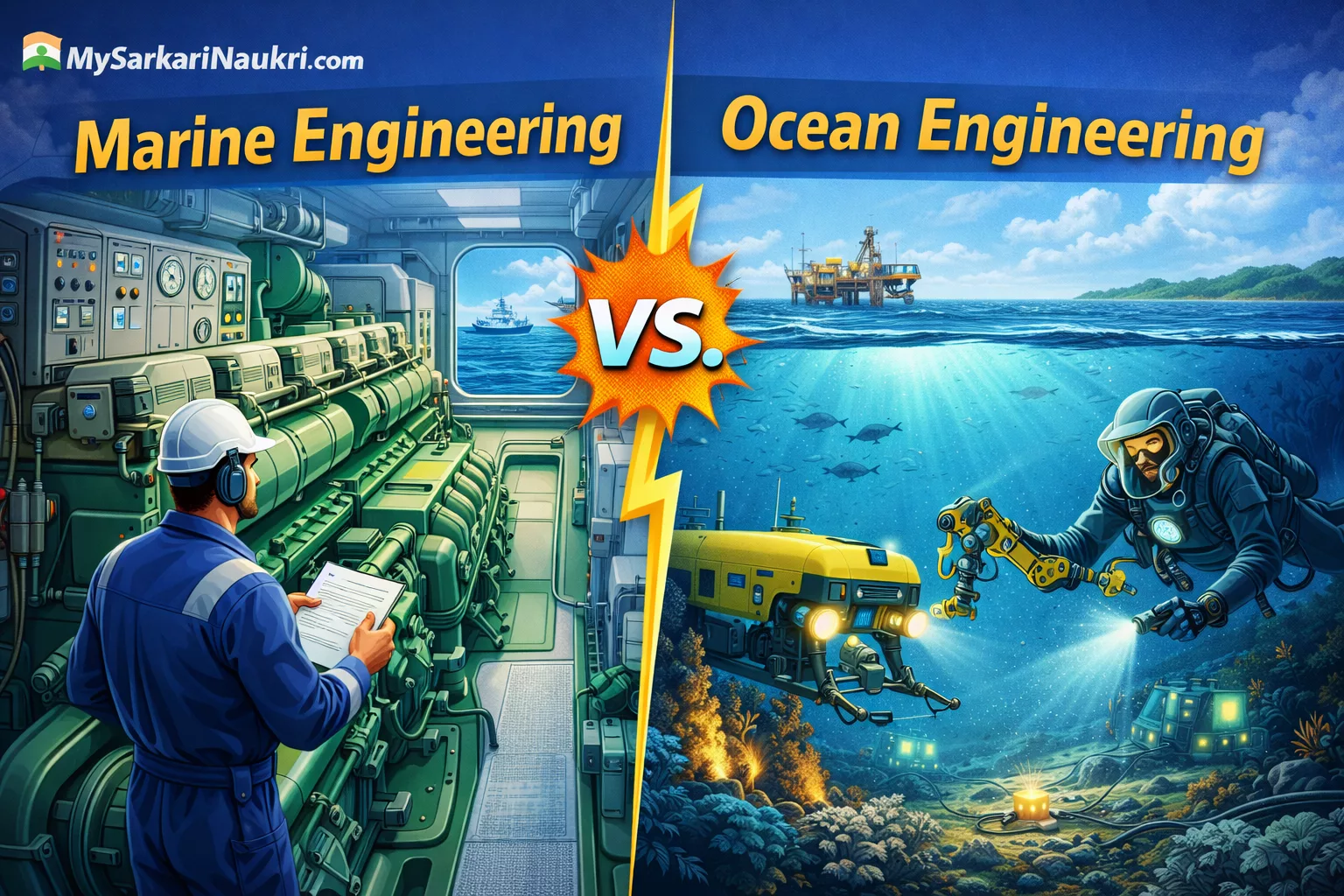
- Marine Engineering: Focuses on the “Internal Systems.” You are responsible for the design, operation, and maintenance of the machinery that moves a vessel (engines, propulsion, power plants, and steering).
- Ocean Engineering: Focuses on the “External Infrastructure.” You deal with the ocean environment itself—designing offshore oil rigs, underwater pipelines, coastal protection structures, and submersibles.
1. Recruitment Ecosystems: Where the Jobs Are
The “better” career growth depends entirely on which recruitment ecosystem you prefer.
Marine Engineering: The Merchant Navy Powerhouse
The primary recruitment cycle for Marine Engineers is the Merchant Navy. This is largely a private, global industry regulated by the Directorate General of Shipping (DGS).
- Standard Cycle: Recruitment begins with the IMU-CET (Indian Maritime University Common Entrance Test). Candidates usually secure “Sponsorship” from global shipping giants (like Maersk, Anglo-Eastern, or Fleet Management) before starting their degree.
- Government Roles: Limited primarily to the Indian Navy (Technical Branch) or as Marine Surveyors for Port Trusts.
Ocean Engineering: The PSU & Research Goldmine
Ocean Engineering is the backbone of India’s “Blue Economy.” It is the preferred degree for high-level technical roles in the government’s energy and defense sectors.
- Standard Cycle: Recruitment is primarily through GATE (Geology & Geophysics or Engineering Science).
- Key Employers: * ONGC: For offshore drilling and platform maintenance.
- DRDO (NPOL): For sonar systems and underwater defense technology.
- NIOT (National Institute of Ocean Technology): For deep-sea exploration and desalination projects.
- Indian Navy: Ocean Engineers are highly valued in the Naval Architecture cadre for hull design and stability.
Also Read: Deep Ocean Mission – A Goldmine for Government Engineering Jobs
2. Comparative Career Trajectory
| Feature | Marine Engineering | Ocean Engineering |
| Primary Workplace | Onboard ships (at sea for 6-9 months) | Offshore platforms or Shore-based R&D |
| Growth Path | Junior Engineer → Chief Engineer | Graduate Trainee → Executive/Scientist → Director |
| Lifestyle | High-intensity, rotational (on/off) | Office-based or Field-based (standard hours) |
| Sarkari Naukri Potential | Moderate (Coast Guard, Navy) | High (PSUs, Research Labs, IITs) |
| Global Mobility | Extremely High (Work for any flag) | High (Oil & Gas majors globally) |
3. Salary and Compensation Structures
The salary profiles for these two fields follow different “Standard Annual Cycles.”
Marine Engineering Salary (Tax-Free Advantage)
Marine Engineering offers higher “liquid cash” early in the career.
- Trainee/Cadet: ₹35,000 – ₹75,000 per month.
- Chief Engineer: ₹5,00,000 – ₹10,00,000+ per month (Tax-free if serving on foreign-going vessels).
Ocean Engineering Salary (Stability & Perks)
Ocean Engineering roles in PSUs follow the 7th Pay Commission (or equivalent IDA scales).
- Entry Level (E1 Scale): Approx. ₹60,000 – ₹1,80,000 (Basic Pay) + DA + HRA + Perks.
- Total CTC: In PSUs like ONGC, the starting CTC often exceeds ₹18-20 Lakhs per annum, including medical benefits and retirement funds.
If you are interested in the design of ships rather than just running them, Naval Architecture is the bridge. Many “Ocean Engineering” degrees are actually “B.Tech in Naval Architecture and Ocean Engineering.” This is arguably the most versatile degree, as it qualifies you for both shipyard roles (Cochin Shipyard, Mazagon Dock) and offshore engineering roles.
Frequently Asked Questions (FAQs)
Ocean Engineering generally offers more diverse opportunities within the Indian Government and PSUs. While Marine Engineers can join the Indian Navy or Coast Guard, Ocean Engineers are specifically recruited by ONGC, GAIL, DRDO (National Physical Oceanographic Laboratory), and NIOT for offshore infrastructure and underwater technology projects.
Yes, but it often requires a bridge course or a Master’s degree (M.Tech) in Ocean Engineering or Naval Architecture. Marine Engineering is highly specialized toward ship machinery, whereas Ocean Engineering requires knowledge of structural dynamics and hydrodynamics of stationary offshore structures.
Marine Engineering: Very strict. Generally, you need 6/6 vision (unaided or aided depending on DG Shipping norms) and zero color blindness, as you must identify colored signals at sea.
Ocean Engineering: If the role is shore-based or R&D (like in DRDO), the medical standards are similar to standard Engineering Services, which are generally more relaxed than the Merchant Navy.
They are “sister” disciplines. Naval Architecture focuses on the design and geometry of floating vessels (ships, yachts), while Ocean Engineering focuses on anything built in the ocean that isn’t necessarily a ship (oil rigs, breakwaters, subsea cables). Most top institutes like IIT Madras or IIT Kharagpur offer combined degrees in “Naval Architecture and Ocean Engineering.”
In the short term, Marine Engineering wins due to tax-free NRI status and high starting wages in the Merchant Navy. However, in the long term, Ocean Engineering offers better “lifecycle value” through PSU pensions, family medical benefits, and the ability to transition into the global Oil & Gas consultancy sector without being away from home for 8 months a year.
While the Merchant Navy is becoming more inclusive, Ocean Engineering is currently more popular among female aspirants due to the availability of shore-based R&D roles in organizations like CSIR-NIO and ISRO (for satellite oceanography).
Also Read: