BPSC AE Syllabus 2026 & Exam Pattern | Detailed Subject List
Contents
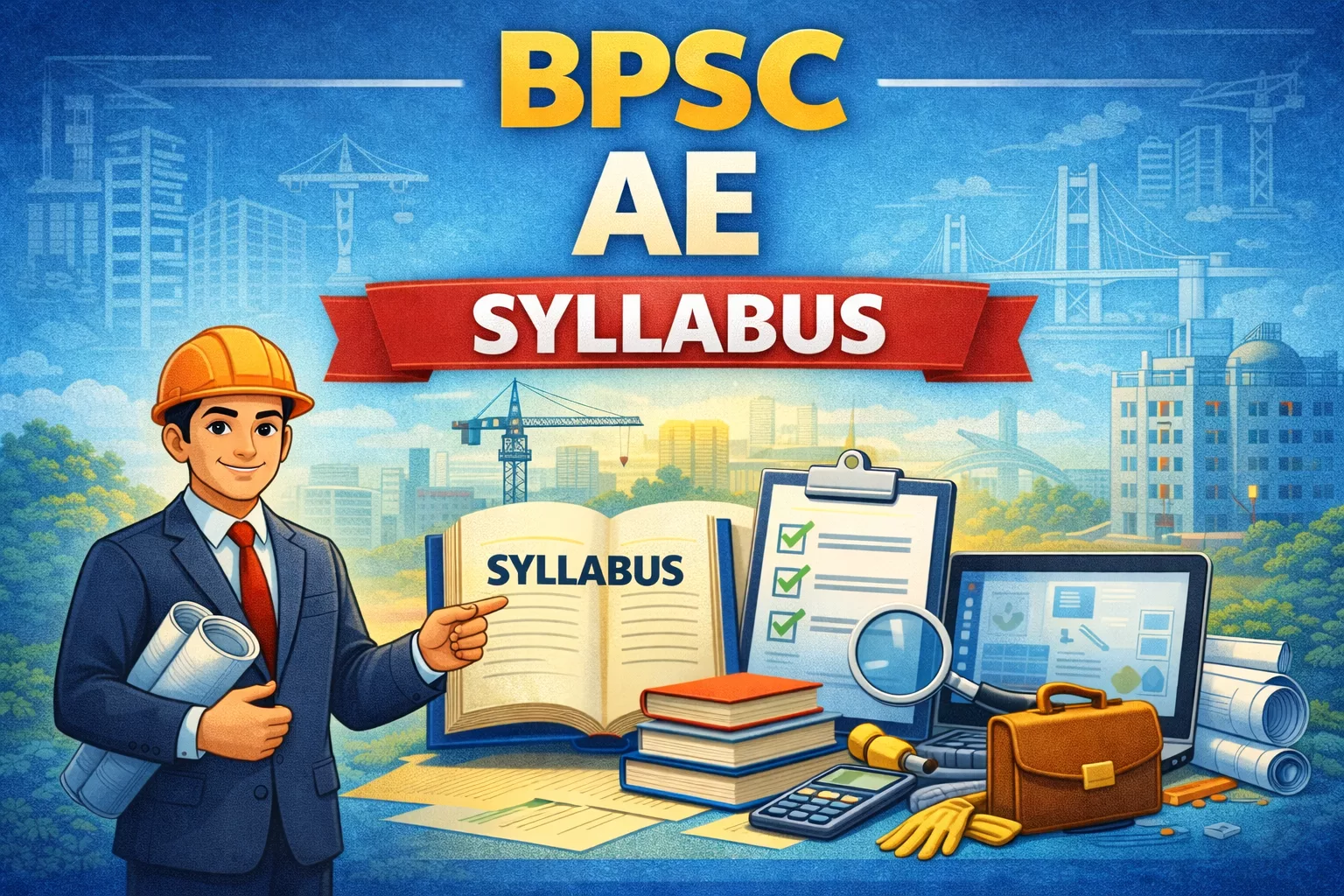
The Bihar Public Service Commission (BPSC) has published the official syllabus and exam pattern for the Assistant Engineer (AE) recruitment exam. A thorough review of both general and engineering-specific sections is essential to create a well-structured study plan. This guide breaks down every topic and exam detail to help you focus on what matters most.
For official reference, candidates can access the detailed syllabus PDF here:
Download BPSC AE Syllabus 2026 PDF
Selection Process
The selection for the BPSC Assistant Engineer recruitment is conducted through a multi-stage process designed to assess both theoretical knowledge and practical aptitude. Based on the official notification, the stages are:
- Written Examination: This is the primary screening stage consisting of objective-type questions.
- Interview: Candidates who qualify in the written examination will be called for a personal interview.
Detailed Exam Pattern
The BPSC AE written examination is structured to test candidates across General Studies, Languages, and Engineering Science within a strict time frame. Below is the detailed exam pattern based on the official source.
| Parameter | Details |
|---|---|
| Exam Name | BPSC Assistant Engineer Recruitment |
| Conducting Authority | Bihar Public Service Commission (BPSC) |
| Total Marks | 600 |
| Total Questions | 150 |
| Duration | 1 Hour |
| Selection Stages | Written Examination & Interview |
| Official Website | bpsc.bih.nic.in |
Comprehensive Subject-wise Syllabus
The syllabus is divided into four primary sections: General Studies, General English, General Hindi, and General Engineering Science. Each section covers specific topics that candidates must master.
General Studies
- Polity: Indian Constitution, political systems, and governance.
- Economy: Basic economic concepts and the Indian economy.
- Physics: Fundamental principles and laws.
- Chemistry: Elements, compounds, and chemical reactions.
- Botany: Plant physiology and classification.
- Zoology: Animal physiology and classification.
- History: Indian History and freedom movement.
- Art & Culture of Bihar: Traditions, monuments, and heritage specific to Bihar.
- Sports: Major national and international events.
- Days and Events: Important historical and national dates.
- Current Affairs: Recent national and international events.
- Static GK: General facts and data.
- Awards & Honors: National and international awards.
- Currencies & Capitals: World currencies and capital cities.
- Geography: Physical and political geography.
- Books and Authors: Famous literary works and writers.
- Important Personalities: Notable figures in history and current events.
General English
- Error Detection: Identifying grammatical errors in sentences.
- Active and Passive Voice: Conversion between voice forms.
- Sentence Rearrangement: Jumbling and ordering sentences.
- Fill in the Blanks: Contextual vocabulary and grammar.
- Sentence Improvement: Enhancing sentence structure and clarity.
- Direct and Indirect Speech: Reporting statements and questions.
- Jumbled Sentence: Rearranging disordered parts.
- Reading Comprehension: Understanding and interpreting passages.
- Cloze Test: Filling gaps in a passage with appropriate words.
General Hindi
- Letter Structure: Vowels and consonants in Hindi.
- Word Formation: Prefix, suffix, sandhi, and samas.
- Word Types: Composition, meaning, history, and grammar.
- Sentence Refinement: Improving sentence structure.
- Proverbs and Idioms: Common Hindi sayings and expressions.
- Parts of Speech: Pronoun, Adverb, Noun, Adjective.
- Spell Checking/Analysis: Identifying and correcting spelling errors.
- Use of Appropriate Words: Filling blank spaces with correct words.
- Syntax: Sentence structure and arrangement.
- Word Correction: Rectifying incorrect word usage.
General Engineering Science
- Engineering Mechanics:
- General Equilibrium and Equation Experiments.
- Motion-Equation Functions.
- Power & Energy.
- Survey and Measurement:
- Distance and Area Measurement.
- Direction Measurement and Angular Measurement of Slope.
- Levitation and Height.
- General Survey Equipment.
- Electrical Workshop Measurements:
- Ammeter, Volt Meter, Charge meter, Insulation Tester, Energy Meter.
- Working principles of electrical measuring instruments.
- Mechanical Workshop Measuring Instruments:
- Linear and angular measurements.
- Straight, plane, and roundness measurements.
- Structure of Solids:
- Generalized pressure and its relation.
- Making laws and transformation of pressure.
- Pressure energy.
- Analysis of beams, columns, and shafts.
- Unbalanced orientations at the center.
- Principles of decay.
- Engineering Materials and Their Manufacture:
- Bricks, lime, Cement, Shrapnel, Da’wa iron and steel.
- Non-ferrous metals, Timber paints, and miscellaneous engineering materials.
- Testing of engineering materials.
Minimum Qualifying Marks
While the specific minimum qualifying marks for each category (General, OBC, SC, ST, etc.) are not explicitly detailed in the source text, candidates are advised to check the official BPSC notification for the exact cutoff criteria. Typically, the commission sets category-wise minimum marks for passing the written examination.
Preparation Strategy
To prepare effectively for the BPSC AE exam, candidates should follow these tailored tips:
- Understand the Exam Pattern and Syllabus: Review the syllabus and exam pattern to plan effectively. Focus on the weightage of General Engineering Science.
- Create a Study Schedule: Organize your study time for General Studies, Languages, and Engineering subjects.
- Refer to the Best Study Materials: Use recommended books for Engineering Mechanics, Surveying, and Electrical Measurements.
- Practice Regularly: Solve practice papers and previous year’s questions to improve your skills in Error Detection and Engineering Mechanics.
- Focus on Conceptual Clarity: Understand core concepts in Engineering Materials and Structure of Solids rather than memorizing.
- Improve Speed and Accuracy: With only 1 hour for 150 questions, practice answering quickly and accurately.
- Stay Updated with Current Affairs: Read newspapers for Static GK and Current Affairs, including Bihar-specific culture.
- Revision is Key: Regularly revise Hindi grammar rules and Engineering formulas.
- Stay Positive and Motivated: Confidence is crucial for the interview stage.
FAQs
The written examination is conducted for a total duration of 1 Hour.
A total of 150 questions are asked in the objective-type written examination.
The written examination is conducted for a total of 600 marks.
Yes, the General Studies section explicitly includes Art, Culture of Bihar as a specific topic.
Yes, the General Engineering Science section covers Electrical Workshop Measurements including Ammeter, Volt Meter, Charge meter, Insulation Tester, and Energy Meter along with their working principles.
The General Hindi syllabus includes Sandhi and Samas, Pronoun, Adverb, Noun, Adjective, Syntax, and Proverbs/Idioms.
Yes, the syllabus covers General Survey Equipment and details like Distance/Area Measurement, Direction Measurement, and Angular Measurement of Slope.