TSPSC Group 3 Syllabus 2026: Detailed Exam Pattern & Subject-wise Topics
Contents
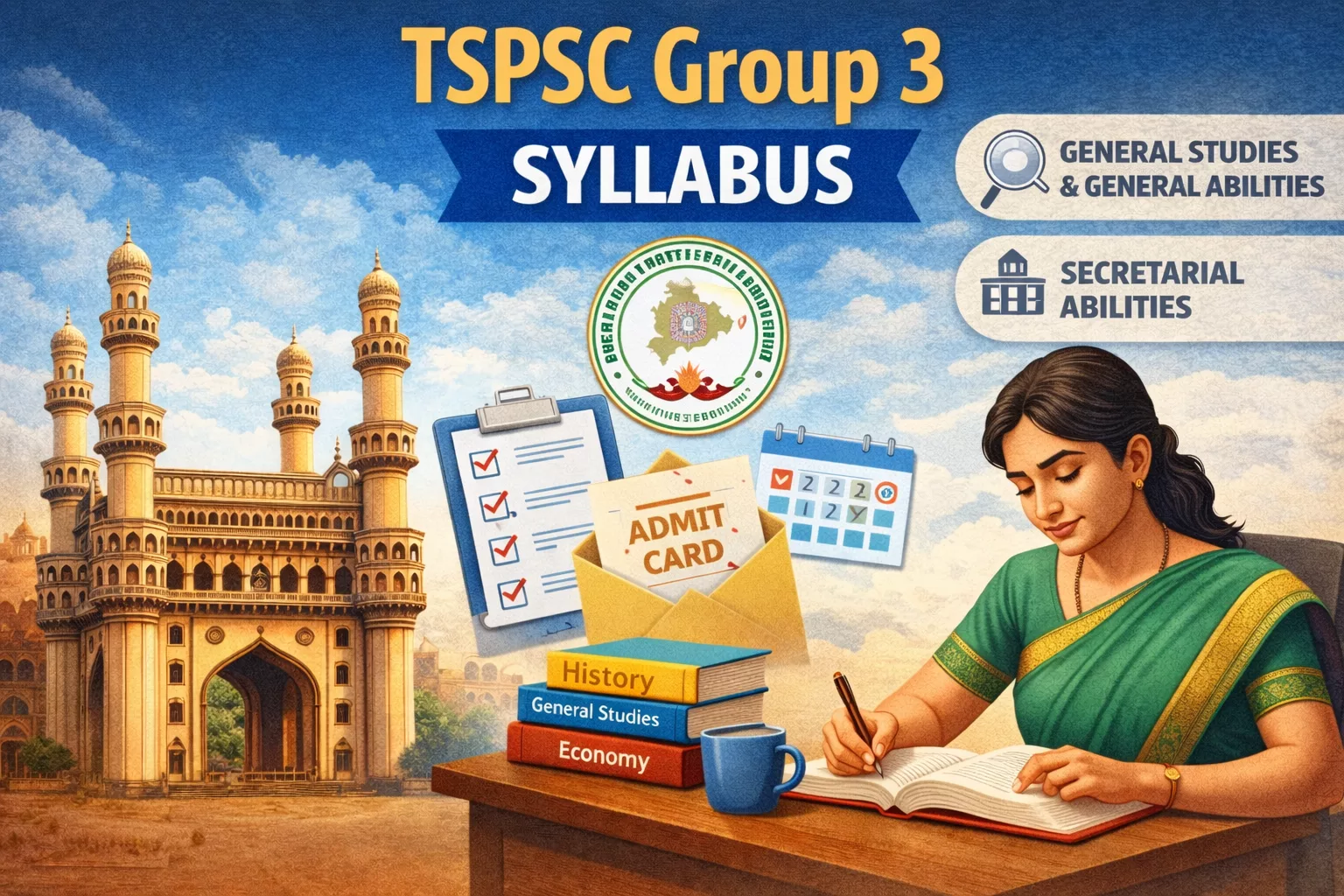
The Telangana State Public Service Commission (TSPSC) has officially released the comprehensive syllabus for the Group 3 Exam 2026. This recruitment drive is a significant opportunity for candidates aspiring to secure Group 3 posts in the Telangana government. Understanding the detailed syllabus and exam pattern is the first step toward effective preparation. The exam is conducted offline (Objective Type) and consists of three distinct papers covering General Studies, History, Polity, Society, Economy, and Development.
Candidates are advised to download the official syllabus PDF and study the provided topics thoroughly. The exam does not carry negative marking, which allows candidates to attempt all questions.
Download TSPSC Group 3 Syllabus 2026 PDF
The official TSPSC Group 3 Syllabus PDF 2026 is available for download. Candidates can access the complete syllabus with all subject-wise topics, weightage, and exam pattern details via the official link below:
Click Here to Download TSPSC Group 3 Syllabus PDF 2026 (Official)
Note: This is the official link from the TSPSC website. The PDF includes the complete and updated syllabus for Group 3 Services.
TSPSC Group 3 Selection Process 2026
The selection process for TSPSC Group 3 is straightforward but requires rigorous preparation across three papers. The stages are:
- Written Examination: The primary screening test consisting of three papers.
- Certificate Verification: Candidates who qualify in the written exam will be called for verification of original documents.
Detailed TSPSC Group 3 Exam Pattern 2026
The TSPSC Group 3 Exam Pattern 2026 is divided into three papers. Each paper is conducted for 150 marks. The total marks for the exam are 450. Below is the detailed breakdown:
| Paper | Subject/Section | No. of Questions | Marks | Duration |
|---|---|---|---|---|
| Paper I | General Studies and General Abilities | 150 | 150 | 150 Minutes |
| Paper II | History, Polity and Society | 150 | 150 | 150 Minutes |
| Paper III | Economy and Development | 150 | 150 | 150 Minutes |
| Total | – | 450 | 450 | 450 Minutes |
Key Exam Guidelines:
- Marking Scheme: Each correct answer carries 1 mark.
- Negative Marking: There is no negative marking for incorrect answers.
- Unattempted Questions: No marks will be awarded for unattempted questions.
- Language: The question paper will be available in English, Telugu, and Urdu.
Comprehensive Subject-wise Syllabus 2026
The TSPSC Group 3 syllabus is vast. Below is the detailed breakdown of topics for each paper.
Paper I: General Studies and General Abilities
- Current Affairs: Regional, National & International events.
- International Relations and Events.
- General Science: India’s Achievements in Science and Technology.
- Environment & Disaster Management: Environmental Issues; Disaster Management- Prevention and Mitigation Strategies.
- Geography: World Geography, Indian Geography, and Geography of Telangana State.
- History: History and Cultural Heritage of India.
- Telangana Culture: Society, Culture, Heritage, Arts and Literature of Telangana.
- Policies: Policies of Telangana State.
- Social Issues: Social Exclusion, Rights Issues and Inclusive Policies.
- Reasoning: Logical Reasoning, Analytical Ability and Data Interpretation.
- Basic English: 8th Class Standard.
Paper II: History, Polity and Society
I. Socio-Cultural History of Telangana and Formation of Telangana State
- Ancient Period: Satavahanas, Ikshvakus, Vishnukundins, Mudigonda and Vemulawada Chalukyas and their contribution to culture; Social and Religious conditions; Buddhism and Jainism in Ancient Telangana; Growth of Language and Literature, Art and Architecture.
- Medieval Period: The establishment of the Kakatiya kingdom and its contribution to socio-cultural development. Growth of Language and Literature under the Kakatiyas; Popular protest against Kakatiyas: Sammakka – Sarakka Revolt; Art, Architecture and Fine Arts. Rachakonda and Deverakonda Velamas, Social and Religious Conditions; Growth of Language and Literature.
- Qutubshahis: Socio-cultural contribution of Qutubshahis – Growth of Language, Literature, Art, Architecture, Festivals, Dance, and Music. Emergence of Composite Culture.
- Asaf Jahi Dynasty: Nizam-British Relations: Salarjung Reforms and their impact; Socio – Cultural- Religious Conditions under the Nizams: Educational Reforms, Establishment of Osmania University; Growth of Employment and the Rise of Middle Classes.
- Modern Period: Socio-cultural and Political Awakening in Telangana: Role of Arya Samaj- Andhra Mahasabha; Andhra Saraswatha Parishat, Literary and Library movements, Adi-Hindu movement, Andhra Mahila Sabha and the growth of Women’s movement; Tribal Revolts, Ramji Gond and Kumaram Bheem, -The Telangana Peasant Armed Struggle; Causes and Consequences.
- Formation of State: Integration of Hyderabad State into the Indian Union and the formation of Andhra Pradesh. Gentlemen Agreement; Mulki Movement 1952-56; Violation of Safeguards – Regional imbalances – Assertion of Telangana identity; Agitation for Separate Telangana State 1969-70 – Growth of popular protest against discrimination and movements towards the formation of Telangana State 1971-2014.
II. Overview of the Indian Constitution and Politics
- Evolution of the Indian Constitution – Nature and salient features – Preamble.
- Fundamental Rights – Directive Principles of the State Policy – Fundamental Duties.
- Distinctive Features of the Indian Federalism – Distribution of Legislative, Financial, and Administrative Powers between the Union and States.
- Union and State Government – President, Prime Minister and Council of Ministers; Governor, Chief Minister and Council of Ministers – Powers and Functions.
- Indian Constitution: Amendment Procedures and Amendment Acts.
- Rural and Urban Governance with special reference to the 73rd and 74th Amendment Acts.
- Electoral Mechanism: Electoral Laws, Election Commission, Political Parties, Anti-defection Law, and Electoral Reforms.
- Judicial System in India – Judicial Review; Judicial Activism; Supreme Court and High Courts.
- Special Constitutional Provisions for Scheduled Castes, Scheduled Tribes, Backward Classes, Women, Minorities, and Economically Weaker Sections (EWS).
- National Commissions for the Enforcement – National Commission for Scheduled Castes, Scheduled Tribes, Backward Classes, Women, Minorities, and Human Rights.
- National Integration issues and challenges: Insurgency; Internal Security; Inter-State Disputes.
III. Social Structure, Issues and Public Policies
- Indian Social Structure: Salient Features of Indian society: Family, Marriage, Kinship, Caste, Tribe, Ethnicity, Religion, and Women.
- Social Issues: Inequality and Exclusion: Casteism, Communalism, Regionalism, Violence against Women, Child Labour, Human trafficking, Disability, Aged and Third / Trans-Gender Issues.
- Social Movements: Peasant Movement, Tribal movement, Backward Classes Movement, Dalit Movement, Environmental Movement, Women’s Movement, Regional Autonomy Movement, Human Rights / Civil Rights Movement.
- Social Policies and Welfare Programmes: Affirmative Policies for SCs, STs, OBC, Women, Minorities, Labour, Disabled and Children; Welfare Programmes: Employment, Poverty Alleviation Programmes; Rural and Urban, Women and Child Welfare, Tribal Welfare.
- Society in Telangana: Socio- Cultural Features and Issues in Telangana; Vetti, Jogini, Devadasi System, Child Labour, Girl Child, Flourosis, Migration, Farmer’s; Artisanal and Service Communities in Distress.
Paper III: Economy and Development
I. Indian Economy: Issues and Challenges
- Demography: Demographic Features of Indian Population – Size and Growth Rate of Population – Demographic Dividend – Sectoral Distribution of Population – Population Policies of India.
- National Income: Concepts & Components of National Income – Measurement Methods – National Income Estimates in India and its Trends – Sectoral Contribution – Per Capita Income.
- Primary and Secondary Sectors: Agriculture and Allied Sectors – Contribution to National Income – Cropping Pattern – Agricultural Production and Productivity – Green Revolution – Irrigation – Agricultural Finance and Marketing – Agricultural Pricing – Agricultural Subsidies and Food Security – Agricultural Labour – Growth and Performance of Allied Sectors.
- Industry and Services Sectors: Growth and Structure of Industry in India – Contribution to National Income –Industrial Policies – Large Scale Industries – MSMEs – Industrial Finance – Contribution of Services Sector to National Income – Importance of Services Sector – Sub Sectors of Services – Economic Infrastructure – India’s Foreign Trade.
- Planning, NITI Aayog and Public Finance: Objectives of India’s Five Year Plans – Targets, Achievements and Failures of Five Year Plans – NITI Aayog – Budget in India – Concepts of Budget Deficits – FRBM – Recent Union Budgets – Public Revenue, Public Expenditure and Public Debt – Finance Commissions.
II. Economy and Development of Telangana
- Structure and Growth of Telangana Economy: Telangana Economy in Undivided Andhra Pradesh (1956-2014) – State Finances (Dhar Commission, Wanchu Committee, Lalit Committee, Bhargava Committee) – Land Reforms – Growth and Development of Telangana Economy Since 2014 – Sectoral Contribution to State Income – Per Capita Income.
- Demography and HRD: Size and Growth Rate of Population – Demographic Features of Telangana Economy – Age Structure of Population – Demographic Dividend.
- Agriculture and Allied Sectors: Importance of Agriculture – Trends in Growth Rate of Agriculture – Contribution of Agriculture and Allied Sectors to GSDP/GSVA – Land Use and Land Holdings Pattern – Cropping Pattern – Irrigation – Growth and Development of Allied Sectors – Agricultural Policies and Programmes.
- Industry and Service Sectors: Structure and Growth of Industry – Contribution of Industry to GSDP/GSVA – MSME – Industrial Policies – Components, Structure and Growth of Services Sector – Its Contribution to GSDP/GSVA – Social and Economic Infrastructure.
- State Finances, Budget and Welfare Policies: State Revenue, Expenditure and Debt – State Budgets – Welfare Policies of the State.
III. Issues of Development and Change
- Growth and Development: Concepts of Growth and Development – Characteristics of Development and Underdevelopment – Measurement of Economic Growth and Development – Human Development – Human Development Indices – Human Development Reports.
- Social Development: Social Infrastructure – Health and Education – Social Sector – Social Inequalities – Caste – Gender – Religion – Social Transformation – Social Security.
- Poverty and Unemployment: Concepts of Poverty – Measurement of Poverty – Income Inequalities – Concepts of Unemployment – Poverty, Unemployment and Welfare Programmes.
- Regional Inequalities: Urbanization – Migration – Land Acquisition – Resettlement and Rehabilitation.
- Environment and Sustainable Development: Concepts of Environment – Environmental Protection and Sustainable Development – Types of Pollution – Pollution Control – Effects of Environment – Environmental Policies of India.
Minimum Qualifying Marks
While the specific qualifying marks are subject to official notification updates, the general rule for TSPSC exams usually applies:
- OC/General: 40%
- BC: 35%
- SC/ST/PH: 30%
Note: Candidates must refer to the official notification for exact category-wise cut-offs.
Preparation Strategy for TSPSC Group 3 2026
Success in the TSPSC Group 3 exam requires a disciplined approach. Here are expert tips:
- Analyze the Syllabus: Download the PDF and break down the syllabus into micro-topics.
- Focus on Telangana Specifics: Since Paper II and III heavily feature Telangana History and Economy, dedicate significant time to local topics.
- Master Time Management: With 450 questions in 450 minutes, the pace is moderate but consistent practice is required. Since there is no negative marking, ensure you attempt all questions.
- Current Affairs: Focus on the last 6-12 months, especially Telangana-related news.
- Mock Tests: Regular mock tests will help in identifying weak areas and improving speed.
FAQs
No, there is no negative marking for incorrect answers in the TSPSC Group 3 Exam.
The total duration is 450 minutes (7.5 hours). Each of the three papers is allotted 150 minutes.
Paper II consists of 150 questions for a total of 150 marks.
High-weightage topics include the Kakatiya Dynasty, Asaf Jahi Dynasty, Social and Political Awakening (Andhra Mahasabha, Arya Samaj), and the Telangana Peasant Armed Struggle.
The English section in Paper I is of 8th Class Standard.
The question paper will be available in English, Telugu, and Urdu languages.
Paper III is equally balanced, covering both Indian Economy (Issues and Challenges) and the Economy and Development of Telangana in detail.