PGCIL Field Supervisor Syllabus & Exam Pattern
Contents
- 1 Download Official Syllabus PDF
- 2 PGCIL Field Supervisor Selection Process 2025-2026
- 3 Detailed PGCIL Field Supervisor Exam Pattern 2026
- 4 Comprehensive Subject-wise Syllabus 2025-2026
- 5 Section A: Technical Knowledge
- 6 Section B: Aptitude & General Section
- 7 Minimum Qualifying Marks
- 8 Preparation Strategy for PGCIL Field Supervisor 2026
- 9 FAQs: PGCIL Field Supervisor Syllabus
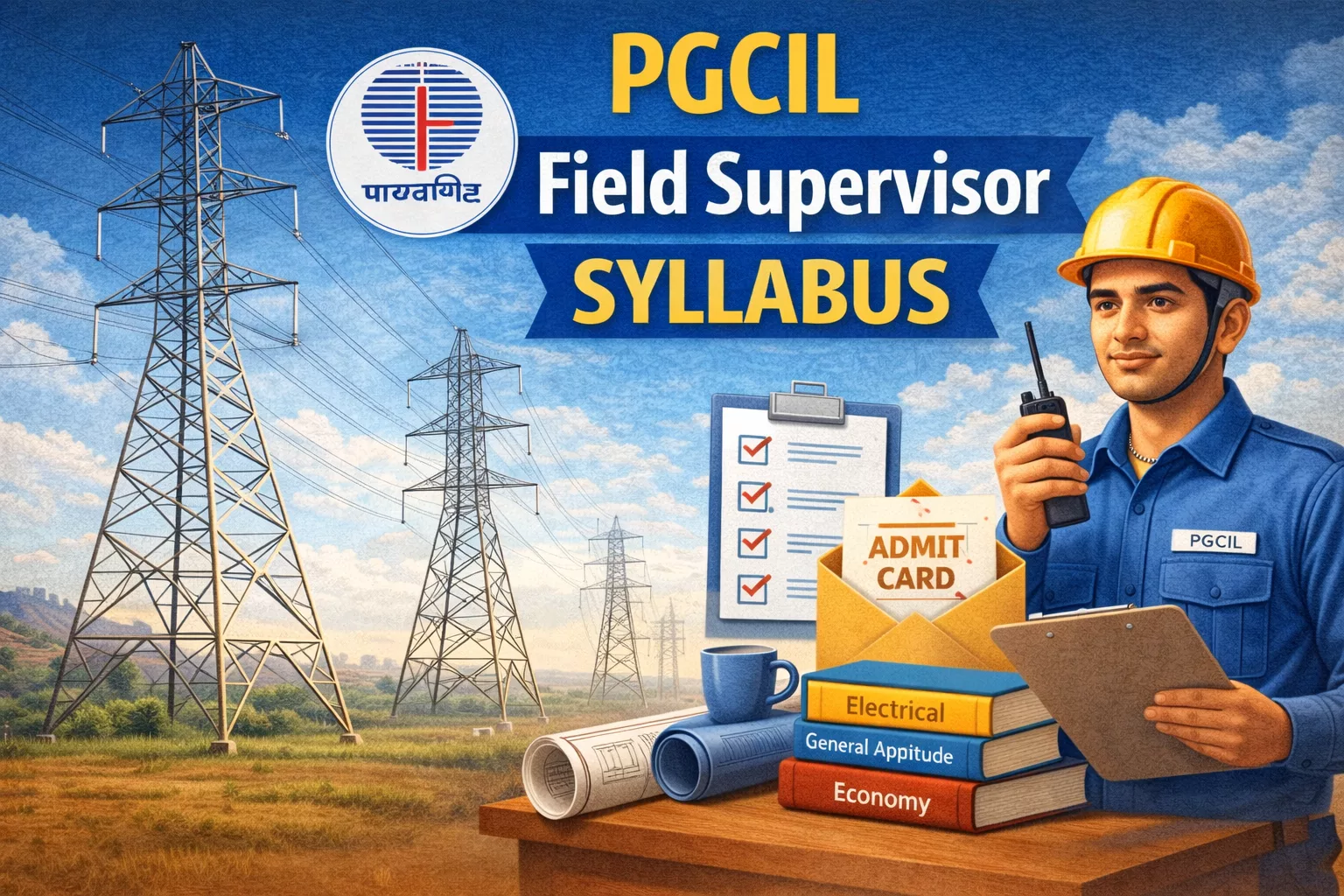
Aspirants seeking recruitment under the Power Grid Corporation of India Limited can now access the updated curriculum. The PGCIL Field Supervisor Syllabus serves as the primary resource for candidates preparing for the upcoming examination cycle, extended into 2026. Understanding the structure and topics is vital for success.
The conducting authority, Power Grid Corporation of India Limited (PGCIL), has released the official syllabus and exam pattern for the Field Supervisor recruitment. To ensure a well-structured study plan, candidates should thoroughly review both technical and general sections of the syllabus. Understanding the detailed syllabus and exam structure is essential for effective preparation.
Download Official Syllabus PDF
Aspirants can access the detailed PGCIL Field Supervisor Syllabus PDF to get a clear overview of all the topics essential for the exam.
Click Here to Download PGCIL Field Supervisor Syllabus PDF
PGCIL Field Supervisor Selection Process 2025-2026
The selection process for the Field Supervisor post is streamlined to assess technical knowledge and general aptitude efficiently. Based on the official overview, the selection relies on a Written Exam.
| Stage | Description |
|---|---|
| Written Exam | Objective type test covering Technical Knowledge and Aptitude. |
Detailed PGCIL Field Supervisor Exam Pattern 2026
The exam pattern is designed to evaluate candidates within a strict time frame. There is no negative marking, which allows candidates to attempt all questions without fear of penalty.
| Parameter | Details |
|---|---|
| Exam Name | PGCIL Field Supervisor Recruitment |
| Conducting Authority | Power Grid Corporation of India Limited (PGCIL) |
| Post Name | Field Supervisor |
| Total Questions | 75 |
| Total Marks | 75 |
| Duration | 1 Hour (60 Minutes) |
| Negative Marking | No Negative Mark |
| Official Website | powergrid.in |
Comprehensive Subject-wise Syllabus 2025-2026
The syllabus is divided into two primary sections: Technical Knowledge and Aptitude & General Section. Candidates must focus on both to secure a high score.
Section A: Technical Knowledge
Electrical Engineering
- Circuit Theory & Network Analysis: Fundamentals of electrical circuits, network theorems, and transient analysis.
- Electrical Machines: Transformers, DC machines, and AC machines (Induction & Synchronous).
- Power Systems: Generation, transmission, and distribution of electrical power; fault analysis.
- Power Electronics: Converters, inverters, and switching devices.
- Control Systems: Feedback control, stability, and system analysis.
- Electrical Measurements & Instrumentation: Measurement of voltage, current, power, and energy; instrument transformers.
Civil Engineering
- Building Materials: Properties and uses of construction materials like cement, concrete, and steel.
- Surveying & Levelling: Principles of surveying, leveling, and mapping techniques.
- Strength of Materials: Stress, strain, bending moments, and torsion.
- Structural Engineering: Design of beams, columns, and foundations.
- Geotechnical Engineering: Soil mechanics, bearing capacity, and foundation design.
- Hydraulics & Fluid Mechanics: Fluid properties, flow in pipes, and open channel flow.
- Transportation Engineering: Highway design, traffic engineering, and pavement materials.
- Environmental Engineering: Water supply, sanitation, and waste management.
Electronics & Communication
- Electronic Devices & Circuits: Diodes, transistors, and amplifiers.
- Analog Electronics: Operational amplifiers and feedback circuits.
- Digital Electronics: Logic gates, Boolean algebra, and combinational circuits.
- Signals & Systems: Classification of signals and system properties.
- Communication Systems: Modulation, demodulation, and transmission media.
- Microprocessors (Basics): Architecture and programming of basic microprocessors.
- Fundamentals of Control Systems: Open and closed-loop systems.
Section B: Aptitude & General Section
Numerical Ability
- Percentages, Ratio & Proportion: Calculation-based problems.
- Averages & Simplification: Mean, median, and basic arithmetic simplification.
- Simple & Compound Interest: Financial calculations.
- Profit & Loss: Commercial mathematics.
- Time, Work & Distance: Speed, velocity, and work efficiency problems.
- Algebra & Geometry: Basic algebraic equations and geometric properties.
- Mensuration (2D & 3D): Area and volume calculations.
- Data Interpretation: Analysis of graphs, charts, and tables.
- HCF & LCM: Number theory basics.
- Trigonometry (Basic): Ratios and identities.
Logical Reasoning
- Syllogism: Deductive reasoning statements.
- Coding–Decoding: Pattern recognition in letters and numbers.
- Blood Relations: Family tree analysis.
- Direction Sense: Spatial orientation problems.
- Series & Analogies: Number and letter series; word analogies.
- Statements & Arguments: Logical validity assessment.
- Puzzles & Decision Making: Complex arrangement problems.
- Calendars & Clocks: Time-based logic problems.
- Seating Arrangements: Linear and circular arrangements.
English Comprehension
- Spotting Errors & Sentence Correction: Grammar and usage identification.
- Fill in the Blanks: Contextual vocabulary and grammar.
- Synonyms & Antonyms: Vocabulary enhancement.
- Sentence Improvement: Restructuring sentences for clarity.
- Active & Passive Voice: Voice transformation.
- Direct & Indirect Speech: Reporting speech changes.
- Sentence Rearrangement: Jumbled sentences to form coherent paragraphs.
- Vocabulary Building: Word meaning and usage.
- Reading Comprehension: Passages with inference-based questions.
General Knowledge & Awareness
- Current Affairs: National and international recent events.
- General Knowledge relevant to Engineering & Technology: Updates in the power and infrastructure sector.
- Basic awareness of science, environment, and society: General science and environmental issues.
Minimum Qualifying Marks
While the specific percentage for minimum qualifying marks is not detailed in the source content, candidates are advised to aim for a score significantly higher than the cutoff to ensure selection. The exam carries a total of 75 marks.
Preparation Strategy for PGCIL Field Supervisor 2026
To prepare effectively for the PGCIL Field Supervisor exam, candidates should follow these tailored preparation tips:
- Understand the Exam Pattern and Syllabus: Review the syllabus and exam pattern to plan effectively. Focus on the 75-question, 60-minute format.
- Create a Study Schedule: Organize your study time for both General and Technical subjects. Allocate more time to heavy-weightage topics.
- Refer to the Best Study Materials: Use standard textbooks for Electrical, Civil, and Electronics engineering, alongside general aptitude books.
- Practice Regularly: Solve practice papers and previous year’s questions to improve your skills. Since there is no negative marking, attempt all questions.
- Focus on Conceptual Clarity: Focus on understanding core concepts, not just memorization, especially for Technical Knowledge.
- Improve Speed and Accuracy: Practice answering questions quickly and accurately within the 1-hour time limit.
- Stay Updated with Current Affairs: Read newspapers and follow online resources for current events, specifically related to the power sector.
- Maintain a Healthy Lifestyle: Eat well, stay hydrated, and take regular breaks to maintain focus.
- Revision is Key: Regularly revise topics to ensure better retention.
- Stay Positive and Motivated: Stay confident and motivated throughout your preparation.
FAQs: PGCIL Field Supervisor Syllabus
The exam consists of 75 questions for a total of 75 marks, making it a one-mark-per-question paper.
No, there is no negative marking in the PGCIL Field Supervisor written exam. Candidates can attempt all questions without penalty.
The total duration of the exam is 1 hour (60 minutes).
The syllabus includes Electronic Devices & Circuits, Analog Electronics, Digital Electronics, Signals & Systems, Communication Systems, Microprocessors (Basics), and Fundamentals of Control Systems.
Topics include Percentages, Ratio & Proportion, Averages, Simplification, Simple & Compound Interest, Profit & Loss, Time Work & Distance, Algebra, Geometry, Mensuration, Data Interpretation, HCF & LCM, and Basic Trigonometry.
Yes, the General Knowledge & Awareness section includes Current Affairs, General Knowledge relevant to Engineering & Technology, and basic awareness of science and the environment.
You can download the syllabus PDF directly from the official Power Grid website at powergrid.in or via the direct link provided in the overview section.