CBSE Superintendent Syllabus 2026: Exam Pattern & PDF Download
Contents
- 1 Quick Overview Table
- 2 Selection Process
- 3 CBSE Superintendent Exam Pattern 2026
- 4 Topic-Wise Detailed Syllabus
- 4.1 1. Current Events & General Knowledge (Tier 1)
- 4.2 2. Analytical and Logical Reasoning (Tier 1)
- 4.3 3. Numerical and Arithmetic Skills (Tier 1)
- 4.4 4. Language Proficiency (Hindi & English) (Tier 1)
- 4.5 5. Computer Knowledge (Tier 1)
- 4.6 6. Indian History & Cultural Heritage (Tier 2)
- 4.7 7. Indian Economy & Development (Tier 2)
- 4.8 8. Geography of India (Tier 2)
- 4.9 9. Science & Technology (Tier 2)
- 4.10 10. Public Administration & Governance (Tier 2)
- 4.11 11. Indian Constitution & Political System (Tier 2)
- 5 Download CBSE Superintendent Syllabus PDF
- 6 Preparation Master Tips
- 7 Summary of Minimum Qualifying Marks
- 8 FAQs
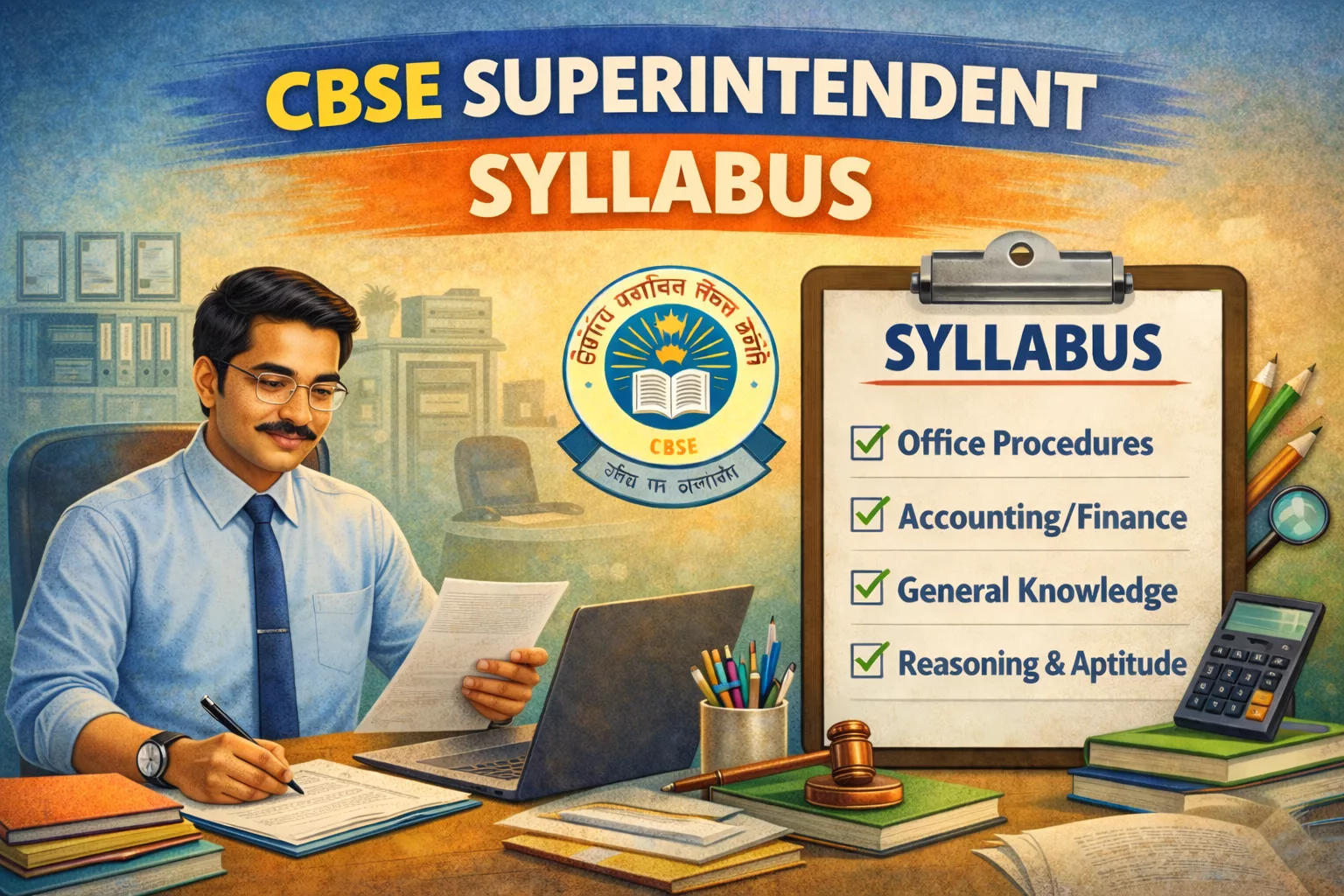
Preparing for the recruitment examination requires a precise understanding of the curriculum. This guide details the CBSE Superintendent Syllabus for the upcoming 2026 cycle. Whether you are targeting the Tier 1 screening test or the Tier 2 descriptive examination, mastering the outlined topics is essential for success. The Central Board of Secondary Education (CBSE) has designed the CBSE Superintendent Syllabus 2026 to test a wide range of skills, including general awareness, logical reasoning, and domain-specific knowledge. Below, we explore the complete CBSE Superintendent Exam Pattern, topic-wise breakdown, and preparation strategies to ensure you are fully equipped for the challenge.
Quick Overview Table
| Feature | Details |
|---|---|
| Exam Name | CBSE Superintendent Recruitment Exam |
| Conducting Body | Central Board of Secondary Education (CBSE) |
| Post Name | Superintendent |
| Selection Process | Tier 1, Tier 2, Skill Test |
| Total Marks (Tier 1) | 450 |
| Total Marks (Tier 2) | 300 |
| Total Questions | 150 (Tier 1) |
| Official Website | cbse.gov.in |
| PDF Link | Download Syllabus PDF |
Selection Process
The recruitment for the Superintendent post follows a rigorous three-tier selection process to ensure the most suitable candidates are chosen. Understanding each stage is vital for strategic preparation:
- Tier 1 (Preliminary Examination): This is the first screening stage consisting of objective-type questions. It tests general aptitude, reasoning, and awareness. Candidates must qualify in this stage to move to Tier 2.
- Tier 2 (Mains Examination): This stage is more descriptive and specific. It includes both objective and descriptive questions covering subjects like Indian History, Economy, and Public Administration.
- Skill Test: As the role of a Superintendent often involves administrative and computer-based tasks, a skill test (likely typing or computer proficiency) is conducted after qualifying the written exams.
CBSE Superintendent Exam Pattern 2026
Understanding the marking scheme and time allocation is critical. The exam is conducted in two distinct tiers.
Tier 1 Exam Pattern
The Tier 1 exam consists of 150 questions totaling 450 marks. The duration is 120 minutes. There is a negative marking of 1 mark for every incorrect answer.
| Part | Subject | No. of Questions | Total Marks |
|---|---|---|---|
| Part I | Current Affairs & General Awareness | 30 | 90 |
| Part II | General Intelligence, Mental Ability, Logical & Analytical Reasoning | 30 | 90 |
| Part III | Arithmetic Skills & Data Interpretation | 30 | 90 |
| Part IV | General Hindi & English | 30 | 90 |
| Part V | Computer Proficiency | 30 | 90 |
| Total | All Sections | 150 | 450 |
Negative Marking: There is a penalty of 1 mark for each wrong answer in the Tier 1 examination.
Tier 2 Exam Pattern
The Tier 2 exam is divided into Objective and Descriptive types, totaling 300 marks.
| Sections | Objective Type (Questions/Marks) | Descriptive Type (Questions/Marks) |
|---|---|---|
| Current Affairs | 10 Q / 30 Marks | 4 Q / 20 Marks |
| Indian History and Culture | 4 Q / 12 Marks | 4 Q / 20 Marks |
| Indian Economy | 4 Q / 12 Marks | 4 Q / 20 Marks |
| Indian Geography | 4 Q / 12 Marks | 4 Q / 20 Marks |
| Science & Technology | 4 Q / 12 Marks | 4 Q / 20 Marks |
| Public Administration & Management Concepts | 8 Q / 24 Marks | 4 Q / 20 Marks |
| Indian Constitution, Polity & Governance | 8 Q / 24 Marks | 4 Q / 20 Marks |
| English Language and Comprehension | 8 Q / 24 Marks | 2 Q / 10 Marks |
| Total | 50 Q / 150 Marks | 30 Q / 150 Marks |
Topic-Wise Detailed Syllabus
This section provides the CBSE Superintendent Syllabus 2026 broken down by subject. Use this to create your study plan.
1. Current Events & General Knowledge (Tier 1)
This section tests your awareness of the surroundings and recent developments.
- Recent national and international developments.
- Important sports events and awards.
- Government schemes and policies.
- Static General Knowledge (Capitals, Currencies, etc.).
- Important summits and conferences.
2. Analytical and Logical Reasoning (Tier 1)
This section evaluates mental agility and pattern recognition.
- Number and Alphabetical Series.
- Coding-Decoding.
- Analogy.
- Classification.
- Syllogism.
- Blood Relations.
- Direction Sense Test.
- Non-verbal reasoning (Mirror Images, Paper Folding).
3. Numerical and Arithmetic Skills (Tier 1)
Focuses on basic mathematical calculations and data interpretation.
- Number Systems.
- Percentages.
- Ratio and Proportion.
- Average.
- Simple & Compound Interest.
- Profit and Loss.
- Data Interpretation (Tables, Bar Graphs, Pie Charts).
- Time and Work.
- Speed, Distance, and Time.
4. Language Proficiency (Hindi & English) (Tier 1)
Tests grammar, vocabulary, and comprehension skills in both languages.
- English:
- Spotting Errors.
- Sentence Correction.
- Fill in the Blanks.
- Synonyms & Antonyms.
- Idioms & Phrases.
- Reading Comprehension.
- Hindi:
- व्याकरण (Grammar).
- शब्द शुद्धि (Word Correction).
- मुहावरे एवं लोकोक्तियाँ (Idioms & Proverbs).
- पर्यायवाची शब्द (Synonyms).
- विपरीतार्थक शब्द (Antonyms).
5. Computer Knowledge (Tier 1)
Basic digital literacy required for administrative tasks.
- Basic Computer Operations.
- MS Office (Word, Excel, PowerPoint).
- Internet & Email usage.
- Hardware and Software basics.
- Operating Systems.
- Cyber Security Basics.
6. Indian History & Cultural Heritage (Tier 2)
Focuses on the freedom movement and cultural diversity.
- Ancient Civilizations & Vedic Culture.
- Medieval Dynasties (Mughals, Delhi Sultanate).
- Modern Indian History (1857 Revolt to Independence).
- Indian National Congress & Freedom Struggle.
- Art, Culture, and Literature.
- Famous Personalities.
7. Indian Economy & Development (Tier 2)
Understanding India’s economic structure and planning.
- National Income & GDP.
- Five-Year Plans.
- Budgeting & Taxation.
- Banking & Financial Institutions (RBI, Commercial Banks).
- Sectors of Economy (Primary, Secondary, Tertiary).
- Poverty and Unemployment.
8. Geography of India (Tier 2)
Physical, political, and economic geography.
- Physical Features (Himalayas, Rivers, Plateaus).
- Climatic Conditions.
- Soil Types and Agriculture.
- Mineral Resources.
- Transportation and Infrastructure.
- States and UTs.
9. Science & Technology (Tier 2)
Recent advancements and scientific concepts.
- Units and Dimensions.
- Human Body and Diseases.
- Environmental Science.
- Recent Developments in IT and Space (ISRO, AI).
- Everyday Science.
10. Public Administration & Governance (Tier 2)
Administrative systems and organizational behavior.
- Concept of Administration.
- Organizational Structure.
- Leadership and Motivation.
- Public Policy Implementation.
- E-Governance.
11. Indian Constitution & Political System (Tier 2)
Political structure and governance mechanisms.
- Formation of the Constitution.
- Fundamental Rights & Duties.
- Directive Principles of State Policy.
- Parliamentary System.
- Panchayati Raj.
- Political Parties and Elections.
Download CBSE Superintendent Syllabus PDF
Aspirants are advised to download the official syllabus PDF to keep a hard copy for offline reference.
- Download Link: Click Here to Download CBSE Superintendent Syllabus PDF
Preparation Master Tips
To maximize your score in the CBSE Superintendent Syllabus 2026, follow these targeted strategies:
- Master Time Management: With 150 questions in 120 minutes for Tier 1, practice mock tests strictly timed to improve speed.
- Focus on Static GK & Current Affairs: Since both Tier 1 and Tier 2 cover current events, make daily newspaper reading a habit.
- Strengthen Reasoning & Arithmetic: These are scoring areas. Dedicate 1-2 hours daily to solve previous year’s papers.
- Practice Descriptive Writing: For Tier 2, practice writing concise answers (20-30 words) for History, Economy, and Polity topics.
- Computer Proficiency: Don’t ignore the computer section; it has equal weightage in Tier 1. Practice MS Office shortcuts.
Summary of Minimum Qualifying Marks
While the official cutoff for 2026 will be released with the notification, candidates should aim for:
- General/OBC: 40% – 50% aggregate in each tier.
- SC/ST/PwBD: 35% aggregate in each tier.
Note: These are estimated benchmarks based on standard Sarkari exam norms. Always check the official notification for exact cutoff criteria.
FAQs
The selection process involves three stages: Tier 1 (Objective), Tier 2 (Objective + Descriptive), and a Skill Test.
Yes, there is a negative marking of 1 mark for each incorrect answer in the Tier 1 examination.
There are a total of 150 questions in the Tier 1 exam, carrying 450 marks.
The Tier 1 exam duration is 120 minutes (2 hours).
Yes, Tier 2 includes both objective and descriptive type questions covering various subjects like History, Economy, and Polity.
Yes, Computer Proficiency is a significant part of the Tier 1 syllabus, carrying 90 marks.
In Tier 1, Hindi and English are combined under “Language Proficiency” with 30 questions total.
You can download the official PDF from the CBSE website (cbse.gov.in) or use the direct link provided in this guide.