CBSE Junior Assistant Syllabus 2026: Pattern, PDF & Exam Guide
Contents
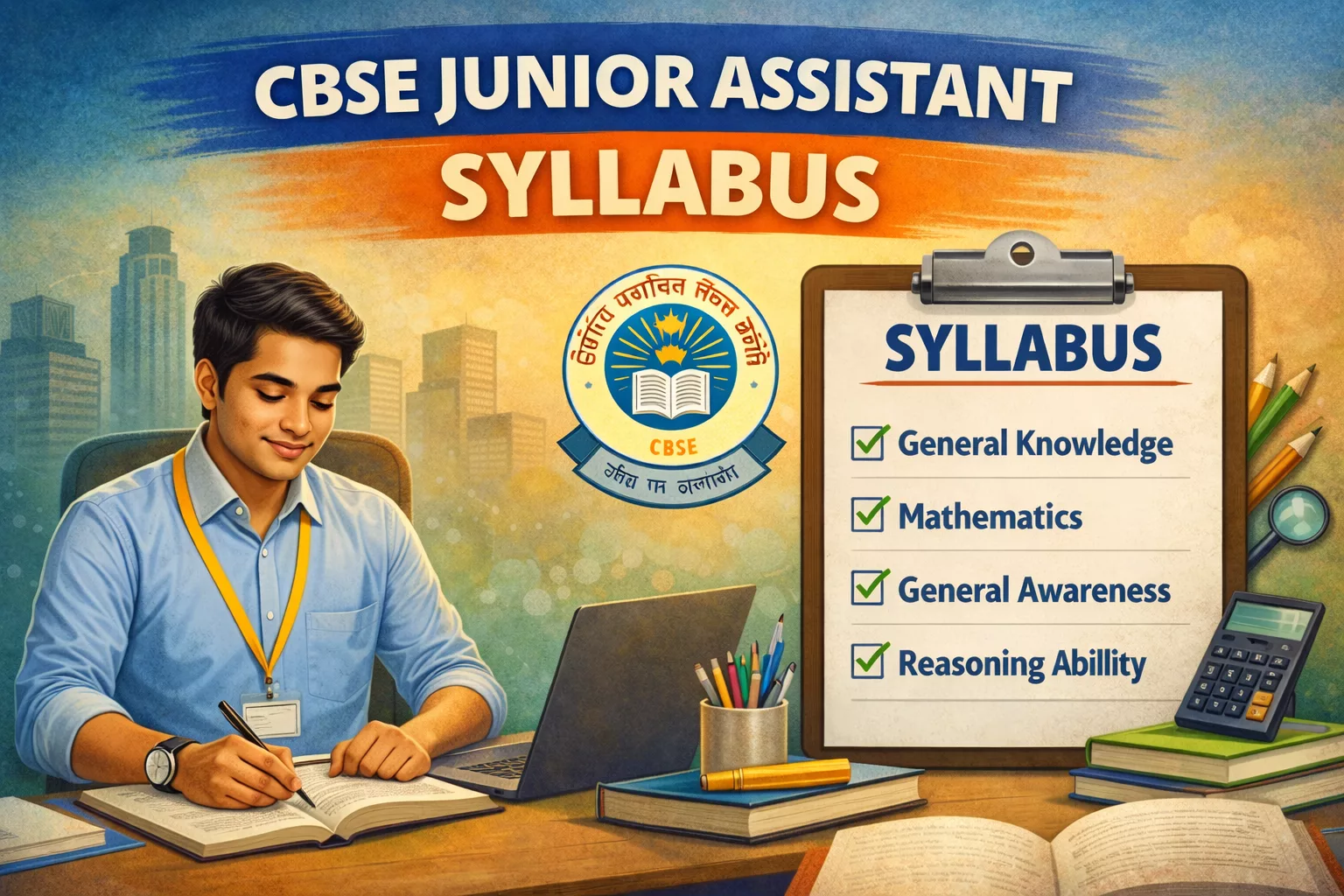
The Central Board of Secondary Education (CBSE) has released the official CBSE Junior Assistant Syllabus 2026 for the upcoming recruitment cycle. Aspiring candidates must thoroughly understand the Syllabus 2026 and the detailed Exam Pattern to secure a position as a Junior Assistant. This recruitment drive is highly competitive, and a strategic approach to studying the prescribed topics is essential for success. The exam is designed to test a candidate’s general awareness, reasoning ability, language proficiency, and basic computer knowledge, along with specific awareness regarding the school education system.
Quick Overview Table
| Parameter | Details |
|---|---|
| Exam Name | CBSE Junior Assistant Recruitment |
| Conducting Authority | Central Board of Secondary Education (CBSE) |
| Post Name | Junior Assistant |
| Selection Process | Written Examination (MCQ) & Skill Test (Typing) |
| Total Questions | 100 |
| Total Marks | 300 |
| Duration | 2 Hours |
| Official Website | cbse.gov.in |
| PDF Link | Download Syllabus PDF |
Selection Process
The selection for the Junior Assistant post is a two-stage process designed to evaluate both theoretical knowledge and practical skills. Candidates must clear the written examination to qualify for the skill test.
- Written Examination (MCQ): This is the first and most critical stage. It consists of 100 multiple-choice questions covering five distinct sections. The exam is bilingual (Hindi and English) except for the language proficiency section.
- Skill Test (Typing Test): Candidates who qualify in the written examination will be called for a typing test. This test evaluates the candidate’s typing speed and accuracy on a computer. The skill test is usually qualifying in nature, but candidates must meet the minimum required speed (typically 30 words per minute in English or 25 words per minute in Hindi) to be considered for the final appointment.
Interactive-style Exam Pattern
The CBSE Junior Assistant Exam Pattern 2026 is structured to test a wide range of skills in a limited time. The total marks are 300, with each correct answer fetching 3 marks.
| Part | Subject/Component | No. of Questions | Maximum Marks | Duration |
|---|---|---|---|---|
| Part I | General Knowledge, Current Affairs & General Awareness | 30 | 90 | 2 Hours (Total) |
| Part II | Reasoning and Mathematical Ability | 25 | 75 | |
| Part III | General Hindi and English | 25 | 75 | |
| Part IV | Basic Knowledge of Computer Operation | 10 | 30 | |
| Part V | Awareness about School Education & Administration | 10 | 30 | |
| Total | – | 100 | 300 | 2 Hours |
Negative Marking Rule
As per the official notification, there is No Negative Marking for incorrect answers in the CBSE Junior Assistant Exam 2026. This allows candidates to attempt all questions without the fear of losing marks, maximizing their potential score.
Topic-Wise Detailed Syllabus
Below is the exhaustive CBSE Junior Assistant Syllabus 2026 breakdown, organized by subject to help you create a targeted study plan.
Part I: Current Affairs & General Awareness
This section tests the candidate’s awareness of the surroundings and recent developments.
- Major Current Events: Significant national and international events from the last 6-12 months.
- National & International Issues: Political, economic, and social issues affecting India and the world.
- Notable Persons & Places: Awards, honors, and important geographical locations.
- Government Schemes: Central and State government policies and initiatives.
- Political & Economic Updates: Recent political developments and economic surveys.
- Science & Technology: Latest inventions, discoveries, and tech news.
- Environment: Environmental issues, global summits (e.g., COP meetings), and climate change.
- Sports: National and international sports events and achievements.
- Important Days & Themes: Dates and themes associated with national and international days.
- Modern Awareness: Social media trends, ICT (Information and Communication Technology), and Artificial Intelligence (AI) updates.
Part II: Reasoning & Mathematical Ability
This section evaluates logical thinking and numerical proficiency.
- Analytical Reasoning: Logical thinking and problem-solving scenarios.
- Mental Ability:
- Number and Letter Series
- Odd One Out
- Blood Relations
- Coding-Decoding
- Direction Sense Test
- Basic Numeracy: Statistical analysis and fundamental arithmetic.
- Data Interpretation: Analysis of data presented in tables, bar graphs, line graphs, and pie charts.
- Arithmetic: Number systems, averages, ratios, percentages, profit & loss, time & work.
- Algebra: Polynomials, LCM, HCF, linear & quadratic equations, set theory.
- Statistics: Data collection, frequency distribution, data representation, mean, median, and mode.
Part III: General Hindi & General English
This section tests language proficiency in both Hindi and English.
General English
- Grammar: Active/Passive voice, Direct/Indirect speech, Parts of speech.
- Sentence Structure: Sentence transformation, punctuation, and error correction.
- Vocabulary: Synonyms, Antonyms, Idioms & Phrases, Fill-in-the-blanks.
- Comprehension: Reading passages to test understanding and interpretation.
General Hindi
- Grammar: Hindi alphabet (Varnamala), sentence structure, punctuation (Viram chihne).
- Vocabulary: Synonyms (Samana), Antonyms (Viparita Shabd), Idioms and Proverbs (Muhavare aur Lokoktiyan).
- Comprehension: Reading passages in Hindi.
Additional Skills
- Techniques for effective communication in both languages.
Part IV: Basic Knowledge of Computer Operation
This section tests basic IT literacy required for the Junior Assistant role.
- Computer Basics: Organization of a computer, Central Processing Unit (CPU), input/output devices, memory (RAM/ROM), ports, and Windows Explorer.
- Software: MS Office (Word, Excel, PowerPoint) – basic formatting and operations.
- Internet & E-mails: Browsing, searching, downloading/uploading files, email handling, and e-banking basics.
- Networking & Cyber Security: Basic networking devices, threats (viruses, hacking), and safety measures.
Part V: Awareness about School Education, Examination Board, and Administration
Specific knowledge regarding the educational ecosystem and CBSE functioning.
- Education Structure: School education structure from primary to higher secondary levels.
- Curriculum & Pedagogy: Curriculum design, teaching methods, and recent educational reforms.
- Role of Schools: Holistic development and learning outcomes.
- Examination Boards: Knowledge of CBSE, ICSE, and various State Boards.
- Examination Administration: Scheduling, paper setting, evaluation processes, and result declaration.
- Guidelines: Fair practices and conduct rules for examinations.
Download CBSE Junior Assistant Syllabus 2026 PDF
Aspirants are advised to download the official PDF for the most accurate and detailed syllabus. This PDF contains the complete list of topics and is the primary source for preparation.
Click Here to Download: CBSE Junior Assistant Syllabus PDF 2026
Preparation Master Tips
- Strategic Time Management: Since the exam has 100 questions to be solved in 120 minutes, practice solving questions within 1 minute each. Prioritize sections you are strongest in first.
- Focus on School Education Section: Part V is specific to CBSE and education administration. This section is often the differentiator, as standard competitive exam books may not cover it deeply. Refer to the NCERT website and CBSE academic circulars.
- Typing Practice: Do not wait for the written exam result to start typing practice. Dedicate 15-20 minutes daily to English and Hindi typing to ensure you meet the skill test criteria (30 wpm English / 25 wpm Hindi).
- Current Affairs Revision: For Part I, revise the last 6 months of current affairs monthly. Focus on government schemes and education sector news.
- Mock Tests & Previous Year Papers: Attempt full-length mock tests to analyze your performance. Since there is no negative marking, ensure you attempt all 100 questions.
Summary of Minimum Qualifying Marks
While the specific cutoff for 2026 will be determined by CBSE based on the difficulty level and number of candidates, candidates generally need to secure:
- General/OBC/EWS: 40% to 50% marks in the written examination.
- SC/ST/PwBD: 35% to 40% marks in the written examination.
Note: These are tentative percentages based on standard CBSE recruitment norms. Final cutoffs will be announced with the result.
Competitive Advantage FAQs
- Is there negative marking in the CBSE Junior Assistant Exam 2026?
No, as per the official exam pattern, there is no negative marking for incorrect answers. - What is the duration of the CBSE Junior Assistant exam?
The exam is 2 hours (120 minutes) long. - Is the exam bilingual?
Yes, most sections (General Knowledge, Reasoning, Mathematics) are bilingual in Hindi and English, except for the language proficiency section. - What is the typing speed required for the skill test?
Typically, candidates need a typing speed of 30 words per minute (WPM) in English or 25 WPM in Hindi. Please check the official notification for specific criteria. - How many questions are asked from Computer Knowledge?
There are 10 questions from Basic Knowledge of Computer Operation, carrying 30 marks. - Where can I download the official syllabus PDF?
You can download it from the official CBSE website: cbse.gov.in. - What is the weightage of the School Education section?
This section has 10 questions carrying 30 marks in the written examination. - Are there any specific books recommended for Part V (School Education)?
While there are no fixed books, candidates should study the CBSE academic website, NCERT textbooks (overview), and recent circulars issued by the Board.