Deep Ocean Mission 2026: A Goldmine for Government Engineering Jobs
Contents
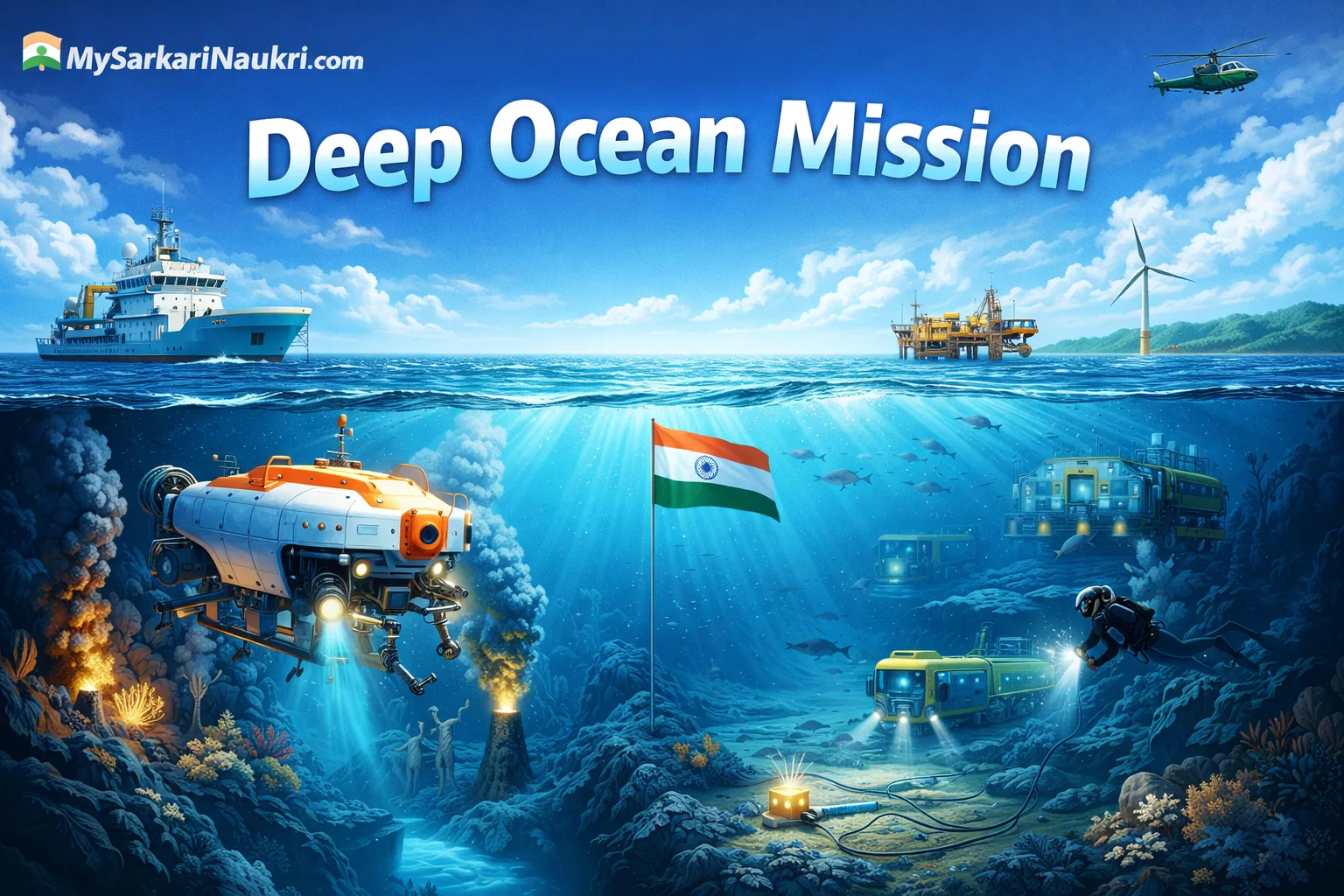
The Deep Ocean Mission (DOM) is no longer just a scientific blueprint; it is now a multi-billion dollar recruitment engine. With an outlay of ₹4,077 crore, the Ministry of Earth Sciences (MoES) is spearheading a mission that places India among an elite club of six nations capable of manned deep-sea exploration.
For government job seekers, particularly in engineering and pure sciences, the 2026-2027 cycle marks the peak of the “Samudrayaan” project. This guide breaks down the institutional recruitment ecosystem, the standard annual hiring cycles, and the specific roles driving India’s Blue Economy.
1. The Recruitment Ecosystem: Implementing Agencies
Unlike standard UPSC or SSC cycles, recruitment for the Deep Ocean Mission is decentralized across premier autonomous R&D institutes under the Ministry of Earth Sciences (MoES).
Key Hiring Hubs
- National Institute of Ocean Technology (NIOT), Chennai: The nodal agency for the MATSYA 6000 manned submersible. Primary recruiter for Mechanical, Electronics, and Ocean Engineers.
- Centre for Marine Living Resources and Ecology (CMLRE), Kochi: Focuses on deep-sea biodiversity. Primary recruiter for Marine Biologists and Biotechnologists.
- National Centre for Polar and Ocean Research (NCPOR), Goa: Manages exploration in the Central Indian Ocean Basin.
- Indian National Centre for Ocean Information Services (INCOIS), Hyderabad: Focuses on ocean climate advisory services and data science.
2. Core Job Profiles & Pay Scales (7th CPC)
Recruitment under DOM generally follows two tracks: Permanent Scientific Cadre and Project-Based Mission Mode.
Scientific & Engineering Roles
| Position | Entry Level / Level | Essential Qualification | Estimated Monthly Emoluments |
| Scientist B/C | Level 10/11 | B.E/B.Tech or M.Sc (First Class) | ₹56,100 – ₹67,700 + HRA |
| Project Engineer | Contractual | B.E/B.Tech (Mech/Elec/ECE/Software) | ₹50,000 – ₹75,000 (Consolidated) |
| Project Scientist I/II/III | Contractual | M.Sc/M.Tech + relevant experience | ₹56,000 – ₹78,000 + HRA |
| Scientific Assistant | Level 6/7 | Diploma in Engineering or B.Sc | ₹35,400 – ₹44,900 + HRA |
3. The “Samudrayaan” Influence: Why 2026 is Critical
The Samudrayaan project is the crown jewel of the Deep Ocean Mission. As India prepares for the 6,000-meter manned dive in late 2026, the demand for specialized technical manpower has reached an all-time high.
Focus Areas for Engineers:
- Mechanical Engineering: Pressure hull design, titanium welding, and syntactic foam buoyancy systems.
- Electronics & Communication: Underwater acoustics, telemetry, and subsea sensors.
- Robotics: Development of Remotely Operated Vehicles (ROVs) and Autonomous Underwater Vehicles (AUVs).
- Software Engineering: Real-time control systems and deep-ocean data visualization.
4. Standard Annual Recruitment Cycle
While “walk-in interviews” are common for project roles, the high-authority Scientist positions follow a predictable institutional cycle:
- Notification (January – March): Most MoES institutes release consolidated advertisements for project-based roles at the start of the final quarter or the beginning of the financial year.
- Screening (April – June): Shortlisting based on GATE scores (for engineers) or academic excellence/NET (for scientists).
- Interview/Test (July – September): Personal interviews are the primary selection tool for Scientist ‘C’ and above.
- Deployment (October – December): Onboarding and specialized training at NIOT or NCPOR.
Pro Tip: Keep a close watch on the “Careers” section of the National Institute of Ocean Technology (NIOT) website during February and August.
5. Eligibility & Skills “Goldmine”
To break into the Deep Ocean Mission ecosystem, candidates must align their profiles with the six mission verticals:
Mandatory Educational Background
- Engineering: Ocean Engineering, Marine Engineering, Petroleum Engineering, Robotics, or Mechanical/Electronics.
- Science: Geophysics, Marine Biology, Oceanography, Biotechnology, or Geology.
Desirable Niche Skills
- Experience with GIS (Geographic Information Systems) and Remote Sensing.
- Proficiency in MATLAB, Python, or C++ for oceanographic data modeling.
- Certification in Non-Destructive Evaluation (NDE) techniques like Ultrasonic Testing (PAUT).
- Sea-faring experience or participation in scientific cruises.
6. Career Growth & Future Prospectus
A stint with the Deep Ocean Mission is a massive value-add to a resume.
- Institutional Shift: Move from project roles to permanent scientist positions within MoES or CSIR labs.
- Global Opportunities: India’s collaboration with nations like Norway and France opens doors for international fellowships and PhDs.
- Private Sector Transition: As the “Blue Economy” grows, private firms in subsea cable laying, offshore energy, and marine mining actively recruit DOM-trained experts.
Also Read:
- Ocean Engineering Careers in India
- Marine Engineering vs. Ocean Engineering
- Top 7 PSUs Hiring Ocean Engineers via GATE
Disclaimer
This guide is for informational purposes. Recruitment cycles and pay scales are subject to the latest 7th Pay Commission updates and official gazette notifications from the Government of India. Always verify specific job details on the official institute websites.