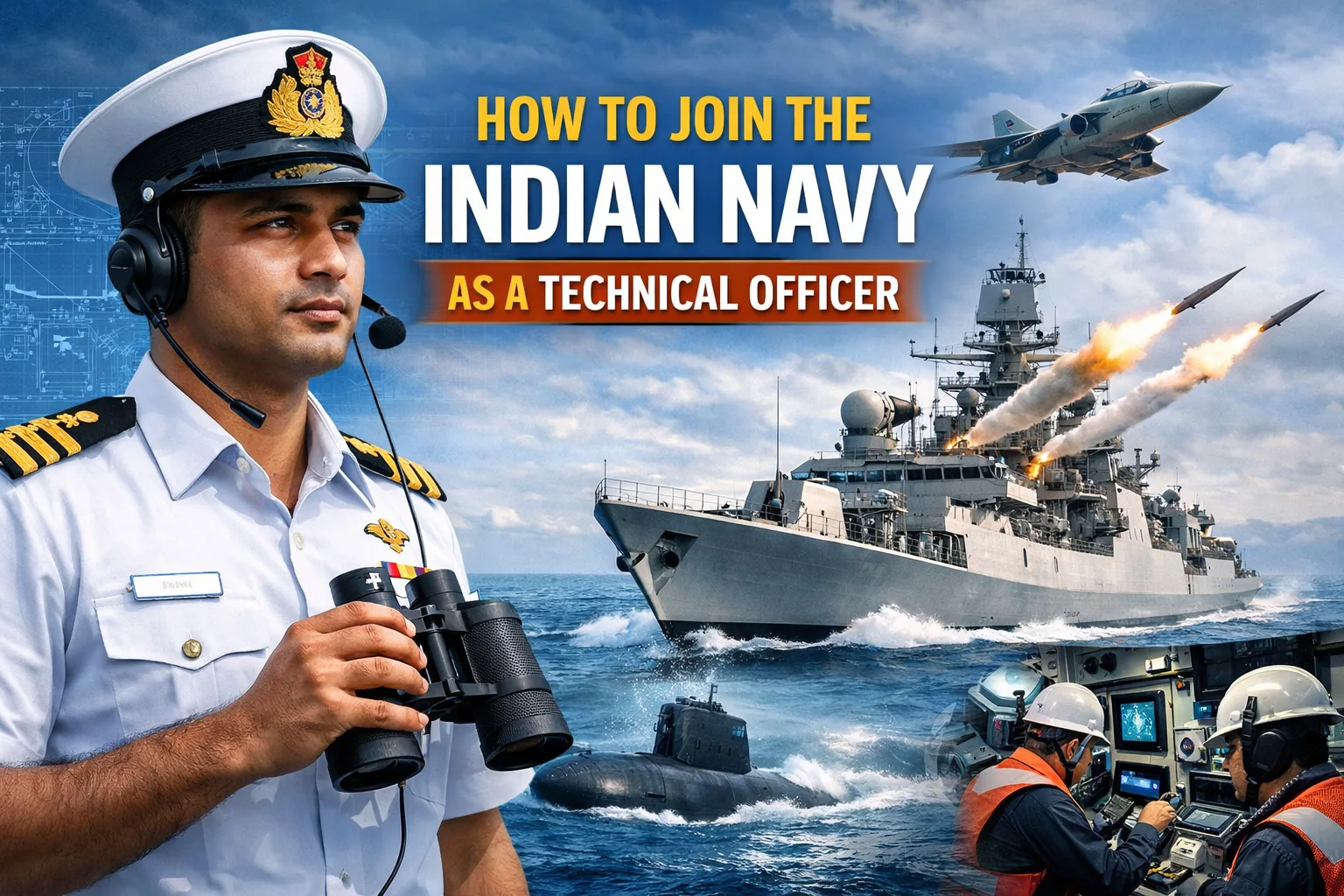
How to Join the Indian Navy as a Technical Officer: The Definitive Career Blueprint
Contents
Becoming a Technical Officer in the Indian Navy is not merely securing a job; it is a transition into a high-stakes engineering environment where you manage some of the world’s most advanced maritime technology. This guide outlines the permanent recruitment frameworks, eligibility standards, and career trajectories for engineering aspirants.
1. The Role of a Technical Officer
Technical Officers are the backbone of the Navy’s operational readiness. They are divided into two main branches:
- Engineering Branch: Responsible for the propulsion, auxiliary systems, and hull integrity of ships and submarines.
- Electrical Branch: Manages power generation, distribution, complex weapon systems, radars, and control sensors.
2. Primary Entry Schemes (Annual Cycles)
The Indian Navy follows a standardized recruitment calendar. Instead of waiting for specific “job links,” candidates should prepare for these annual windows:
A. Direct Entry (GS/Technical) via INET
The Indian Navy Entrance Test (INET) is the primary gateway for engineering graduates.
- Frequency: Conducted twice a year.
- Target: Final year students or B.E./B.Tech graduates.
- Branches: Engineering (General Service), Electrical (General Service), and Naval Architecture.
B. University Entry Scheme (UES)
- Status: Currently transitioned into specialized Short Service Commission (SSC) entries.
- Process: Preliminary interviews are conducted at various engineering campus hubs followed by SSB.
C. Short Service Commission (SSC) via GATE Score
In recent years, the Navy has shifted toward using GATE (Graduate Aptitude Test in Engineering) scores for shortlisting candidates for SSB interviews.
- Requirement: A valid GATE score in relevant papers (ME, EE, EC, CS, etc.).
- Advantage: Bypasses the written entrance exam, moving straight to the personality assessment.
3. Eligibility Criteria: The Institutional Standard
To maintain the high standards of a “Young Officer,” the following criteria are strictly enforced:
| Criteria | Requirement Details |
| Gender | Men and Women (Entry specific) |
| Age Limit | Generally 19 to 24 years (varies slightly by entry) |
| Education | B.E. / B.Tech with minimum 60% aggregate marks |
| Physical Standard | Min Height: 157 cm (Men) / 152 cm (Women) |
| Vision | 6/24, 6/24 correctable to 6/6, 6/6 with glasses |
4. The Selection Ecosystem: The SSB Process
Regardless of the entry scheme, every candidate must clear the Services Selection Board (SSB). This is a 5-day rigorous evaluation of “Officer Like Qualities” (OLQs).
- Stage I (Day 1): Officer Intelligence Rating (OIR) tests and Picture Perception & Description Test (PP&DT).
- Stage II (Day 2-5):
- Psychological Tests: TAT, WAT, SRT, and Self-Description.
- GTO Tasks: Group discussions, obstacles, and command tasks.
- Personal Interview: A comprehensive sit-down with a Deputy President of the board.
- Medical Board: A week-long clinical evaluation at a Naval Hospital.
5. Training and Career Progression
Once selected, Sub-Lieutenants undergo a structured transformation:
- Naval Academy (INA) Ezhimala: 22 weeks of Naval Orientation Course.
- Specialized Schools: Technical training at INS Shivaji (Lonavala) for Marine Engineers or INS Valsura (Jamnagar) for Electrical Engineers.
6. Promotion Hierarchy
- Sub-Lieutenant (Starting Rank)
- Lieutenant (After 2 years)
- Lieutenant Commander (After 6 years)
- Commander (After 11 years)
- Captain / Commodore / Admiral Ranks (Selection based)
7. Frequently Asked Questions (FAQs)
No. You must have a clear degree with the minimum required percentage (usually 60%) at the time of joining the academy.
The Navy offers both. SSC is typically for 10 years (extendable to 14), while PC allows you to serve until retirement. Many technical entries now start as SSC with an option for PC based on performance and vacancies.
Yes, the Indian Navy has opened various technical roles for women, including the Submarine and Provost arms, subject to current policy notifications.
Absolutely. Only specific branches like Mechanical, Marine, Electrical, Electronics, Telecommunication, and Naval Architecture are eligible for Technical Officer roles.
Disclaimer: Recruitment policies and medical standards are subject to change by the Integrated Headquarters of Ministry of Defence (Navy). Always verify specific notification details on the official joinindiannavy.gov.in portal.