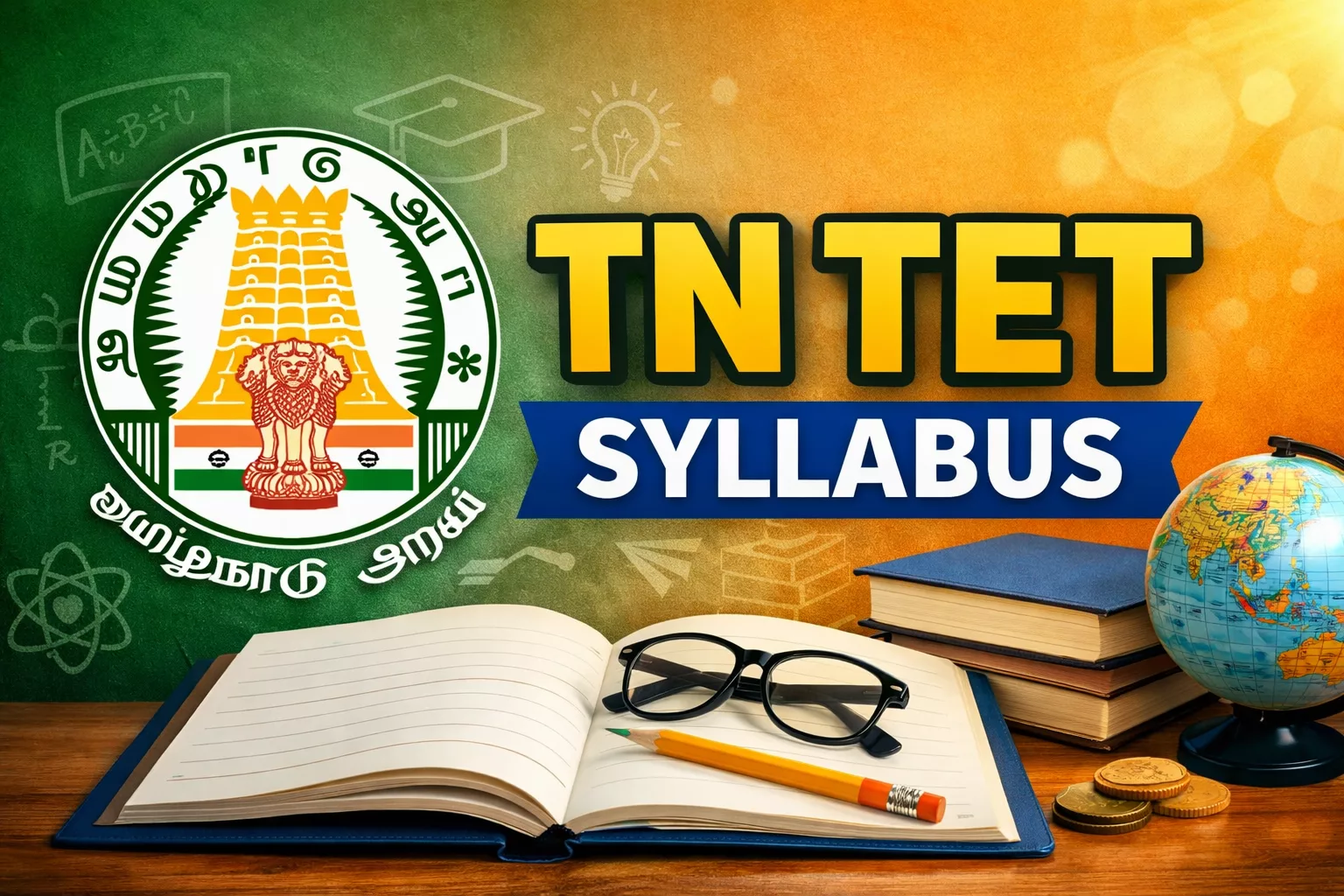
TNTET Paper 1 & Paper 2 Syllabus 2026 – Complete Topic-wise Breakdown
Contents
✓ Verified against TRB Tamil Nadu Notification No. 01/2026. All topics reproduced verbatim for Working Teachers.
Exam Pattern Overview (2026)
The Tamil Nadu Teacher Eligibility Test (TNTET) for working teachers follows a structured offline OMR-based pattern. There is no negative marking for incorrect answers.
| Paper | Section | Questions | Marks | Duration | Negative Marking |
| Paper 1 | Child Development & Pedagogy (6-11 yrs) | 30 | 30 | 3 Hours | None |
| Language I (Tamil/Telugu/Malayalam/Kannada/Urdu) | 30 | 30 | |||
| Language II (English) | 30 | 30 | |||
| Mathematics | 30 | 30 | |||
| Environmental Studies | 30 | 30 | |||
| Total | 150 | 150 | 180 Mins | ||
| Paper 2 | Child Development & Pedagogy (11-14 yrs) | 30 | 30 | 3 Hours | None |
| Language I (Tamil/Telugu/Malayalam/Kannada/Urdu) | 30 | 30 | |||
| Language II (English) | 30 | 30 | |||
| Mathematics & Science OR Social Science | 60 | 60 | |||
| Total | 150 | 150 | 180 Mins |
Complete Syllabus
TNTET Paper 1 (Classes 1–5)
Child Development and Pedagogy (30 Marks)
Part A: Child Development
- Physical and Cognitive Development.
- Social and Emotional Development.
- Physical & Intellectual Development (6 to 10 Years).
- Social and Emotional Development (6 to 10 Years).
- Moral Development (6 to 10 Years).
- Theories of child development: Erikson, Piaget, Kohlberg, Vygotsky, Bronfenbrenner.
- Attention, perception, memory: nature, types, strategies, errors.
Part B: Learning
- Learning.
- Types, levels and approaches to Learning.
- Concepts and constructs.
- Factors Contributing to Learning.
- Constructivist Approach to Learning.
- Learning and Knowledge.
- Motivation and learning theories: Maslow, Pavlov, Skinner, Thorndike, Dewey, Rogers.
Language I (Regional Language) (30 Marks)
- Language comprehension.
- Speaking.
- Reading.
- Vocabulary.
- Language Functions.
- Grammar, sentence structure, paragraph types.
- Dictionaries, literary appreciation, reading for pleasure.
Language II (English) (30 Marks)
- English language comprehension.
- Elements of language.
- Communication and comprehension abilities.
- Listening, speaking, reading, and writing (LSRW).
- Vocabulary.
- Language Functions.
- Functional grammar, sentence structure, punctuation.
- Writing skills: messages, short essays, paragraphs.
Mathematics (30 Marks)
- Shapes and Figures.
- Numbers.
- Number system: whole numbers, integers, decimals, rational numbers.
- Arithmetic operations, LCM, HCF, factors, multiples, prime numbers.
- Measurements: length, weight, capacity, time, money.
- Algebra: expressions, identities, exponents, power laws.
- Geometry: basic shapes, properties, mensuration.
- Patterns.
- Study of Data and Data handling.
Environmental Studies (30 Marks)
- Family and friends.
- Plants.
- Animals & Birds.
- Food.
- My Body.
- Shelter.
- Small Creatures Around the children.
- Day and Night.
- Water.
- Air.
- Man, Matter and Materials.
- Work.
- Science in Everyday.
- Keeping Healthy and Clean.
- Life.
- Travelogue and Communication.
- Natural resources and conservation.
TNTET Paper 2 (Classes 6–8)
Child Development and Pedagogy (30 Marks)
- Nature of Educational Psychology.
- Human Growth and Development.
- Cognitive Development.
- Social, Emotional and Moral Development.
- Learning.
- Intelligence and Creativity.
- Motivation and Group Dynamics.
- Personality and Assessment.
- Mental Health and Hygiene.
- Guidance and Counselling.
- Inclusive education, learner-centered methods.
- Classroom management, assessment, ICT integration.
- Professional development, CCE, NCF 2005, Right to Education Act.
Language I (Regional Language) (30 Marks)
- Language comprehension.
- Intermediate language skills: conversation, vocabulary building.
- Grammar and sentence formation.
- Reading and literary appreciation aligned with classes 6-8 curriculum.
- Writing skills: messages, notices, essays.
Language II (English) (30 Marks)
- Listening comprehension, speaking fluency.
- Advanced reading comprehension and literary analysis.
- Grammar and vocabulary expansion.
- Writing skills: formal and informal letters, essays.
- Dictionary and reference skills.
Subject Specialization: Mathematics and Science (60 Marks)
- Mathematics: Number System, Measurements, Algebra, Life Mathematics, Geometry, Data handling, Practical Geometry, Statistics, Mathematical reasoning.
- Science: Physics (Magnetism, Light, Heat, Electricity), Chemistry (Atomic Structure, Water, Chemistry in Everyday Life), Biology (Cell, Crop Protection and Management, Our Environment).
Subject Specialization: Social Science (60 Marks)
- History: Pre-historic Period, Indus Valley Civilization, Ancient Land of Thamizhagam, Vedic Period, Jainism and Buddhism, Rise of Empires, Kushana Empire, Great Mughal, Rise of Marathas, Advent of Europeans, Rule of East India Company, Vellore Mutiny.
- Geography: Earth and Solar System, Lithosphere, Weather and Climate, Oceanography, Resources and their types, Primary Activity (Gathering, Hunting, Fishing, Mining), Secondary Activity (Industries), Tertiary Activity (Transport, Trade), Population and Resource.
- Civics: Our Nation (Location, National Symbols), Indian Constitution, Political Parties, United Nations Organization, Legislation and Welfare schemes for Children and Women.
- Economics: Consumption, Sectors of Economy, Money, Savings and Investment.
Post-wise Subject Requirements
| Post Type | Compulsory Subjects | Optional Subjects (Choose One) |
| Secondary Grade Teacher (Classes 1-5) | CDP, Language I, Language II, Maths, EVS | N/A (All are compulsory) |
| Graduate Teacher (Maths/Science) | CDP, Language I, Language II | Mathematics & Science (60 Marks) |
| Graduate Teacher (Social Science) | CDP, Language I, Language II | Social Science (60 Marks) |
| Special/Other Teachers | CDP, Language I, Language II | Either Maths & Science OR Social Science |
Strategic Preparation Guide
High-Weightage Topics
- Pedagogy: Focus on Piaget’s stages and the Constructivist approach. These comprise nearly 40% of the CDP section.
- Mathematics: For Paper 2, Life Mathematics and Algebra are historically high-yield.
- EVS/Social Science: Review the Tamil Nadu State Board textbooks (Samacheer Kalvi) from Class 6 to 10 thoroughly.
Free Resource Suggestions
- NCERT & SCERT: Follow the Tamil Nadu School Education Department’s digital textbooks.
- Online Tests: Utilize the official TRB practice link for OMR-based mock trials.
Common Mistakes to Avoid
- Ignoring Language I Pedagogy: Many candidates focus only on grammar and miss the pedagogy of language development.
- Time Management: 150 questions in 180 minutes means you have roughly 1.2 minutes per question. Do not get stuck on complex Math problems.
Official Resources
- Download Official Notification PDF
- Official TRB Website
Frequently Asked Questions (FAQs)
Yes, for teachers appointed on or before September 1, 2025, who have not yet cleared the TET. According to recent government and Supreme Court directives, qualifying the TET is essential for continued service, regularization, and future promotions.
The passing marks vary by category:
General: 60% (90 out of 150 marks)
BC / BCM / MBC / DNC / PWD: 50% (75 out of 150 marks)
SC / SCA / ST: 40% (60 out of 150 marks)
Yes, eligible teachers who handle both primary and upper-primary classes or possess the requisite qualifications for both levels can apply. Note that separate applications and fees are required for each paper.
No. There is no negative marking for incorrect or unattempted questions. Candidates are advised to attempt all 150 questions.
The TNTET qualifying certificate is valid for a lifetime. Once you pass, you do not need to appear for the eligibility test again.