He was the king of the Vijayanagara Empire who reigned in the 16th century over most of South India. He built large tanks and canals for irrigation. He mai...
• Key concept: King Krishnadevaraya
• Essential for UPSC CSE Prelims, State PSCs, SSC CGL & Railway exams.
• Comprehensive analytical coverage and factual pointers provided below.
He was the king of the Vijayanagara Empire who reigned in the 16th century over most of South India. He built large tanks and canals for irrigation. He maintained friendly relations with the Portuguese governor, Albuquerque.
Portuguese traveler Domingo Paes and Barbosa visited his court.
Eight eminent luminaries in literature known as Ashtadiggajas were at his court.
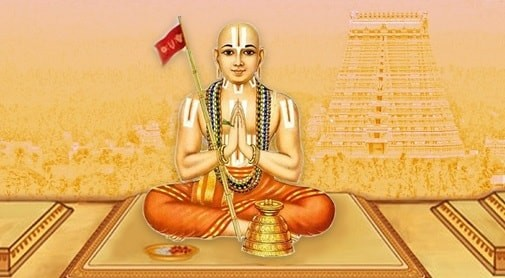
He was a Sri Vaishnava, a follower of the Tamil saint Ramanuja.
He was commonly known as abhinava-bhoja, ―a New Bhoja,‖ sakala-kala-bhoja, ―Bhoja in all arts,‖ and Andhra Bhoja.
He wrote Amuktamalyada, which tells the story of the Tamil poet-saint Andal. He wrote Amuktamalyada in Telugu. The famous Allasani Peddana, the author of Manucharitram, also known as Andhra Kavitapitamaha was part of eight poets in the court of King Krishnadevaraya
Recently, the first-ever epigraphical reference to the date of death of Vijayanagara king Krishnadevaraya has been discovered at Honnenahalli in the Tumakuru district.
The inscription is engraved on a slab kept on the north side of the Gopalakrishna temple.
The inscription is written in Kannada and also registers the gift of village Honnenahalli in Tumakuru for conducting worship to the god Veeraprasanna Hanumantha of Tumakuru.
He assumed the title of ‘Yavanarajyasthapanacharya’ (Establisher of the Yavanaor Muslim kingdom).
In 1523 he captured Orissa and Warangal.
Chapter 5
Maratha Empire (1674-1818)
22 Nov 2026 Sagar Charpe
UPSC CSEState PSCSSC CGLRailways
The Maratha Empire dominated a large part of the Indian subcontinent in the 17th century. The empire formally existed from 1674 with the coronation of Chat...
• Key concept: Maratha Empire (1674-1818)
• Essential for UPSC CSE Prelims, State PSCs, SSC CGL & Railway exams.
• Comprehensive analytical coverage and factual pointers provided below.
The Maratha Empire dominated a large part of the Indian subcontinent in the 17th century.
The empire formally existed from 1674 with the coronation of Chattrapati Shivaji Maharaj and ended in 1818 with the defeat of Peshwa Bajirao II at the hands of the British East India Company.
Maloji Raje Bhonsle
He joined Nizam Shah with a small band of cavalry.
Served under Nizam Shah and Adil Shah, and came to prominence as a leading Maratha.
After the fall of Ahmadnagar, he transferred his services to Bijapur.
Sambhaji (1681–89)
Sambhaji was defeated by the Mughal commander Muqqarrab Khan and was killed along with his personal counsellor, Kavi Kalash.
Rajaram (1689-1707)
The younger brother of Sambhaji, who never sat on the throne, as he claimed that he was ruling on behalf of Shahu.
Shifted his headquarters to Ginjee.
After the Mughals conquered Ginjee, he fled to Vishalgarh and then to Satara, giving Hukumat Panha (King status) to Peshwa Ramchandra Pant.
After his death in 1700, his widow Tarabai assumed control in the name of her infant son Shivaji II.
Shahu (1707-49)
Shahu was released by Zulfiqar Khan (Bahadur Shah) hoping for a civil war among Marathas.
In 1707 with the help of a Chitpavan Brahman named Balaji Vishwanath, Shahu was successful in defeating Tarabai at the Battle of Khed.
Tarabai went away to Kolhapur, establishing the Royal House of Kolhapur.
In 1719, Shahu, under the advice of Peshwa Balaji Vishwanath, assisted the Saiyyad brothers in the execution of Farukkh Siyar and got his mother released.
Soon after he declared Swaraja the Independence of Maratha land.
Rajaram II (1749–77)
Rajaram II was the adopted son of Shahu
Peshwa Baji Rao retained him as the titular Chattrapati.
The power of the Chhatrapati was almost totally overshadowed by that of the Peshwa.
Royal House of Kolhapur
Shivaji II (1710–14)
Son of Queen Tarabai and Rajaram, and was under the regency of Queen Tarabai.
Sambhaji II (1714–60)
Son of Rajaram from his second wife Rajabai, who deposed Shivaji II and Tarabai by the palace revolution in 1714.
He signed the Treaty of Warna in 1731 with his cousin Shahu to formalize the two separate seats of the Bhonsle family.
British sent expeditions against Kolhapur in 1765 and 1792.
State entered into a treaty with the British after the collapse of the Maratha confederacy in 1812.
maratha empire shivaji history
Office of the Peshwa (1640–1818)
The word ‘Peshwa’ probably originated in Persian, meaning ‘foremost’, and was introduced in Deccan by the Muslim rulers.
The duties of a Peshwa were equal to that of a Prime Minister.
Sonopant Dabir (1640–52)
First unofficial Peshwa
Moropant Trimbak Pingle (1674-1683)
Participated in the battles at Trimbakeshwar Fort and Wāni-Dindori against the Mughal Empire.
Moropant introduced sound revenue administration to Shivaji's regime and played an important role in resource planning concerning defences and maintenance of strategic forts.
He was also responsible for the construction and administration of Pratapgad.
Nilakanth Moreshvar Pingale (1683-1689)
Nilakanth Moreshvar Pingale was the second Peshwa of the Maratha Empire.
In 1689, he was killed together with the Maratha King Sambhaji.
Ramchandra Pant Amatya (1689–1708)
Peshwa under Rajaram.
Rajaram had to escape to Ginjee in 1689, he gave Hukumat Panha (King status) to Pant before leaving.
He wrote Adnyapatra.
Bahiroji Pingale (1708-1711)
Parshuram Trimbak Kulkarni (1711-1713)
Balaji Vishwanath (1713–19)
Balaji Vishwanath belonged to the Bhatt family of Shri Vardhan in the Konkan region.
He made the post of the Peshwa hereditary.
He helped Shahu become the Maratha empire ruler by seeking the support of all Maratha leaders for Shahu.
Shahu conferred the title of Sena-karte (organizer of forces) to him.
In 1719, he got certain rights from the Farrukh Siyar, including recognition of Shahu as the Maratha empire king.
He got permission to collect chauth and sardeshmukhi from the six provinces of the Deccan.
Nana Sahib belonged to this family.
Peshwa Bajirao I (1720–40)
The Eldest Son of Balaji Vishwanath succeeded him as Peshwa at the young age of twenty.
Baji Rao I was the most famous of all nine Peshwas and also known as “Thorale”, meaning ‘Elder’ Baji Rao.
He was the greatest exponent of guerrilla tactics after Shivaji.
During his lifetime, he neverlostabattle and the Maratha empire reached its zenith under him.
Baji Rao I preached and popularized the idea of HinduPad Padshahi.
He defeated the Nizam on both occasions when they fought at Palkhed and Bhopal.
In 1722, he captured Salsette and Bassein from the Portuguese.
He shifted the administrative capital from Satara to Pune in 1728.
He initiated the system of the confederacy among the Maratha chiefs.
They were the Gaekwads at Baroda, the Bhonsles at Nagpur, the Holkars at Indore, the Scindias at Gwalior, and the Peshwas at Poona.
Balaji Baji Rao I/ Nana Sahib I (1740–61)
Balaji Baji Rao succeeded his father as Peshwa at the young age of nineteen and was appointed as Peshwa by Shahuji.
It was during his reign that the Maratha empire king Shahu died in 1749 without an issue.
His nominated successor, Ramraja, was imprisoned by the Peshwa Balaji Baji Rao at Satara.
The supreme power of the Maratha empire was passed into the hands of Peshwa by the Sangola Agreement in 1750.
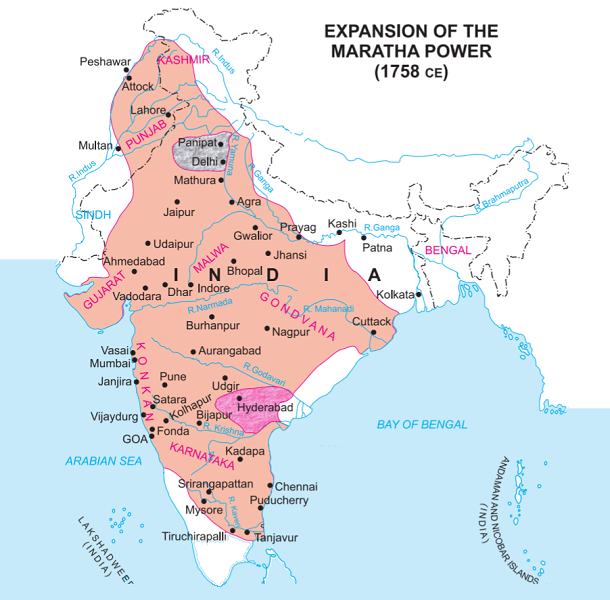
He defeated Bengal Nawab Alivardi Khan and one-third of the Indian sub-continent was under the Maratha empire.
According to an agreement in 1752, the PeshwagaveprotectiontoMughalEmperor from internal and external enemies.
Maratha got chauth of the northwest provinces and total revenue of the Agra and Ajmer provinces as per the agreement.
Honouring this agreement, Marathas fought the 3rd Battle of Panipat in 1761 when Ahmad Shah Abdali invaded India.
The defeat of Panipat checked the expansion of the Maratha empire and fragmented it.
Madhav Rao (1761–72)
Madhav Rao defeated the Nizam and compelled Haidar Ali of Mysore to pay tribute.
He reasserted control over northern India by defeating the Rohillas and subjugating the Rajput state and Jat chiefs.
In 1772, he brought back Emperor Shah Alam to Delhi.
Maratha's empire got weakened and divided into semi-independent states.
The most important were the Gaikwads (Gaekwars), the Holkars, and the Scindias.
SawaiMadhavRao (1774–95)
Son of Narayan Rao, who was merely 40 days old when crowned as Peshwa.
The empire was managed by Nana Phadnavis, an able administrator and warrior.
There were twelve member regency councils called the Barbhai Council.
Out of frustration, Raghunath Rao went to the British for help which resulted in the First Anglo–Maratha war in 1775–82.
At the battle of Talegaon in 1776, Nana Phadnavis defeated the British.
The treaty of Purandhar in 1776 and the treaty of Salbai in 1782 were signed.
After the death of Nana Phadnavis in 1800 the Maratha empire could not sustain itself against the British.
Baji Rao II (1796–1818)
Son of Raghunath Rao.
Baji Rao II signed the humiliating Treaty of Bassein with the British in 1802.
He was defeated by the East India Company in the Third Anglo– Maratha War in 1818.
After this, the Peshwa’s territory was annexed to the British Bombay province, and he was pensioned off.
Nana Sahib ( Dhondu Pant ) was the adopted son of Baji Rao II.
Maratha Empire Administration
King was assisted by a council of ministers called the Ashtapradhan
Provinces were known as Prants.
Prants divided into Tarfs Parganas.
Mauzas or villages were the lowest unit.
There were two divisions in the Maratha cavalry:
Bargirs: Equipped and paid by the state
Silahdars: Maintained by the nobles.
Mavli foot soldiers played an important role in the infantry.
Shivaji strongly discouraged revenue farming.
Marathas employed a special script known as the ‘Modi script’ in the documents of the revenue and administrative records.
Chauth and sardeshmukhi were two major sources of revenue
Chauth: One-fourth (1/4th of the land revenue) was paid to the Marathas in order to avoid the Maratha raids.
Sardeshmukhi 1/10 of land revenue on those lands on which the Marathas claimed hereditary rights.
The decline of the Maratha Empire
Madhavrao Peshwas was made a pensioner of the British and exiled to Bithoor, Uttar Pradesh. The Maratha kingdoms of Nagpur, Indore and Gwalior all slipped into the administrative powers of the British. They all became princely states and all the Maratha powers had no other chance to succeed so they surrendered to the British. This gave rise to the Treaty of Gwalior (5th November 1817).
The Treaty of Mandeswar was signed by Holkar on 6th January 1818 and it required the Holkar state to remain as a subsidiary of the British.
The British East India Company seized the Nassak Diamond as part of the war spoils, apart from large quantities of land which were governed by the Maratha Empire. This led to the decline of the Maratha Empire.
Chapter 6
Shivaji Raje Bhonsle (1674-80)
22 Nov 2026 Vinay Yadav
UPSC CSEState PSCSSC CGLRailways
Born:19 February 1630, Shivneri Fort, KusurDied:3 April 1680, Raigad FortShivaji Raje Bhonsle (1674-80) Born in the hill fortress of Shivmer in Poona on Fe...
• Key concept: Shivaji Raje Bhonsle (1674-80)
• Essential for UPSC CSE Prelims, State PSCs, SSC CGL & Railway exams.
• Comprehensive analytical coverage and factual pointers provided below.
Born:
19 February 1630, Shivneri Fort, Kusur
Died:
3 April 1680, Raigad Fort
Shivaji Raje Bhonsle (1674-80)
Born in the hill fortress of Shivmer in Poona on Feb 19, 1630
Belonged to the Bhonsle clan of Marathas.
His mother was Jijabai.
Shivaji, influenced by Dadaji Kondev (his teacher), Sufi saint Pir Shaikh Yacub, Guru Ramdas, Tukaram, Hazrat Baba of Ratnagiri, Ramayana, and the Mahabharata.
He started his career as an independent young prince at Poona and Supa in 1637.
After the death of Dadaji Kondadev in 1647 Shivaji assumed full charge of his jagir.
In 1646, he captured Torna from Bijapur and built the fort of Raigarh.
By 1654, Shivaji had captured forts in the Western Ghats and along the Konkan coast.
Shivaji and his elder brother defeated invading armies of Adil Shah and secured the release of their father.
He raided the Portuguese settlement at Daman.
The battle of Pratapgarh in 1659 was fought between Afzal Khan (represented by Adil Shah of Bijapur) and Shivaji.
Shivaji killed Afzal Khan with his tiger claws and became a local hero.
He won the Battle of Kolhapur against Rustemjaman (represented by Adil Shah of Bijapur).
Aurangzeb considered Shivaji a mountain rat.
In 1660, Aurangzeb sent Shaista Khan to fight against Shivaji, but the war continued till 1663.
In 1663 in a night attack on Shaista Khan, Shivaji injured him and killed his son.
Shivaji sacked the port of Surat, an important Mughal trading city in 1664.
Aurangzeb sent Raja Jai Singh and Diler Khan, and they won and signed a treaty of Purander in 1665 with Shivaji.
His minor son Sambhaji was granted a mansab of 5000.
When Shivaji visited Agra with his son, was house arrested by Aurangazeb.
Shivaji escaped along with his son.
In 1670, he recovered most of his lost forts and attacked Surat for the second time.
Shivaji defeated the Mughals in the Battle of Salher in 1672.
Shivaji was coronated on 6th June 1674 at Raigarh.
He assumed the title Maharaja Chattrapati Haindava Dharmodharak (Protector of Hinduism).
Shivaji issued the gold coin, Shivaraihon, on this occasion.
He died in 1680 at the age of 53.
Shivaji promoted Sanskrit, but respected all religions and opposed the forced conversion.
Chapter 7
Sambhaji (1681–89)
22 Nov 2026 Sagar Charpe
UPSC CSEState PSCSSC CGLRailways
Born: 14 May 1657, Purandar Fort, GherapurandharDied:11 March 1689, TulapurSambhaji (1681–89) Sambhaji was the elder son of Shivaji who was credited for de...
• Key concept: Sambhaji (1681–89)
• Essential for UPSC CSE Prelims, State PSCs, SSC CGL & Railway exams.
• Comprehensive analytical coverage and factual pointers provided below.
Born:
14 May 1657, Purandar Fort, Gherapurandhar
Died:
11 March 1689, Tulapur
Sambhaji (1681–89)
Sambhaji was the elder son of Shivaji who was credited for defeating Chikka Deva Raja of Mysore.
Prince Akbar, the rebellious son of Aurangzeb, took shelter with him and in a pursuing battle at Sangmeshwar in 1689.
He was defeated by the Mughal commander Muqqarrab Khan and was killed along with his personal counsellor, Kavi Kalash.
Widow of Sambhaji, Yesubai could not protect the fort of Raigarh, and she along with her son, Shahu was made prisoners.
FAQs
Why did Sambhaji join the Mughals?
At the age of nine, Sambhaji was sent to live with Raja Jai Singh I of Amber as a political hostage to ensure compliance with the Treaty of Purandar that Shivaji had signed with the Mughals on 11 June 1665. As a result of the treaty, Sambhaji became a Mughal mansabdar.
How many battles did Sambhaji win?
Out of 127 battles fought, Sambhaji didn't lose a single one.
Chapter 8
Foreign Travellers in Medieval India
22 Nov 2026 Sagar Charpe
UPSC CSEState PSCSSC CGLRailways
India is known as the world’s spiritual leader. In ancient times, India’s educational system was superior to that of all other countries. Perhaps this is w...
• Key concept: Foreign Travellers in Medieval India
• Essential for UPSC CSE Prelims, State PSCs, SSC CGL & Railway exams.
• Comprehensive analytical coverage and factual pointers provided below.
India is known as the world’s spiritual leader. In ancient times, India’s educational system was superior to that of all other countries. Perhaps this is why so many international visitors come to India to learn about the Indian educational system.
List of Foreign Travellers who came to India in the Medieval Period
Foreign Travellers before 1500
Name
Country
Time
Ruler / Dynasty
Book / Remarks
Al-Masudi
Arab
957
Muruj-ul-Zehab
Al-beruni
Uzbekistan
1024-30
Sultan Mahmud
Tahqiq-i-Hind
Marco Polo
Italy
1288-92
Pandya Kakatiya
Book of Sir Marco Polo
Ibn-e-Batuta
Morocco
1333-42
Mohammad Bin Tughlaq
Rehla
Shihabuddin al-Umari
Damascus
1348
Masalik albsar fi-mamalik al-amsar
Nicolo Conti
Italy
1420-22
Dev Ray I
Tsang Hi (Mahuan)
China
1421-31
Jalaluddin of Bengal
Abdur Razzak
Iran
1442-43
Dev Ray II
Athnasius Niketin
Russia
1470-74
Mohammad III, Bahmani
Vasco da Gama
Portugal
1498
Zamorin
Foreign Travellers before 1500
Foreign Travellers 1500-1600
Name
Country
Time
Ruler / Dynasty
Book / Remarks
Ludovico de Varthema
Italy
Gujrat, Vijayanagar
Duarte Barbosa
Portugal
1500-16
Krishna Dev Ray
Domingo’s Paes
Portugal
1520-22
Krishna Dev Ray
Nuniz
Portugal
1535-37
Achyut Dev Ray
Anthony Monserrate
Portugal
1578-82
Akbar
Ralph Fitch
England
1585-91
Akbar
John Mildenhall
England
1603
Akbar
1st recorded burial of an Englishman in India
Ceaser Fredriseh
Vijay Nagar
John Linscoten
Dutch
Vijay Nagar
Lama Taranath
Tibet
Eastern India
Foreign Travellers 1500-1600
Foreign Travellers 1600-20
Name
Country
Time
Ruler / Dynasty
Book / Remarks
William Hawkins
England
1608-13
Jahangir
King James I
William Fisch
England
1608-12
Jahangir
John Jurdan
Portugal
1608-17
Jahangir
Nicholos Doughton
England
1608-15
Jahangir
Nicholos Withurgton
England
1612-16
Jahangir
Thomas Coryat
England
1612-17
Jahangir
Thomas Roe
England
1615-19
Jahangir
King James I
Pal Canning
England
1615-25
Jahangir
Edward Terry
England
1616-19
Jahangir
Francisco Paelsert
Dutch
1620-27
Jahangir
Foreign Travellers 1600-20
Foreign Travellers after 1620
Name
Country
Time
Ruler / Dynasty
Book / Remarks
Pietra Della Velle
Italy
1622-60
Jahangir
John Loyatt
Dutch
1626-33
Shahjahan
John Fryer
England
1627
Shahjahan
Peter Mundy
Italy
1630-34
Shahjahan
John Albert de Mandesto
Germany
1638
visited Surat
Baptiste Tavernier
France
1641-87
Shahjahan Aurangzeb
Nicolao Manucci
Italy
1656-87
Dara Shikoh
François Bernier
France
1658-68
Aurangzeb
Physician of Dara Sikho
Jean de Thevnot
France
1666-68
Aurangzeb
John Fryer
English
1672-81
Surat and Bombay
Gammilly Careri
Italy
1695-97
Bijapur
Foreign Travellers after 1620
Chapter 9
History of Medieval India
22 Nov 2026 Vinay Yadav
UPSC CSEState PSCSSC CGLRailways
The time from the 8th to the 12th century is known as the Medieval Period. It is again divided into two periods- The early Medieval period a...
• Key concept: History of Medieval India
• Essential for UPSC CSE Prelims, State PSCs, SSC CGL & Railway exams.
• Comprehensive analytical coverage and factual pointers provided below.
The time from the 8th to the 12th century is known as the Medieval Period. It is again divided into two periods- The early Medieval period and the later medieval period.
Medieval India is the phase of the Indian subcontinent between the ancient period and the modern period. This phase can be related to the time period between the 6th century and 16th century.
By the end of the Sultanate Period, Multan and Bengal were the first territories to break away from Delhi and declared independence. Many other territories...
• Key concept: Vijayanagar Empire (1336-1672)
• Essential for UPSC CSE Prelims, State PSCs, SSC CGL & Railway exams.
• Comprehensive analytical coverage and factual pointers provided below.
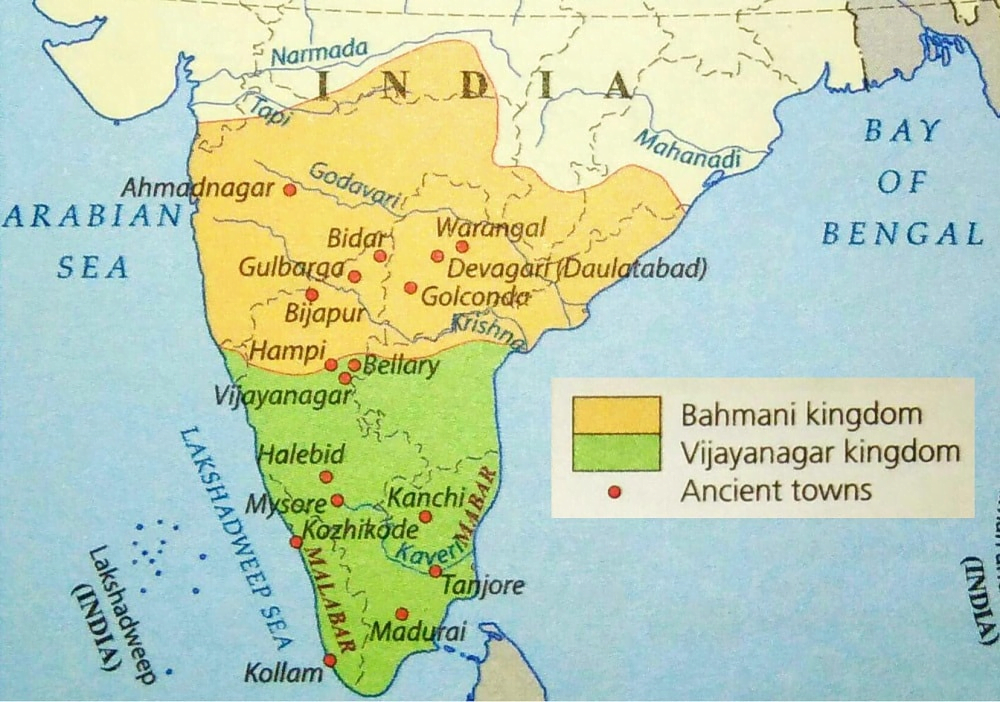
By the end of the Sultanate Period, Multan and Bengal were the first territories to break away from Delhi and declared independence. Many other territories in the Deccan region also rose to power.
The ‘Vijayanagara’ or ‘City of Victory’ was the name of the city as well as an empire that was founded by two brothers, Harihara and Bukka in 1336 AD.
It was on the southern banks of the Tungabhadra river. They made Hampi the capital city. Before they served under Kakatiya ruler of Warangal.
The sources of Vijayanagar empire history include accounts of foreign travellers, Indigenous Works (local vernacular literature), and archaeological excavations.
Vijayanagar Empire (1336-1672)
Vijayanagar Empire was Ruled by
Sangama dynasty (1336-1486)
Saluva dynasty (1486-1506)
Tuluva dynasty (1506-1565)
Aravidu dynasty (1570-1647)
Sangam Dynasty
Harihara (1336–56)
In 1336 Harihara became the ruler of Sangama Dynasty.
By 1346, the whole of the Hoyasala kingdom had passed into the hands of the Vijayanagar rulers.
By 1377, the sultanate of Madurai was completely wiped out.
Vijayanagar empire then comprised the whole of south India upto Rameswaram.
Bagepalli Copper Plate Inscription of Harihara I tells us about his achievements.
In 1356 Bukka succeeded Harihara.
Deva Raya II (1424–46)
Deva Raya II was the greatest ruler of the Sangama dynasty.
He acquired the title of Gajabetegara.
In order to strengthen his army, he inducted more Muslims in his army.
He asked all his Hindu soldiers and officers to learn the art of archery from the Muslim army.
Srirangam copper plates of Deva Raya Il list the various achievements of the ruler.
Sanskrit poet Gunda Dimdima and Telugu poet Kavisarvabhauma Srinatha, author of Haravilasam, were in his court.
Persian traveller Abdur Razzak visited his court.
Saluva and Tuluva Dynasty
After some time of the death of Dev Raya II the throne was usurped by the king’s minister, Saluva Narasimha.
Thus the Sangama dynasty came to an end and the Saluva dynasty was established.
The Saluva dynasty also soon came to an end, and a new dynasty called the Tuluva dynasty was founded by Vira Narasimha.
Krishna deva Raya (1509-29)
Krishnadevaraya was the king of Vijayanagara Empire who reigned in the 16th century over most of South India.
Achyuta Deva Raya was the younger brother of Krishna Deva Raya.
Portuguese traveller, Fernoa Nuniz, came to India during his reign.
He patronised the Kannada poet Chatu Vittalanatha, the great singer and composer Purandaradasa (father of Carnatic music), and the Sanskrit scholar Rajanatha Dindima II.
The Tiruvengalanatha temple is now popularly known as the Achyutaraya temple.
Tenali Rama, the author of Panduranga Mahatyam also was a famous poet in this region.
Rama Raja
Ram raja was a son-in-law of Krishna Deva Raya.
He was able to playoff various Muslim power against one another.
He entered into a commercial treaty with the Portuguese.
Ram Raja completely defeated the Bijapur ruler.
Then he allied himself with the Bijapur ruler to inflict humiliating defeats on Golconda and Ahmednagar.
However, his enemies (except Berar) ultimately combined to inflict a crushing defeat on Vijayanagar at Bannihatti, in the Battle of Talikota, in 1565.
This battle is also known as the Battle of Raksasa Tangadi.
Rama Raja was imprisoned and immediately executed.
The city of Vijayanagar was destroyed. This battle was generally considered to mark the end of the Vijayanagar Empire. However, the Vijayanagar kingdom existed under the Aravidu dynasty for about another century.
Aravidu Dynasty:
Thirumala, Sri Ranga and Venkata II were the important rulers of this dynasty.
Venkata II was contemporary to Akbar. He shifted capital city to
The last ruler of the Vijayanagar kingdom was Sri Ranga III.
Sri Ranga was defeated by Mir Jumla of Golconda in the battle of Vandavasi in 1647.
Vijayanagar empire came to an end with this.
Revenue:
Land revenue was the major source of income for the state.
Generally, it was at the rate of one-sixth of the total produce.
Religion:
The Sangama rulers were chiefly Saivaites and Virupaksha was their family deity. But other dynasties were Vaishnavites.
But all kings were tolerant towards other religions. Borbosa referred to the religious freedom enjoyed by everyone.
Muslims were employed in the administration and they were freely allowed to build mosques and worship.
Shunya sampadane– a collection of vachanas produced in this age.(vachanas literally meaning sayings in kannada, these are poetic verses composed in kannada language, popularized by veershaiva movement led by Basavanna).
Literature:
Sanskrit, Kannada, Telugu language witnessed voluminous literature in Vijayanagar period.
Few Sanskrit works are.
Gangadevi wrote- Madhuravijayam
Krishnadevarya wrote – usha parinayan, jambavanti kalyanam, madalasa charita.
Ashtadiggajas– eight great poets of Telugu literature flourished in the court of Krishnadevaraya.
Trade and Commerce
According to Abdur Razzak, the state had 300 seaports.
The most important commercial area on the west coast was Malabar, with its important port Cannanore.
Among the exports, the main items were cloth, spices, rice, iron, salt petre, sugar, etc.
They issued Gold Pagoda or Varaha Coin.
Position of Women
Women occupied a high position and took an active part in the political, social and literary life of the empire.
They were educated and trained in wrestling, in the use of various weapons of offence and defence, and in music and fine arts.
Nuniz writes that the kings had women astrologers, clerks, accountants, guards and wrestlers.
Architecture
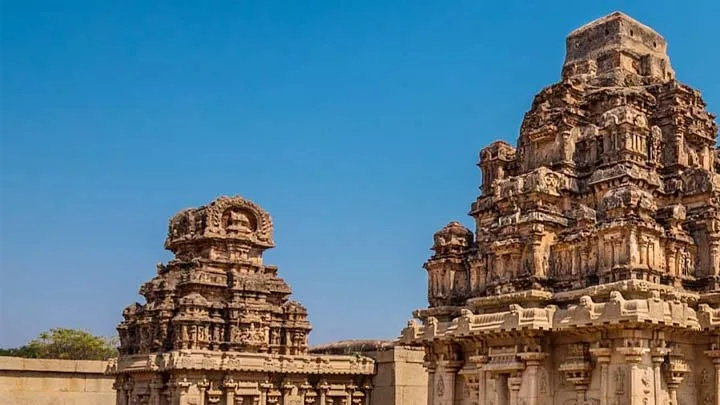
They used the Dravidian style of architecture later added some unique features to it and it came to be called as Vijayanagara style.
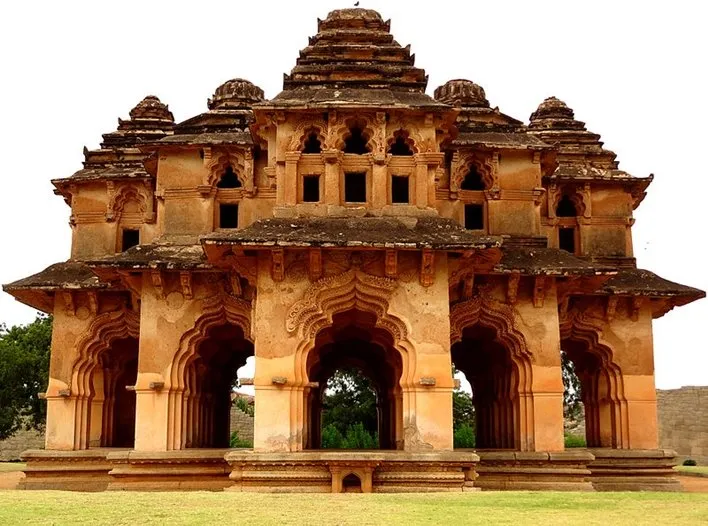
The courtly architecture of Vijayanagar is generally made of mortar mixed with stone rubble and often shows secular styles with Islamic-influenced arches, domes, and vaults.
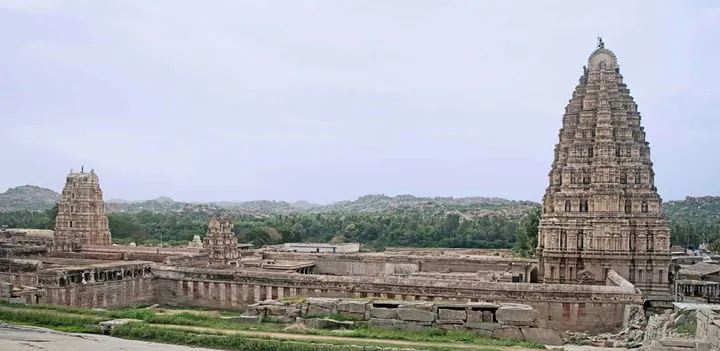
Some famous temples exemplifying the Vijayanagar style include the Virupaksha Temple at Hampi and the Hazara Rama temple of Deva Raya I etc.
Lotus MahalHazara Rama TempleVirupaksha Temple
Sources of Vijayanagar Empire
Sources
Literary Works
Information
Foreign Traveller Accounts
Rehlatar Tuhfat-un-Nuzzat by Ibn Batuta
Account of the empire under Harihara I
Matla as Sadain Wa Majma ul Bahrain by Abdur Razzaq
An account of the reign of Devaraya II
An Account of Countries Bordering the Indian Ocean and their Inhabitants by Duarte Barbosa
A vivid account of Vijaynagara governance under Krishna Deva Raya
Domingo Paes gave the most detailed accounts of all historic descriptions of ancient city Hampi
Governance under Krishna Deva Raya of Vijayanagara Empire
Fernao Nuniz gave a detailed account of the history of Vijaynagar.
Mentioned the cultural aspects of the empire and admire the jewels worn of women as well as how women were appointed in the King's service and also detailed account on the foundation of the city
Indigenous Works
1. Manucharitam by Allasani Peddan 2. Gangdas Pratapa Vilasam by Gangadhara 3. Amuktarmalyada by Krishnadeva Raya
Polity and political ideas of the ruler's society and the caste system
Archaeological Sources
Salu Vabhyudyam by Rajanatha Dindima
1. A contemporary drama, deals with the siege of Vijayanagara city by the Brahmins and the Gajapatis of Odisha after the death of Deva Raya II 2. Historical eulogy of Saluva Dynasty
Inscriptions
Bagapellisi Copper Plate Inscription
Achievement of Harihara I
Bitragunta grant of Sangama II
Genealogy of 5 Sangama Brothers
Channa Raya Pateeka Inscription of Harihara II
Successful invasions of Bukka I
Srirangam Copper Plates of Deva Raya II
Achievements of Bukka I
Devulapalli Copper Plates of Immadi Narasimha
Genealogy of Saluva Dynasty
Sources of Vijayanagar Empire
The history of the Vijayanagara Empire was recovered through the efforts of Mr. R Sewell, who was the Keeper of the Madras Record Office and was tasked with the responsibility for documenting ancient inscriptions and remains in the region.
Chapter 11
Rashtrakuta Dynasty (755–975 AD)
22 Nov 2026 Vinay Yadav
UPSC CSEState PSCSSC CGLRailways
The main Chalukya dynasty survived until 753 when one of its feudatories seized power and installed a new dynasty on the throne. This was the Rashtrakuta d...
• Key concept: Rashtrakuta Dynasty (755–975 AD)
• Essential for UPSC CSE Prelims, State PSCs, SSC CGL & Railway exams.
• Comprehensive analytical coverage and factual pointers provided below.
The main Chalukya dynasty survived until 753 when one of its feudatories seized power and installed a new dynasty on the throne. This was the Rashtrakuta dynasty.
The Rashtrakutas were more expansionist than the Chalukyas had been.
They became involved in the great power struggles in both northern, where they competed with the powerful Gurjara-Pratihara and Pala kingdoms for dominance (a contest known to modern scholars as the Tripartite Struggle); and southern India, where they contested the power of the Pallava kingdom.
Rashtrakuta dynasty called themselves descendants of Satyaki.
They were a feudatory of the Badami Chalukyas
Dantidurga overthrew Chalukya king Kirtivarman II
He built an empire with the Gulbarga region in modern Karnataka as its base.
This clan came to be known as the Rashtrakuta of Manyakheta, rising to power in South India.
Rashtrakuta dynasty was of Kannada origin and their mother tongue was Kannada or Kanarese.
Vaishnavism and Saivism flourished during their period.
Active commerce was witnessed between the Deccan and the Arabs.
Sources:
Ellora and samugarh inscription.
S Altekar has written book “Rashtrakuta and their times”
Rulers of Rashtrakutas
Dantidurga (735 – 756)
Dantidurga was the founder of the Rashtrakutas dynasty.
He occupied all territories between the Godavari river and Vima river.
Dantidurga occupied Maharashtra by defeating Chalukya King Kirtivarman II.
From Samangad Plates and Dasavatara Cave of Ellora we can know about his victory
Krishna I (756-774)
Krishna I succeeded Dantidurga.
He occupied Konkan coast region.
Krishna I also defeated Vishnuvardhana of Vengi (Eastern Chalukyas) and the Ganga king of Mysore.
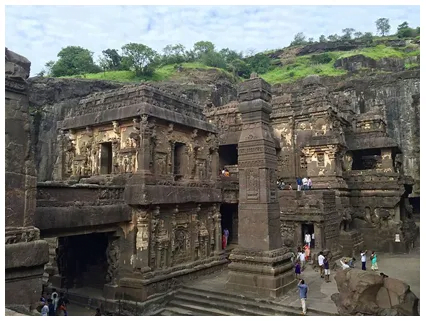
The Monolithic Kailash Temple at Ellora was built by the Krishna I.
Govinda II (774–780 AD)
He left the administration to his younger brother named Dhruva Dharavarsha. Apart from his commitment to exotic joys and an intrusion of Vengi and the ensuing annihilation of Eastern Chalukya ruler Vishnuvardhana IV (when his dad Krishna I was still the Rashtrakuta emperor), very little is thought about Govinda I.
Dhruva (780-793)
Dhruva defeated Gurjara Pratihara King Vatsyaraja, the Pallavas of Kanchi and the Pala King Dharmapala of Bengal.
He is the most notable ruler of the Rashtrakut dynasty.
The Dhulia grant of 779 and Garugadahalli inscription of 782 proclaim Dhruva the emperor.
Govinda III (793-814)
Govinda III son of Dhruva succeeded the throne.
The Most successful emperor of the Rashtrakut dynasty
Govinda III conquered from Cape Comorin in the south to Kannauj in the north, from Banaras in the east to Broach.
He defeated the great Gurjara King Nagabhatta II.
Pala King Dharmapala and his protege Charayudh sought the help of Govinda III.
His kingdom spread up to the Vindhyas and Malava in the north and the river Tungabhadra to the south.
Amoghavarsha I (814- 878)
Also known as Sarva (Amoghavarsha I)
He was one of the greatest rulers of the Rashtrakuta tradition.
Amoghavarsha I set up a new capital at Manyakheta (now Malkhed in Karnataka State).
Broach became the best port of the kingdom during his reign
Amoghavarsha wrote Kavirajamarga, a landmark literary work in the Kannada language
He was converted into Jainism by Jinasena, a Jaina monk, author of Adipurana.
Suleman, an Arab merchant, in his account called Amoghavarsha I as one of the four greatest kings of the world.
Indra III was married to princess Vijamba of the Kalachuri dynasty of central India (Chedi)
His Jain general Sri Vijaya (who was also a poet) won may wars for his king
Govinda IV
He patronised Kannada poet Ravinagabhatta.
Krishna III (939–967)
The last powerful and efficient king of the Rashtrakuta dynasty.
He also succeeded in conquering Tanjore and Kanchi.
Krishna III defeated the Cholas decisively in a battle of Takkolam in the North Arcot district.
He patronise the famous Kannada poets Sri Ponna, who wrote Shanti purana, Gajankusha, also known as Narayana, who wrote on erotics, and the Apabhramsha poet, Pushpadanta who wrote Mahapurana
We can know about Krishna III from Atakur inscription
Decline Rashtrakuta Dynasty
In 972 during the rule of Khottiga Amoghavarsha, the Paramara King Siyaka Harsha attacked and plundered the capital Manyakheta
The Rashtrakuta King Karka II was defeated and deposed by Taila or Tailapa II, the Chalukya king of Kalyani.
With the fall of the Rashtrakuta dynasty, their feudatories declared independence.
Rasjtrakuta Dynasty Administration
Rashtrakuta kingdom was divided into Rashtras (provinces) – controlled by rashtrapatis.
Rashtras divided into Vishayas or districts, governed by Vishayapatis.
Subdivision was Bukti, consisting of 50 to 70 villages under the control of Bhogapatis.
Village headmen carried on village administration.
Village assemblies played a significant role in the village administration.
Art, Culture and Literature
The Rashtrakuta rulers were great patrons of learning. Kannada and Sanskrit literature made great progress during their reign.
The three gems of ancient Kannada literature –Pampa, Ranna, Ponna were patronised by Rashtrkuta kings. They wrote the following books in Kannada
Pampa- Adipurana, vikramarjuna vijaya
Ranna- Gadhayudha
Ponna- Shantipurana
Amoghvarsha wrote Kavirajamarga, first book on poetics in kannada
Mahaveeracharya , a mathematician , wroteGanithasarasangraha in sanskrit.
Halayudha wrote Kavirahasya in Sanskrit.
The Rashtrakutas constructed surely understood Jain temples at areas, for example, Lokapura in Bagalkot locale and their reliable feudatory, the Western Ganga Dynasty, assembled Jain landmarks at Shravanabelagola and Kambadahalli.
Lord Amoghavarsha I was a follower of the Jain acharya Jinasena.
Ellora, Ajantha and Elephanta are centres of their art.
Architecture
They built structural temple , cave temple and Basadis. Ellora, Ajantha and Elephanta are centres of their art.
Kailasa Temple:
Kailasa Temple:
it was built by the 8th century Rashtrakuta King Krishna I between the year 756 and 773 AD. Cave 16, known as the Kailasha temple, is a particularly notable cave temple in India as a result of its size, architecture and having been entirely carved out of a single rock.
Other shrines carved from the same rock are dedicated to Ganga, Yamuna, Saraswati, the ten avatars of Vishnu, Vedic gods and goddesses including Indra, Agni, Vayu, Surya and Usha, as well as non-Vedic deities like Ganesha, Ardhanarishvara (half Shiva, half Parvati), Harihara (half Shiva, half Vishnu), Annapurna, Durga and others.
The scenes of Ramayana were also depicted on the walls.
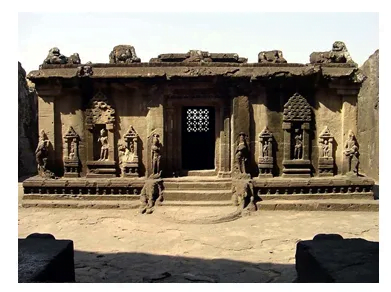
Dasavathara cave:
Dasavathara cave:
Cave 15, Dashavatara Cave is one of the finest at Ellora. The two storeyed temple contains mesmerising Shiva Nataraja and a Shiva emerging from Lingam while Vishnu and Brahma pay homage. finest relief of this cave is the one depicting the death of Hiranyakashipu, where Vishnu in man-lion (Narasimha) form, emerges from a pillar to lay a fatal hand upon his shoulder.
Other reliefs in Cave 15 include the Gangadhara, marriage of Shiva and Parvati, Tripurantika of Shakti tradition, Markendeya, Garuda, aspects of life, Nandi in mandapa, dancing Shiva, Andhakasura, Govardhanadhari, Gajendravarada and others.
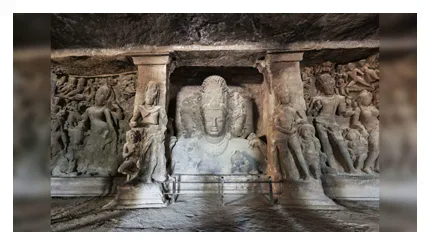
Elephanta cave:
Elephanta cave:
Elephanta, which is an island 6 miles from Mumbai has 7 caves.The Portuguese after seeing the large elephant named it elephant. The sculptural art of Rashtrakutas reached its zenith in this place.
The sculptures such as Nataraja and Sadashiva excel even that of the Ellora sculptures in beauty and crafsmanship. Ardhanarishvara and Maheshamurti are the other famous sculptures.
The most imposing figure of this temple is Trimurthi It is said to represent the three aspects of Shiva as creator, preserver and destroyer. It is a UNESCO world heritage site.
Religion:
Rashtrakuta rulers had great quality of religious tolerance.
The worship of Shiva and Vishnu was popular during the Rashtrakuta reign. The famous rock-cut Shiva temple at Ellora was built by Krishna I.
Jainism was patronized by laters rulers like Amoghavarsha. He was also staunch devotee of Kolhapur Mahalaxmi .
Buddhism had declined and its only important centre was at Kanheri.
Chapter 12
Gurjara Pratihara Dynasty (725-1036)
22 Nov 2026 Sagar Charpe
UPSC CSEState PSCSSC CGLRailways
The geographical name of Gujarat is supposed to be derived from Gurjara. The literary meaning of Pratihara is ‘door keeper.’ The Gurjara Pratihara dynasty ...
• Key concept: Gurjara Pratihara Dynasty (725-1036)
• Essential for UPSC CSE Prelims, State PSCs, SSC CGL & Railway exams.
• Comprehensive analytical coverage and factual pointers provided below.
The geographical name of Gujarat is supposed to be derived from Gurjara. The literary meaning of Pratihara is ‘door keeper.’
The Gurjara Pratihara dynasty kings were followers of Hinduism. It is believed that their ancestor Lakshmana served as a doorkeeper to his brother Rama.
They ruled between mid-8th and 11th century A.D. over northern and western India.
The Pratiharas stood as a fortification of India’s defence against the hostility of the Muslims from the days of Junaid of Sind (725. A.D.) to Mahmud of Ghazni.
Capital of Gurjara Pratihara dynasty was first at Ujjain and later at Kannauj.
Colonel James Todd wrote “Annals of Rajputana” or “ Rajasthan Kathavali”, According to James Todd Rajputs were descendants of HUNs. Somadeva Suri's “Kathasaritha Sagara” also gives details of Rajputs. Rashtrakuta poet Pampa also mentions Gujara in his book.
Rulers:
Bhoja
The Gwalior inscription mentioned the early history of the family founded by King Bhoja in the 7th century.
Nagabhatta I (725-740)
Nagabhatta is the realfounder of the Gurjara Pratihara dynasty. He established the capital at Avanti in Malwa.
He came into conflict with Rashtrakuta king Dhruva (tripartite warfare for Kannauj)
Junaid, another Arab commander defeated by him in Battle of Rajasthan.
Vatsaraja (780–800)
Nagabhtta was followed by Vatsaraja.
Vatsaraja captured Kannauj and came in direct conflict with the Palas of Bengal. He defeated Dharmapala.
In 786 AD the Rastrakuta King Dhruva defeated him.
Nagabhatta II (805-33)
Nagabhatta was initially defeated by Rastrakuta King Govinda III but later recovered and captured Kannauj.
He is best known for rebuilding the Somnath Temple in 815. Somnath Temple was destroyed by the Arab armies of Junayad in 725 AD.
This was a large structure of Red Sandstone which was again destroyed in 1024 by Mahamud of Ghazni.
Mihirabhoja (836-85)
Mihirabhoja ruled long for 46 years. He defeated Rashtrakuta king Krishna-II and captured the region of Malwa and Gujarat.
Mihirabhoja was a devotee of Vishnu, and adopted the title of ‘Adivaraha.’
Mihirbhoj was mentioned by Arab travellers. Abu Suleman called him king Juzr, al-masudi called king Baura.
Mahendrapala (885-908)
Son of Mihirabhoja, was also known as ‘Mahendrayudha’, and ‘Nirbhayanarendra.’
Rajashehara, Sanskrit poet was in his court.
Mahipala
Arab scholar, Al-Masudi, visited his court in 915-916.
Rajyapala
The last king Rajyapala was defeated by Krishna 3 of Rashtrakuta and Ghazni Mohammed.
Decline of the Pratihara Dynasty
The Rashtrakuta king, Indra-II again attacked Kanauj between A.D. 915 and A.D. 918 and destroyed it.
Krishna III was another Rashtrakuta ruler who invaded north India in about A.D. 963.
He defeated the Pratihara rulers. This led to the decline of the Gurjara Pratihara Empire.
Rajyapala was the last Gurjara Pratihara king. In his time empire was reduced to Kanauj and nearby areas.
The Pratihara power came to an end after Mahmud of Ghazni attacked the kingdom in 1018 A.D.
This led to fragmentation of Rajput
fragmentation of Rajput
Architecture
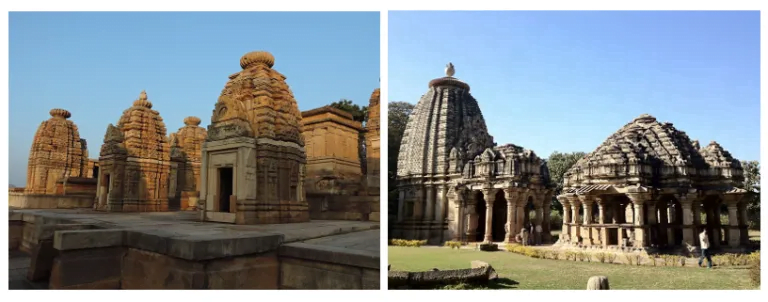
There are notable examples of architecture from the Gurjara-Pratihara era, including sculptures and carved panels. They started Maru- Gujara style of architecture.
Bateshwar Hindu temples complex: Located near Gwalior(MP) Dedicated to Shiva, Vishnu and Shakti.
Baroli temple complex
Bateshwar Hindu temples complex & Baroli temple complex
Chapter 13
Chola Dynasty (848-1279)
22 Nov 2026 Sagar Charpe
UPSC CSEState PSCSSC CGLRailways
The Chola dynasty was a Tamil dynasty in southern India. They are one of the longest-ruling dynasties in history. The earliest references to the Chola dyna...
• Key concept: Chola Dynasty (848-1279)
• Essential for UPSC CSE Prelims, State PSCs, SSC CGL & Railway exams.
• Comprehensive analytical coverage and factual pointers provided below.
The Chola dynasty was a Tamil dynasty in southern India. They are one of the longest-ruling dynasties in history. The earliest references to the Chola dynasty can be traced to Sangam Age.
The Heartland of the Chola kingdom was the valley of the Kaveri River.
More than 10,000 inscriptions engraved on copper and stone form the primary sources for the study of Chola history.
Literary sources, such as Tamil literature flourished during this period. The rise in bhakti saints and compilation of hymns reflect sociocultural features of that period Muvarula, and Kamba Ramayanam, the great epic, belong to this period
Chola Dynasty (848-1279)
Chola Dynasty Kings
Medieval Cholas
Vijayalaya Chola
848-871(?)
Aditya I
871-907
Parantaka Chola I
907-950
Gandaraditya
950-957
Arinjaya Chola
956-957
Sundara Chola
957-970
Uttama Chola
970-985
Rajaraja Chola I
985-1014
Rajendra Chola I
1012-1044
Rajadhiraja Chola
1018-1054
Rajendra Chola II
1051-1063
Virarajendra Chola
1063-1070
Athirajendra Chola
1067-1070
Chalukya Cholas
Kulothunga Chola I
1070-1120
Vikrama Chola
1118-1135
Kulothunga Chola II
1133-1150
Rajaraja Chola II
1146-1163
Rajadhiraja Chola II
1163-1178
Kulothunga Chola III
1178-1218
Rajaraja Chola III
1216-1256
Rajendra Chola III
1246-1279
List of Chola kings
Vijayalaya Chola (848–871)
Vijayalaya was the founder of the Chola Dynasty.
He captured Tanjore from Muttarayar, an ally of the Pandyas, around 850 AD.
He founded the temple of Nishumbhasudini (Durga) in Thanjavur, Tamil Nadu.
They were feudatories of the Pallavas.
Aditya Chola (891–907)
Aditya Chola defeated and murdered his Pallava overlord Aparajita and occupied the entire Tondaimandalam.
He conquered the Kongu country as well.
He is said to have built Siva temples on both banks of the Kaveri river.
Parantaka I (907–950)
At the start of his reign, Parantaka I invaded the Pandya territory.
Parantaka I assumed the title of ‘Maduraikonda’ (Conqueror of Madurai).
Uttaramerur inscription tells about his region.
Krishna Ill, one of the greatest Rashtrakuta rulers, defeated Parantaka in the famous battle of Takkolam (near Arkonam) in 949 AD.
Rajaraja Chola I (985–1014)
Rajaraja Chola I (985–1014)
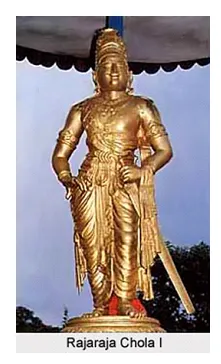
The real greatness of the Chola kingdom began with Rajaraja Chola I.
He is also known as Arumolivarman.
Rajaraja Chola I defeated a confederation of the three kingdoms of Pandya, Kerala and Ceylon.
He destructed the Anuradhapura after defeating north Ceylon.
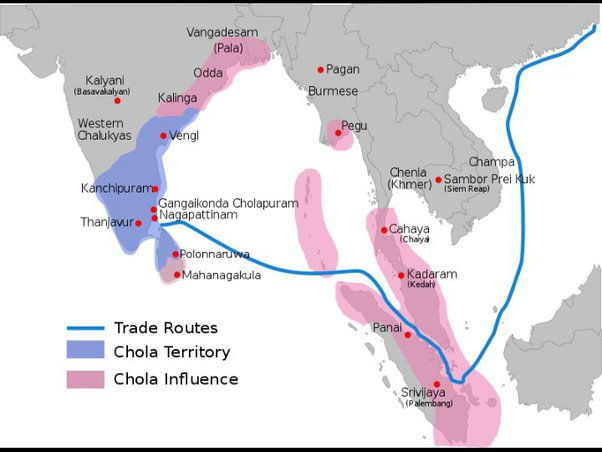
Rajaraja Chola I also annexed the Maldives probably for securing the trade routes of the Indian Ocean.
He built the Famous Rajeshwara / Brihadeshwara temple at Thanjavur (Dravida Style) in 1010 AD.
Rajaraja Chola I encouraged Sailendra ruler of Srivijaya (South-East Asia), to build a Buddhist vihara at Nagapattinam.
The vihara was called ‘Chudamani Vihara‘.
Rajendra Chola I (1012–1044)
Rajendra I conducted the most striking military exploit after his accession in 1023 by his expedition to northern India.
Rajendra Chola defeated southern Srilanka & annexed the whole Cylon (Srilanka).
He moved to the north & Captured Bengal defeating Mahipala I.
Rajendra Chola assumed title of Gangaikonda Chola.
He conquered the Malay Peninsula & converted the Bay of Bengal to Chola lake for trading purposes with China.
He founded the new capital of the Chola dynasty Gangaikondacholapuram at Kaveri valley.
Rajendra Chola also built the famous Gangaikondachola Temple (Dravida style) in the new capital of the Chola dynasty.
In 1025, Rajendra Chola sent an expedition to Sumatra and Malaya and defeated the ruler of the Srivijaya empire.
He established many educational institutes in his empire, for this he got the title Pandita chola.
In 1015 and 1033 Rajendra Chola I sent diplomatic missions to China.
Rajadhiraja (1044–1054)
Rajadhiraja suppressed rebellions in Pandya, Kerala and Ceylon kingdoms.
He performed the virabhisheka.
It was the coronation of the victory there and assumed the title of ‘Vijayarajendra’.
Kulottunga I (1070–1120)
Kulottunga I is the son of Rajaraja Narendra of Vengi and Chola princess Ammangadevi.
He united the Vengi kingdom with the Chola kingdom.
Kulottunga I sent a large embassy of 72 merchants to China.
Suryavarman Il, the builder of Angkor Wat, sent a precious jewel to Kulottunga who then donated it to the temple of Chidambaram in 1114 AD.
Last Chola dynasty king was Rajendra Chola III (1246–1279).
Rajendra III (1246-1279)
He was the last Chola king who was defeated by Jatavarman Sundarapandya II. On the ruins of the Chola empire, Pandya and Hoysala kingdoms came into existence.
Chola Administration
King: The emperor or king was at the top of the administration. All authority rested in his hands. He often went on tours in order to keep better touch with the administration.
Chola rulers appointed Brahmins as spiritual preceptors or rajagurus (the kingdom’s guide). Rajaraja I and Rajendra I mention the names of rajagurus and Sarva-sivas in their inscriptions.
Chola kings granted huge estates of land to Brahmins as brahmadeyams and caturvedimangalams..
Provinces: The Chola Kingdom was divided into Mandalams or provinces.
Mandalams were further divided into Towns and Villages.
Autonomous administration for towns and townships, known as Tankurrams.
Town autonomy was quite similar to village autonomy and both were administered by assemblies.
In the sabha, membership was restricted to the Brahmins of the village or was found exclusively in a village gifted to Brahmins.
The nagaram was found more commonly in trade centres such as cities and towns.
Military administration: The Cholas maintained a large army consisting of infantry, cavalry and elephants which were called the three limbs of the army. The venetian traveller Marco Polo says that all the bodyguards of the king burnt themselves on the funeral pyre of the dead king.
Public Works in Chola Kingdom
Extensive irrigation works, roads and cities were made in the time of Chola dynasty.
They made an artificial lake (16 miles in length) near Gangaikonda Cholapuram, and constructed dams across the Kaveri river for irrigation purposes.
Trade & Diplomacy of Chola Dynasty
Chola Dynasty Coins
Merchants, who operated locally were called swadeshi and those who operated internationally called nanadesi.
The merchants had their own settlements (nagara) with autonomous institutions of local government.
The great ports (pattinam) also had their guilds and autonomous institutions.
They financed local development projects, and the construction of temples, and lent money to the Chola kings.
Among the most powerful guilds were the Ayyavole and the Manigramam. Ayyavole extended to West Asia, while the Manigramam concentrated on trade with South-East Asia.
Religion
Chola Dynasty Religion
Chola rulers were ardent Saivite. Shiva was the preeminent god for the Cholas and he was represented in two forms. The iconic form of Siva was Lingodhbhava, and the Nataraja idol was the human form.
A highly evolved philosophical system called Saiva Siddhanta was founded during this period.
Kulathunga Chola was ardent shaivite. He persecuted vaishnavites. Bhakti saint Ramnujacharya left Srirangam and settled in Melkote,Karntaka.
Literature
Tamil and Sanskrit languages flourished during the Chola period. Tamil literature witnessed golden age.
Few Tamil literary works are:
Kamban Ramayan by Kamban (Tamil Ramayan)
Periyapuranam or Tiruttondarpuranam by Sekkilar
Kalladam by Kalladanar
Nalavenba was written by Pugalendi etc.
Kesava swami composed the Sanskrit work nannaranava samkshevam.
Architecture
Chola art saw culmination of dravida temple art resulting in most sophisticated buildings.
They used material of stone instead of bricks due to its greater durability. Neatly detailed frescos including birds, dancing figurines and other pictorial stories from Puranas. Some temples have potraits of the Kings and queens themselves.
The temples had a Garbhaghriha(Deity room); Vimana(Brihadeshwara Temple); Shikhara(Stone weighing 90 tonne); Mandap. Metal Art(Nataraja at Chidamabaram Temple) Lofty Gates
Examples include Brihadeswara , Vijayalaya temples
The Grand Temple of Tanjavur, known as Rajarajisvaram and Brihadishvarar Temple, stands as an outstanding example of Chola architecture, painting, sculpture and iconography. Gangaikonda Cholapuram: In commemoration of his victory in North India, Rajendra I built GangaikondChozhapuram on the model of Brihadisvarar temple
Chola bronze sculptures
The cire-perdu or ‘lost-wax’ process for casting was learnt as long ago as the Indus Valley Culture. Along with it was discovered the process of making alloy of metals by mixing copper, zinc and tin which is called bronze. The bronze casting technique and making of bronze images of traditional icons reached a high stage of development in South India during the medieval period.
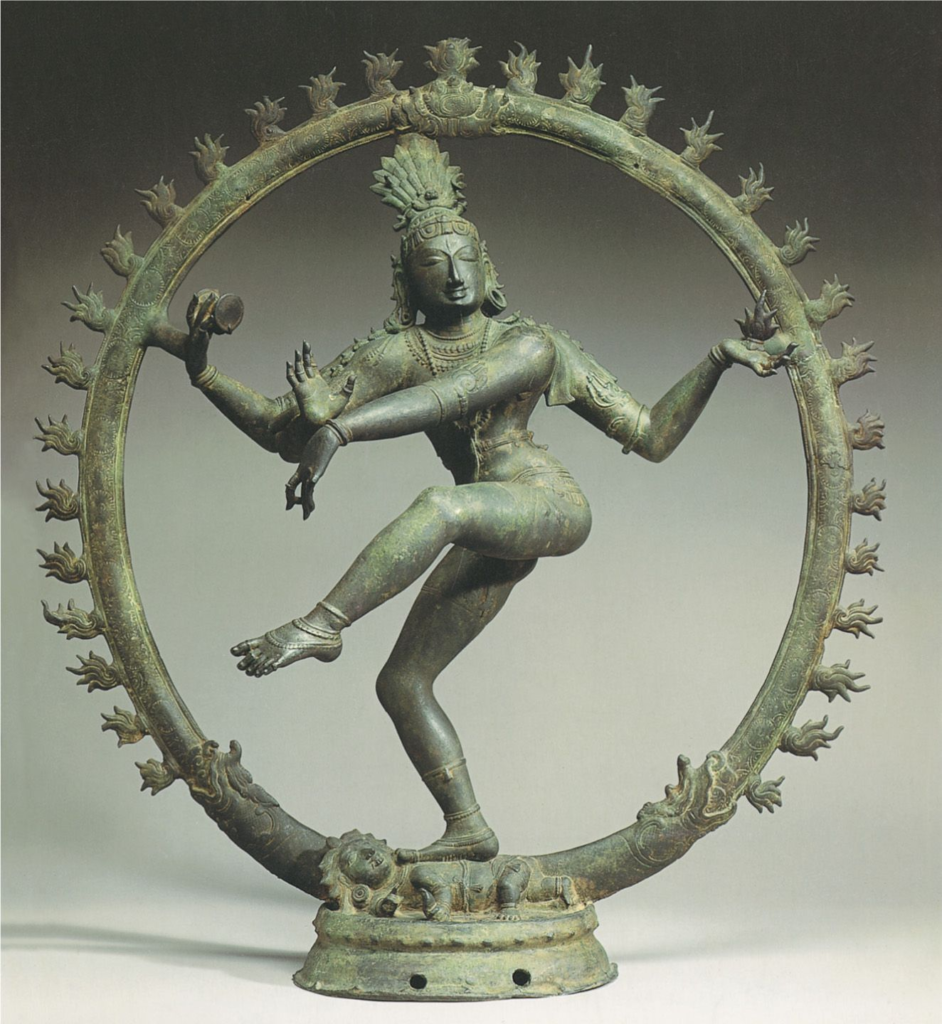
The well-known dancing figure of Shiva as Nataraja was evolved and fully developed during the Chola Period and since then many variations of this complex bronze image have been modelled.
A wide range of Shiva iconography was evolved in the Thanjavur (Tanjore) region of Tamil Nadu. The ninth century kalyanasundara murti is highly remarkable for the manner in which Panigrahana (ceremony of marriage) is represented by two separate statuettes.
Shiva with his extended right hand accepts Parvati’s (the bride’s) right hand, who is depicted with a bashful expression and taking a step forward.
The union of Shiva and Parvati is very ingeniously represented in the Ardhanarisvara Murti (in fig) in a single image.
Chola bronzes are the most sought-after collectors’ items by art lovers all over the world.
FAQs
Who is the famous King of the Chola dynasty?
Rajaraja- I was the greatest ruler of the Chola dynasty. He defeated Cheras at Thiruvananthapuram to control the trade with Arabs.
Who ended the Chola dynasty?
The Chola dynasty came to an end in 1279, when King Maravarman Kulasekara Pandyan I defeated the last Chola king, Rajendra Chola III, and established Pandya's rule.
Chapter 14
Bhakti Movement
22 Nov 2026 Sagar Charpe
UPSC CSEState PSCSSC CGLRailways
There is a close relationship between socio-political and economic trends and religious activity, the bhakti movements cannot be seen in isolation. The 14t...
• Key concept: Bhakti Movement
• Essential for UPSC CSE Prelims, State PSCs, SSC CGL & Railway exams.
• Comprehensive analytical coverage and factual pointers provided below.
There is a close relationship between socio-political and economic trends and religious activity, the bhakti movements cannot be seen in isolation.
The 14th and 15th centuries saw the decline of the powerful and centralized state.
Economic Front
Artisans were coming from the ranks of people outside the professions
They were not accepted as equals among the Indian artisans.
Merchants also did not find a place in the social hierarchy.
Religious Equality
People opposed to the traditional, rigid, elaborate and meaningless rituals that had crept into the society.
Social Participation
The people who did not fit into the broad varna set-up were termed as the chandalas or the out-castes
Characteristics of Bhakti & Sufi Movement
Term ‘Bhakti’ symbolises ‘devotion or passionate love for the Divine’.
Focused on singular devotion, mystical love for God
These saints spoke of a direct relationship between man and god
They had no desire to set up a separate religion, nor did they have blind faith in any of the sacred scriptures.
The bhakti saints preached in simple vernaculars
They came from the lower sections of society and worked for their living.
Most of the bhakti saints were artisans by origin or belonged to the class of less prosperous cultivators
Phases of Bhakti Movement
1st phase
The first phase can be traced back to the origin of the Bhagavata cult
In south India, Bhakti grew from a religious tradition to a popular movement in the 7th and 12th century CE
2nd phase
The second phase, spanning nearly four centuries, extended from the 13th to the 16th centuries
They were not linked with any particular religious creed and did not believe in rituals and ceremonies.
They condemned polytheism and believed in one god.
Greatly emphasized on the fundamental unity of all religions.
1st phase of Bhakti Movement
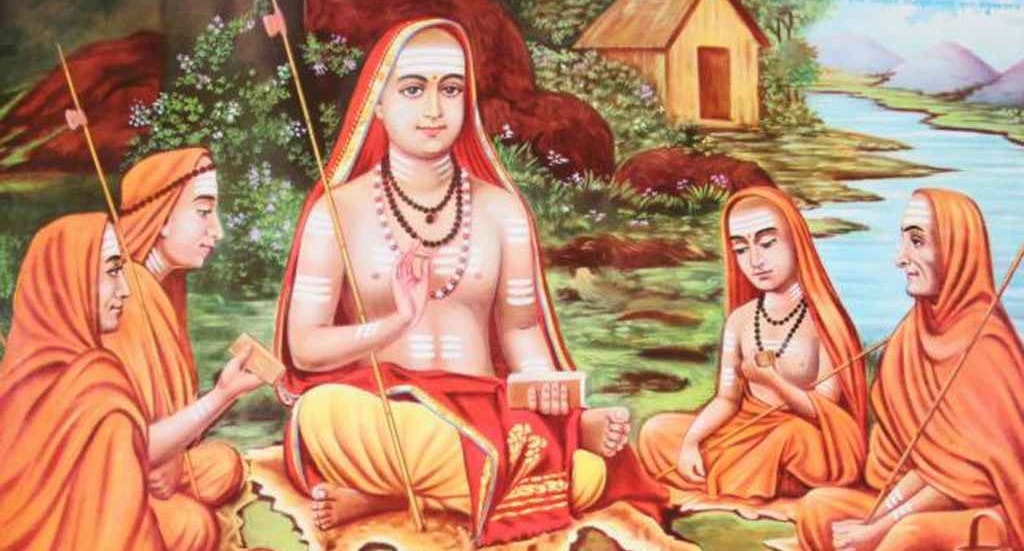
Sankaracharya
Sankaracharya
Hindu revivalist movement of the 9th century
He was born in Kaladi (Kerala)
he propounded the Advaita (Monism) philosophy and Nirguna brahman (god without attributes).
In Advaita, the reality of the world is denied and Brahman is considered as the only reality.
According to him, gyaan (knowledge) alone can lead to salvation.
He wrote commentary on the Bhagvat Gita, Upadesh Shastri, Vivek Chudamani, Bhaja Govindum Stotra
Established mathas at Sringiri, Dwarka, Puri, and Badrinath.
Ramanuja
Ramanuja
Born at Sriperumbudur near modern Chennai in the 12thcentury.
He opposed the mayavada of Shankara
He advocated the philosophy of Vishihsta Advaitavada (qualified monism),
He founded the Sri Vaishnava sect.
According to him, God is Saguna Brahman.
He wrote Sribhashya, Vedanta dipa, Gita Bhasya, Vedantasara
Madhavacharya
In the 13th century, Madhava from Kannada region
He propagated Dvaita or the dualism of the Jivatma and Paramatma.
He also founded the Brahma Sampradya
Nimbraka
Nimbraka propounded the Dvaita advaita philosophy and the philosophy of Bheda Abheda
Preacher of Vaishnavite Bhakti in the Telangana region.
Worshipper of Krishna and Radha and established his ashrama in Braja (Mathura).
He also founded the Sanak Sampradaya
Vallabhacharya
Born in Benaras in the 15th century and lived at the court of Krishnadeva Raya.
He propounded the Shudhadvaita (pure monism)
He was a preacher of the Krishna cult.
Its philosophy is Pushtimarga.
He founded the Rudra Sampradya
Surdas was the disciple of Vallabhacharya who was blind and popularized the Krishna cult in north India.
Vidyapati
Vidyapati was a 14th century Maithili poet known for his
His poetry dedicated to Shiva
Bhakti movement in Maharashtra
Jnaneswara or Jnanadeva
A 13th century pioneer bhakti saint of Maharashtra
commentary on the Bhagvat Gita called Jnanesvari
Arguing against caste distinctions
Known as Maharashtra dharma
Namdeva
He was a poet-saint from Maharashtra belonging to the 14th century
He was greatly influenced by Islam
One the five revered gurus in the Dadu panth tradition, other four being Dadu, Kabir, Ravidas, and Hardas
Sant Eknath
He was a Marathi saint Varkari sampradaya, belonging to the 16th century.
In the development of Marathi literature, Eknath is seen as a bridge between his predecessors Dnyaneshwar and Namdeva and the later Tukaram and Ramdas.
He introduced a new form of Marathi religious song called Bharood.
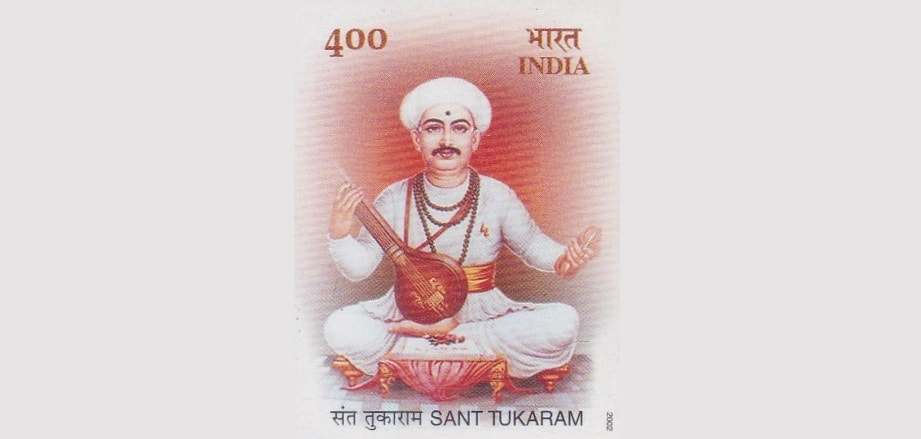
Tukaram
Tukaram was a 17th century poet-saint in Maharashtra
He was a Sudra by birth.
Tukaram is known for his Avangas (dohas)
He was a contemporary of Shivaji and was responsible for creating a background for Maratha nationalism, ‘Parmaratha’.
Ramdasa
He was born in 1608 and was the spiritual guide of Shivaji.
He wrote Dasabodha, combining his vast knowledge of sciences and arts with the principles of spiritual life.
2nd phase of Bhakti Movement
Ramananda
Ramananda lived in the 15th century, born in Allahabad
He was a follower of Ramanuja.
Later, he founded his own sect and preached his principles in Hindi at Benaras and Agra.
He considered it to be the linkbetween the SouthIndianBhakti and NorthIndianVaishnavaBhakti traditions
He was the founder of the Ram cult in north India.
Ramananda like the monotheist bhakti saints, also rejected caste hierarchies
He was against the rigidity of the Hindu philosophy
His major contribution was the use of the common language
The teachings of Ramananda created two distinct schools among his disciples and the later bhakti saints.
Schools
Nirguna
Nirguna school represented by Kabir
Kabir preached absolute abolition of caste and seriously questioned the authority of the Vedas.
He also made an attempt to learn from Islam and tried to establish a synthetic movement which made him to declare the famous dictum that Ram and Rahim are equal.
Some of the other important saints Nanak, Dadu Dayal, Raidas, etc.
These philosophers denied both the Hindu and the Muslim ideas of God and even equated them by stating that they were identical.
Saguna
Suguna tried to enrich the religion of Hinduism and also preserved the authority of the Vedas and did not wish to break away from the past.
Chaitanya, Shankardeva, Surdas, Mirabaiand Tulsidas are some of the most important saguna saints.
Nirguna School
Kabir (1398 – 1518)
Kabir was a Bhakti poet whose verses are found in the Sikh holy scripture, Adi Granth.
He was born near Benares to a Brahman widow, but was brought up by a Muslim couple
Kabir laid great emphasis on the equality of man before God.
His dohas and sakhi (poems), whose collection is found in the Bijak
Other writings are ‘SakhiGranth’, ‘AnuragSagar’ and ‘KabirGranthawali’
Dadu Dayal is one of the major representatives of the Nirguna Sant
He was from Gujarat, who spent the best part of his spiritual life in Rajasthan.
‘Dadu’ means ‘brother’, and ‘Dayal’ means ‘the compassionate one’
Emperor Akbar was one of his followers.
His followers, Dadupanthis, expose their dead like the Parsis.
Saguna School
Chaitanya Mahaprabhu (1436 – 1533)
Well-known saint, ascetic Hindu monk, and social reformer of Bengal
He popularised the Krishna cult in the 16th century.
Popularised the Sankirtan/Kirtan system
biography of Chaitanya was written by Krishnadas Kaviraj.
Surdas (1483—1563)
He popularized the Krishna cult in UP
He was the author of Sur Sagara, Sur Sarawali
Mirabai (1498—1569)
Hailing from the Sisodia dynasty of Chittor
She was a great devotee of Krishna
Popularised his cult in Rajasthan through her songs.
Sankaradeva (1463—1568)
A contemporary of Chaitanya, he spread Vaishnava bhakti in Assam.
Tulsidas (1532—1623)
He was a worshipper of Rama
Tulsidas composed the famous Ramcharit manas in Hindi
Expounding the various aspects of Hindu dharma.
Narsingh Mehta
Saint from Gujarat who wrote songs in Gujarati depicting the love of Radha–Krishna.
Author of Mahatma Gandhi’s favorite bhajan –“Vaishanava jan ko”
Saint Tyagaraja
He was one of the greatest composers of Carnatic music,
Saint Tyagaraja composed thousands of devotional compositions, most in Telugu and in praise of Lord Ram.
He was a prolific composer and composed the famous Pancharatna Kritis
Sufism in India
The word ‘sufi’ is derived from ‘suf’, which means wool in Arabic, it also means ‘purity’,Sufism or mysticism emerged in the 8th century,The early known Sufis were Rabia al-Adawiya, Al-Junaid, and Bayazid Bastami.Well-developed movement by the end of the 11th century.Al Hujwiri, is regarded as the oldest Sufi in the sub-continent.By the 12th century, the Sufis were organised in Silsilahs
Lower classes and women were raised to a position of greater importance.
Interaction and unity among the two communities, Hindu and Muslim
New Languages Emerged
Hindi
The Hindi language originated between the 7th and 10th centuries.
The first stage of Hindi literature, known as adi kala (1206—1318)
Narapati Nalha and Amir Khusrau were the two major poets of the adi kala.
The second stage, known as bhakti Kala (1318—1643
Urdu
It emerged due to the interaction of Persian and Indian languages in the military camps of Alauddin Khalji
The Deccan was the cradle of Urdu and the language flourished first in the kingdoms of Bijapur and Golconda
Amir Khusro interspersed it with Persian as the first school of ghazal poets emerged in the Deccan during the 15th and 16th centuries
The works of Vali reached Delhi in 1720, the town was in an uproar and,within a decade, Urdu became the language of poetry
Oriya
Although Oriya originated in the 8th century, major works in the language appeared only in the 13th and 14th centuries.
Important Oriya writers were Sarladasa (Mahabharata in the 14th century),
Bengali
The first stage covered the period between the 10th and 12th centuries.
Its literature was mainly in the form of folk songs and influenced by the philosophy of the Sahaja cult
Gujarati
The first phase, from the 13th to 15th centuries
It was marked by two main forms—the prabandha (narrative poem) and the mukta (shorter poem)
Important poets of this phase were Sridhara and Bhima
Marathi
Marathi literature emerged in the latter half of the 13th century.
A major contribution was made by the saint poets of the Natha cult (founded by Gorakhanatha) such as Mukundaraja
Tamil
The literature of the Alvars or Vaishnava saints was known as Prabhanda, the most important among them being Nalayiram
Telugu
The group of poets called kavitraya were Nannaya (1Ith century), Tikkana (13th century) and Yerrapragada(13th and 14th century).
They translated the Mahabharata into Telugu.
Kannada
The earliest extant work in Kannada is Kavirajamarga by Rashtrakuta Amoghavarsha I.
Malayalam
The earliest literary work in Malayam is Unnunili Sandesam, a work by an unknown writer of the 14th century
Ramanuja Elluttoccan (greatest of all) wrote Harinamakirtanam, Bhagavatam Kilippattu
FAQs
Who started Bhakti movement?
In the 14th and 15th centuries, Ramananda, Kabir and Nanak emerged as the great proponents of the Bhakti cult.
Why is the Bhakti movement important?
The Bhakti movement emphasized the unity of all the different Hindu gods, the surrender of the self to God, equality and brotherhood of all people, and devotion to God as the number one priority of life. One of the most important impacts of the Bhakti movement on Indian society was the rejection of the caste system.
Where is Bhakti movement started?
The Bhakti movement started in the 7th Century-8th Century in Kerala and Tamil Nadu. Later it spread to Karnataka, Maharashtra, and it reached North India in the 15th Century.
What caused the Bhakti movement?
The Bhakti movement started in the South in response to the conquest of northern India by Muslim rulers. From 8th century A.D. to 15th century A.D. this movement gathered its momentum in the south. The earliest reformer-saint in South was Adi Shankaracharya who had a unique success.
Who was the first Bhakti saint?
Ramananda (1360-1470) was the first Bhakti saint to use Hindi for the propagation of his message. Q. 26.
Who were the propagators of the Bhakti Movement?
One of the leaders of this Hindu revivalist movement was Shankaracharya, a great thinker and a distinguished philosopher. And this movement was propounded by others like Chaitanya Mahaprabhu, Namadeva, Tukaram, Jayadeva.
Chapter 15
Sufism in India
22 Nov 2026 Vinay Yadav
UPSC CSEState PSCSSC CGLRailways
Sufism was a liberal reform movement within Islam. It had its origin in Persia and spread into India in the 11th century. Most of the Sufis (mystics) ...
• Key concept: Sufism in India
• Essential for UPSC CSE Prelims, State PSCs, SSC CGL & Railway exams.
• Comprehensive analytical coverage and factual pointers provided below.
Sufism was a liberal reform movement within Islam. It had its origin in Persia and spread into India in the 11th century. Most of the Sufis (mystics) were persons of deep devotion who disliked the display of wealth and degeneration of morals following the establishment of the Islamic empire.
The word ‘sufi’ is derived from ‘suf’, which means wool in Arabic, it also means ‘purity’,
Sufism or mysticism emerged in the 8th century,
The early known Sufis were Rabia al-Adawiya, Al-Junaid, and Bayazid Bastami.
Well-developed movement by the end of the 11th century.
Al Hujwiri, is regarded as the oldest Sufi in the sub-continent.
By the 12th century, the Sufis were organised in Silsilahs
Chisti Order
Established in India by Khwaja Muinuddin Chishti,
He moved to India after the invasion of Muhammad Ghori, and settled in Ajmer around c.1206 CE
His dargah reached unprecedented heights after the support of Mughal Emperor Akbar.
The Chisti presence in Delhi was established by Qutbuddin Bakhtiyar Kaki (the Qutub Minar is named after him)
Another sufi saint was Nizamuddin Auliya, who lived in the 14th century
Suhrawardi Silsilah
The Silsilah was founded by Shihabuddin Suhrawardi in Baghdad
It was established in India by Bahauddin Zakariya.
Naqshbandi Silsilah
This order was established in India by Khwaja Bahauddin Naqshbandi
Propagated by his successors, Sheikh Baqi Billah and Shaikh Ahmad Sirhindi
Qadri Silsilah
The Quadiriyya Silsilah, was popular in Punjab
Started during the Mughal rule under the teachings of Sheikh Abdul Qadir and his sons, Shaikh Niamtullah, Mukhdum Muhammad Jilani, and Miyan Mir, who had enrolled the Mughal princess Jahanara and her brother Dara as disciples.
Another prominent pir was Shah Badakhshani.
Importance of Sufism in India
Sufism in India has a history of over 1000 years. Muslims that arrived or resided in this country can be divided into two camps. There were the extremely religious teachers called ulemas and the fakirs who are known as Sufis today. The fakirs were generally tolerant of other religions and even had non-Islamic followers in some cases.
The main reason behind the early popularity of Sufism in India was the Khanqahs. Khanqahs were large gathering halls where followers lived with their gurus or teachers. The gathering halls also acted as community centres and were open to everyone, specifically providing support and sustenance to poor people. They also became known as a centre for spiritual learning which helped in further enhancing their popularity. As Sufis played an important role in the intellectual development of India their contributions in the field of religion and society are immense.
The Sufis also abstained from religious and communal conflicts and reached out even to the poor and marginalised communities.
FAQs
Who started Sufism in India?
Khwaja Moinuddin Chishti, a disciple of Khwaja Usman Harooni, the propounder of this order, introduced it in India. He came to India from Afghanistan with the army of Shihab-ud-Din Ghuri in 1192 AD and started living permanently in Ajmer from 1195.
What is the main belief in Sufism?
Sufism, mystical Islamic belief and practice in which Muslims seek to find the truth of divine love and knowledge through direct personal experience of God.
How many types of Sufism are there?
The four main Sufi orders – Chisti, Qadiriyya, Suhrawardiyya and Naqshbandi order were practiced in India.
Chapter 16
Sikhism
22 Nov 2026 Sagar Charpe
UPSC CSEState PSCSSC CGLRailways
Sikh Gurus Guru Nanak (1469 – 1539) Guru Nanak is the 1st Sikh Guru and founder of the Sikhism, who was also a Nirguna Bhakti Saint.He was born in a villag...
• Key concept: Sikhism • Essential for UPSC CSE Prelims, State PSCs, SSC CGL & Railway exams. • Comprehensive analytical coverage and factual pointers provided below.
Sikh Gurus
Guru Nanak (1469 – 1539)
Guru Nanak is the 1st Sikh Guru and founder of the Sikhism, who was also a NirgunaBhaktiSaint.
He was born in a village of Talwandi (now called Nankana, in Pakisthan), on the banks of the river Ravi in 1469.
Guru Nanak was opposed to all distinctions of caste.
He is also said to have met Babur.
After his death, his followers called themselves ‘Sikhs’ and a new religious sect, Sikhism, was founded.
Nanak was followed by nine Sikh gurus.
Guru Angad
The 2nd guru, started the Gurumukhi script.
He started the tradition of Mall Akhara
Guru Amardas
The 3rd guru, began the institution of langar (commonkitchen) to abolish the caste system.
Preached against the Hindu society’s sati system and advocated widow-remarriage
Asked Akbar to remove the pilgrim’s tax for non-Muslims
Guru Ramdas
4th guru, was given the site of Harmandir at Amritsar by Akbar.
Guru Ramdas also laid the foundation stone of Chak Ramdas or Ramdas Pur, now called Amritsar.
Composed the four Lawans (stanzas) of the Anand Karaj, a distinct marriage code for Sikhs.
Guru Arjan
5th guru, compiled 1st official edition of Sikh scripture Adi Granth,
Later it expanded into the Guru Granth Sahib.
Guru Arjan completed the construction of the Harmandir at Amritsar.
He installed the Adi Granth inside the new temple in 1604.
Guru Arjan was arrested asked to convert to Islam under the orders of Jahangir.
He refused, was tortured and executed in 1606.
Guru Hargobind
6th guru, who was also imprisoned by Jahangir for ten years.
Longest tenure as Guru.
He transformed Sikhs into a militant community, established the Akal Takht, and fortified Amritsar.
Defeated a Mughal army at Sangrama.
Took the title of Sachcha Padshah.
Shifted his headquarters to Kartarpur.
Guru Hargobind was the proprietor of the concept of miri and piri
Guru Tegh Bahadur
The 9th guru, was executed by Aurangzeb
Guru Gobind Singh
10th and last guru
He passed the Guruship of the Sikhs to the Guru Granth Sahib.
Established the Khalsa in 1699 at Anandpur Sahib and organised the Sikhs into a military sect.
All his sons were killed by a Mughal army at Sirhind, and he was also slain by a Pathan in revenge.
The orthodox Sikhs are also distinguished by the five kakka (the five k’s), kesa (top knot), kachha (short drawers), kara (iron bangle), kanga (comb) and kirpan (sword)
Chapter 17
Rajput Dynasties
22 Nov 2026 Vinay Yadav
UPSC CSEState PSCSSC CGLRailways
The term Rajput denotes a tribe or clan, the members of which claimed themselves as Kshatriyas belonging to the ‘solar’ or lunar’ dynasties. The Hunas, Gur...
• Key concept: Rajput Dynasties
• Essential for UPSC CSE Prelims, State PSCs, SSC CGL & Railway exams.
• Comprehensive analytical coverage and factual pointers provided below.
The term Rajput denotes a tribe or clan, the members of which claimed themselves as Kshatriyas belonging to the ‘solar’ or lunar’ dynasties.
The Hunas, Gurjaras and the other allied tribes who entered India during the 5th and 6th centuries merged themselves with the Indians, just as their predecessors, the Greeks, the Kushanas and the Sakas had done.
The Rajput dynasties formed by the social promotion of aborigines were inimical to the Rajputs descended from foreigners.
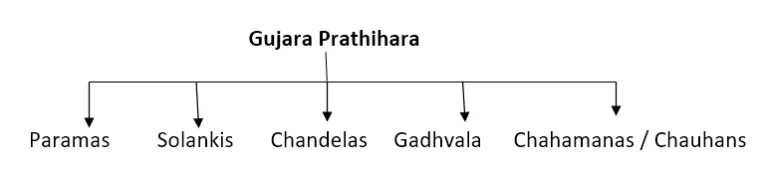
Paramara Dynasty (9th–14th Century CE)
The Paramara Dynasty (9th–14th Century CE) was a powerful Rajput clan that ruled the Malwa region in Central India. Known for their patronage of art, literature, and temple architecture, they played a pivotal role in the resistance against early Islamic invasions.
The Chalukyas or Solanki Dynasty ruled Gujarat and Kathiawar
Mularaja established an independent kingdom with its capital at Anahilapataka
Bhima I (1022–64)
His kingdom was rudely shaken by the invasion of Sultan Mahmud of Ghazni who plundered the immense riches of the famous temple of Somnatha.
The famous Dilwara temple was built at Abu in the Reign of Bhima I.
His queen Udayamati built Ran-ki vav
Karna
He built numerous temples and founded a city after his name, now represented by Ahmadabad.
Jayasimha
Scholar Hemachandra, who wrote the Siddha-Hemachandra, was in JAyasimha’s court.
Kumarapala
He embraced Jainism under the influence of Hemachandra.
Mularaja II
In 1178 Muizuddin Muhammad Ghori invaded Gujarat.
Solanki dynasty under Mularaja’s mother bravely opposed the Muslims and defeated them near Mt. Abu.
Qutub-ud-din invaded Gujarat and plundered Anahilapataka in 1197
Later Gujarat was conquered by Alauddin Khalji.
Chahamanas Dynasty
The main branch ruled in Sakambhari, modern Sambhar, in Jaipur Vasudadeva founded the main line in the middle of the 6th century
Vakpatiraja
He built at Pushkaraa temple for Siva.
Prithviraja I
He is reputed to have killed a body of 700 Chalukyas who had come to Pushkara to rob the Brahmins
Ajayaraja II
He founded the city of Ajayameru or Ajmer
Vigraharaja III
He composed the celebrated drama, Harikeli Nataka.
Among the many temples built by him at Ajmer, the Sarasvati Mandira is undoubtedly the best.
Prithviraj Chauhan
Jayachandra organised a svayamvara ceremony for the marriage of his beautiful daughter Samyukta. Prithviraj Chauhan was not invited there.
He succeeded in carrying off the Gahadvala princess by force.
Prithviraj Chauhan met Muhammad Ghori at the field of Tarain in 1190-91.
1st battle of Tarain was disastrous for the Muhammad Ghori.
Shihab-ud-din came to Tarain in 1192 practically unopposed by passing through Multan and Lahore.
One lakh soldiers were killed in the 2nd battle of Tarain, including Govindaraja, chief of Delhi.
Prithviraj Chauhan himself was taken prisoner and executed thereafter.
Prithvirajavijaya and Prithviraj Raso, written by his court poets Jayanaka and Chanda (Chand Bardai) respectively.
Gahadvalas Dynasty
The emergence of the Gahadvalas in Kanauj in the latter part of the 11th century.
The Gahadvala dynasty was founded by Yasovigraha
Chandradeva
He made Banaras the second capital
Govindachandra
Govindachandra raised Kanauj to unprecedented glory.
His minister named Lakshmidhara produced Kritya Kalpataru or Kalpadruma.
Jayachandra
Muiz-ud-din Muhammad Ghori, who, after conquering Delhi and Ajmer from the Chahamanas, advanced with a large force against Kanaujin 1193
patronage extended by him to Sriharsha, who wrote the well-known Naisadhacharita, Khandana-khanda-khadya
Adakkamalla, was deprived of his ancestral kingdom by Iltutmish
Chandela Dynasty
Chandela dynasty had rule over Bundelkhand.
The Chandela dynasty claim their descent from Chandratreya, a descendant of the Moon dynasty.
The earliest capital of the Chandela dynasty kings seems to have been at Khajuraho.
Khajuraho reached its zenith in the 10th century.
Nannuka founded the dynasty in the first quarter of the 9th century around Khajuraho in Bundelkhand.
Yasovarman
He built a magnificent temple at Khajuraho.
In the Chaturbhuja temple, he installed the image of Vishnu.
Dhanga (954-1002)
The most famous ruler of the Chandela dynasty.
Temples of Jinanatha and Vaidyanatha were also built during the reign of Dhanga
Ganda
Sultan Mahmud twice invaded his kingdom in 1019 and 1022.
Paramard
He was defeated at the hands of Prithviraj Chauhan.
In 1202, Qutub-ud-din Ibak seized and plundered the fort of Kalinjar, the strong citadel of the Chandellas.
In1309, Alauddin Khalji conquered the greater part of the kingdom.
The last known king of Chandela dynasty is Viravarman II.
Kalachuri dynasty
The Kalachuri dynasty, also known as the Haihayas, have been referred to the Epics and the Puranas.
Their earliest seat of power was possibly at Mahishmati on the bank of Narmada river.
Three Kalachuri kings- Krishnaraja, his son Sankaragana and the latter’s son Buddharaja—were known to have ruled between 550-620.
Several branches of the Kalachuris were settled in different parts of northern India.
One of them founded a principality in Sarayupara in the modern Gorakhpur district.
The most powerful, brunch ruled in the Chedi country in Bundelkhand.
The Kalachuri dynasty of Chedi, also known as kings of ‘Dahala-mandala’ had their capital at Tripuri, near Jabalpur in Madhya Pradesh.
Kokalla I
Kokalla I accession on throne in 845 AD.
He came into conflict with the Pratihara king Bhoja I and gained a victory over him.
Yuvaraja I
Poet Rajasekhara, lived in the Kalachuri court, staged the famous drama Viddhasalabhanjika.
Gangeyadeva
During his reign the Kalachuri dynasty became the greatest political power in India.
Kalachuri dynasty remained unaffected by the marauding raids of Sultan Mahmud.
He commemorated this great victory by assuming the proud title of ‘Trikalingadhipat
Karna
Atisa Dipankara, who at that time had been residing in Magadha, took the initiative in inducing Karna and Nayapala, Pala king to conclude a treaty.
Vijayasimha was the last kalachuri king of any importance.
Trailokyavarman a Chandella king defeated him and conquered the whole of the Dahalamandala.
Tomaras
The Tomaras are reckoned as one of the 36 Rajput dynasties.
According to the bardic tradition, Anangpal Tuar founded Delhi in 736 and established the Tomara dynasty.
The Tomaras ruled the Haryana country from their capital city Dhillika or Delhi.
Society Under Rajputs
Major literary works of this period
Kalhana’s Rajatarangin – ‘River of Kings’
Jayadeva’s Gita Govindam – Song of the cowherd
Somadeva’s Kathasaritasagar
Chand Bardai, the court poet of Prithviraj Chauhan, wrote Prithviraj Raso in which he refers to the military exploits of Prithviraj Chauhan.
Bhaskara Charya wrote Siddhanta Shiromani, a book on astronomy.
Rajasekhara – The court poet of Mahendrapala and Mahipala. His best known works were Karpuramanjari, Kavyamimamsa, and Balaramayana.
Art and Architecture
Mural paintings and Miniatures paintings were popular.
Temples at Khajuraho
Lingaraja Temple at Bhubaneshwar
The Sun Temple at Konark
The Dilwara Temple at Mount Abu
Religion
The Rajputs were staunch followers of Hinduism.
They also patronized Buddhism and Jainism.
During their period the Bhakti Cult started.
FAQs
Who is the founder of the Rajput dynasty?
The emergence of Rajputs was the outcome of the death of Harshavardhana and the breakup of the Pratihara Empire. They dominated the Indian political scene for nearly 500 years from the 7th century.
What are the five Rajput kingdoms?
These dynasties were the Pratiharas of Kannauj, the Chahamanas (of Shakambhari, Nadol and Jalor), the Tomaras of Delhi, the Chalukyas, the Paramaras, the Gahadavalas, Chandela, Sisodias, Guhilas etc.
Who is the last king of Rajput?
KARANDEV VAGHELA, also known in history as Karan Ghelo, was the last in the line of Vaghela chieftains of Anhilwar in Gujarat. He was also the last Rajput ruler to have held control of most of Gujarat and Saurashtra.