Ocean Engineering Careers in India: Eligibility, Top IITs, and Govt Job Opportunities
Contents
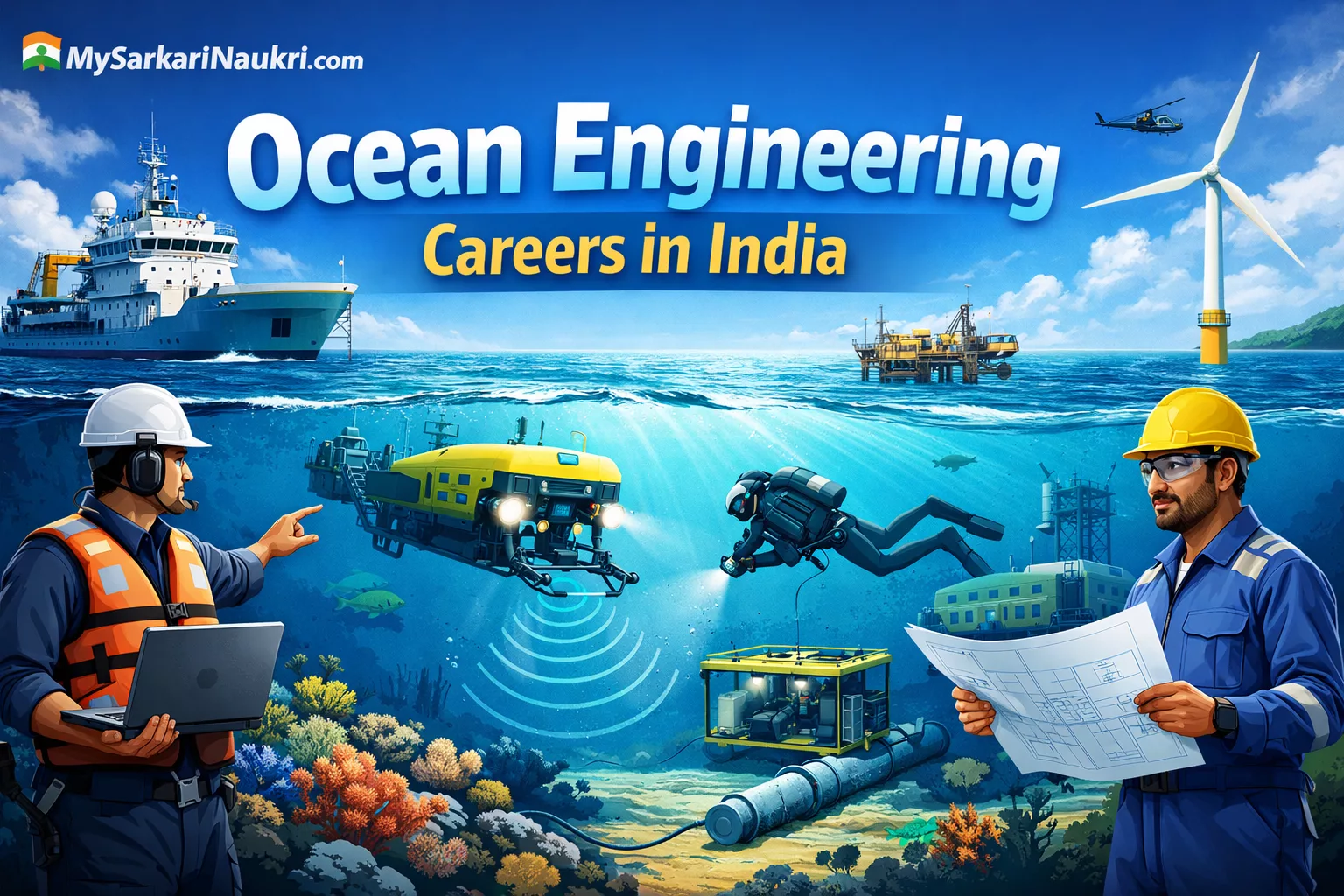
Ocean Engineering is the silent force behind India’s maritime strength. From designing stealth submarines for the Indian Navy to building massive offshore platforms for ONGC, this field is the backbone of the “Blue Economy.”
As India invests heavily in the Deep Ocean Mission and Sagarmala Project, the demand for skilled Ocean Engineers is skyrocketing. This guide covers everything from B.Tech eligibility to high-ranking government career paths.
What is Ocean Engineering?
Ocean Engineering is a multidisciplinary branch combining mechanical, civil, and electrical engineering with marine science. It focuses on the design, construction, and maintenance of structures in the marine environment.
Core Areas of Impact:
- National Defence: Designing naval ships, submarines, and autonomous underwater vehicles (AUVs) for DRDO.
- Energy Security: Developing offshore oil rigs and subsea pipelines for the energy sector.
- Climate Resilience: Constructing seawalls and breakwaters to protect India’s 7,500 km coastline.
- Renewable Energy: Innovating in tidal, wave, and offshore wind energy.
How to Become an Ocean Engineer: Courses & Eligibility
India hosts some of the world’s most advanced maritime research facilities, primarily within the IIT ecosystem.
1. Undergraduate (B.Tech / B.E.)
- Eligibility: 10+2 with Physics, Chemistry, and Mathematics (PCM).
- Entrance Exams: * JEE Advanced: For admission into IITs.
- IMU CET: For the Indian Maritime University.
2. Postgraduate (M.Tech)
Admission is primarily via GATE scores. Specialized branches include:
- Ocean Structures: Design of offshore platforms and structural reliability.
- Ocean Technology: Focus on robotics, AUVs, and oceanographic tools.
- Petroleum Engineering: Deep-sea drilling and reservoir modeling.
| Institution | Location | Key Highlight | Best For |
| IIT Madras | Chennai | India’s oldest and most advanced Ocean Engg. department. | Naval Architecture & Deep Ocean Research |
| IIT Kharagpur | Kharagpur | Offers a high-demand Dual Degree (B.Tech + M.Tech). | Hydrodynamics & Ship Design |
| IIT Bombay | Mumbai | Top-tier M.Tech programs with strong links to ONGC. | Offshore Structures & Petroleum Engineering |
| Indian Maritime University (IMU) | Chennai/Vizag | Central University under the Ministry of Ports & Shipping. | Practical Seafaring & Ship Building |
| CUSAT | Kochi | Strategic location near Cochin Shipyard for internships. | Marine Engineering & Coastal Research |
| NIT Surathkal | Mangalore | Only NIT with a dedicated Water Resources & Ocean Engg. dept. | Coastal Infrastructure & Wave Modeling |
| IIT Bhubaneswar | Bhubaneswar | Focus on Climate Science and Ocean-Atmospheric interaction. | Marine Hazards & Oceanographic Research |
| Andhra University | Visakhapatnam | Strong ties with Hindustan Shipyard Limited (HSL). | Naval Architecture & Offshore Engineering |
| IIT Delhi | New Delhi | Advanced research in AI-driven Ocean Dynamics. | Tropical Cyclone Tracking & Ocean Modeling |
| AMET University | Chennai | Private leader with 100% placement focus for top cadets. | Commercial Merchant Navy & Offshore Jobs |
Career Opportunities: Where Can You Work?
One of the biggest draws of Ocean Engineering is the stability of Government (PSU) jobs combined with high-paying private-sector roles.
Government & Public Sector (Sarkari Naukri)
- Indian Navy: Technical branch commissions for Naval Architects.
- DRDO: Researching underwater surveillance and defence systems.
- NIOT (National Institute of Ocean Technology): Leading India’s deep-sea exploration.
- PSUs: Huge opportunities in ONGC, Mazagon Dock, and Garden Reach Shipbuilders.
Private & Global Sectors
- Energy Giants: Reliance Offshore, L&T Hydrocarbon.
- Emerging Tech: Offshore wind energy firms and marine robotics startups.
- Logistics: Smart port development and green shipping.
The Future: India’s Blue Economy
With the Deep Ocean Mission, the Indian government has identified the ocean as a final frontier for resource wealth. For students, this means:
- Increased Funding: More research grants and Ph.D. fellowships.
- Job Growth: Expansion in offshore wind, seabed mining, and coastal protection.
- Strategic Importance: Ocean engineers are now vital to India’s energy and border security.
Expert View: “Ocean Engineering stands out as a field that promises purpose along with prosperity for those curious about the natural world.” — Dr. Dali Agrahari, JEE Coach & Career Counsellor.
Also Read: