GSSSB MPHW Syllabus 2026 & Exam Pattern | Multi Purpose Health Worker
Contents
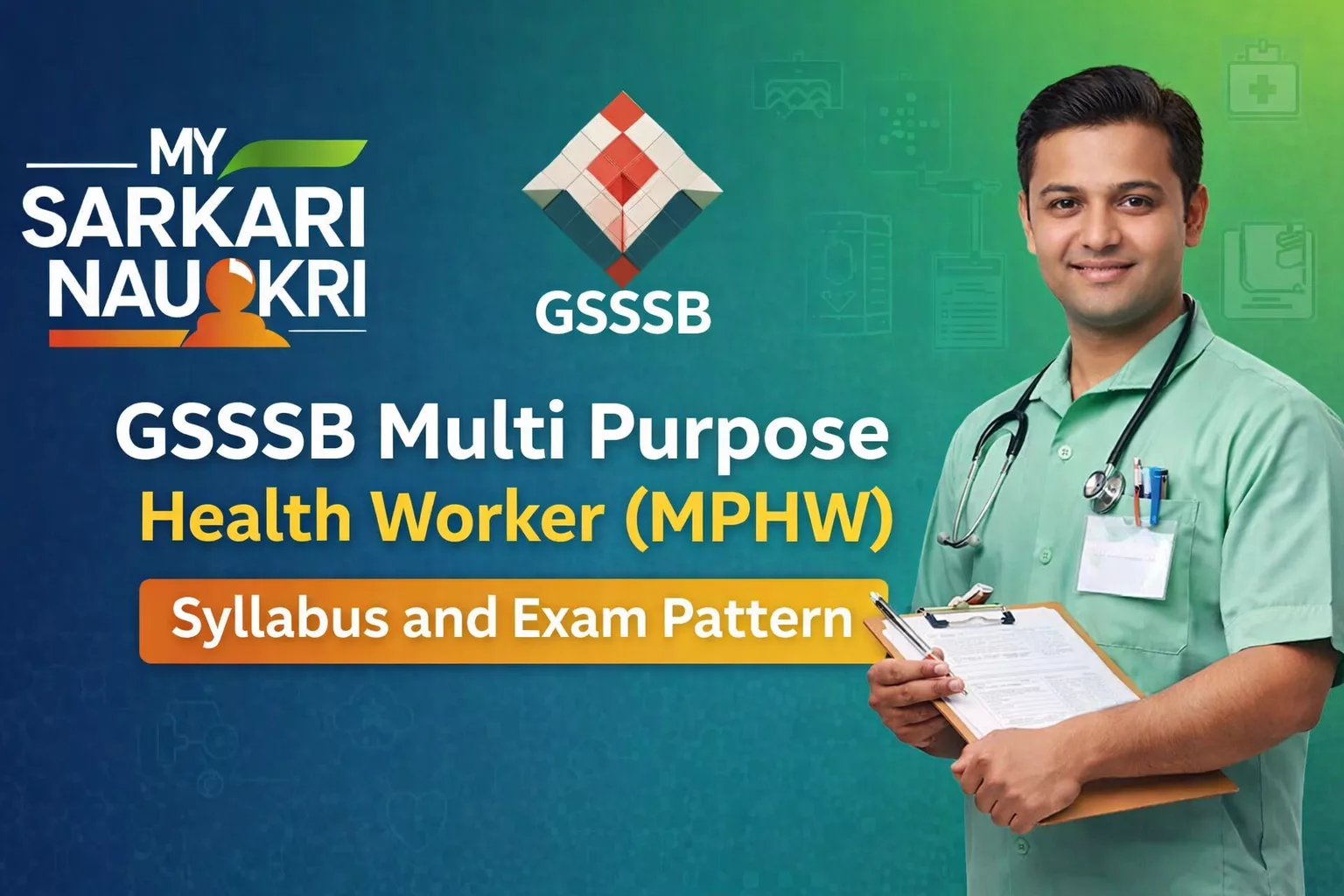
The official GSSSB Multi Purpose Health Worker (MPHW) Syllabus and Exam Pattern for 2026 is anticipated to be released soon for Class-3 positions. Based on previous cycles, this direct recruitment examination is expected to be an objective-type test totaling 100 marks. The exam focuses heavily on technical health knowledge alongside Gujarati, English, and General Knowledge. It is a crucial step for securing a government job in Gujarat.
GSSSB Multi Purpose Health Worker (Male) Recruitment 2026 – Overview
| Organization | Gujarat Secondary Service Selection Board (GSSSB) |
| Post Name | Multi Purpose Health Worker (Male) |
| Total Vacancies | 254 |
| Category | Syllabus |
| Application Start Date | 07 March 2026 |
| Last Date | 21 March 2026 |
| Official Website | gsssb.gujarat.gov.in |
Anticipated Exam Pattern 2026
The examination is expected to be a Written/Online test. The pattern is designed to test the candidate’s proficiency in specific health-related topics as well as general aptitude.
- Exam Type: Objective Type (MCQ)
- Total Marks: 100
- Mode: Written/Online (As per GSSSB regulations)
- Duration: Typically 1 to 2 hours (to be confirmed by official notification)
Key Subjects:
- Technical Subject: Health-related topics specific to MPHW (highest weightage)
- Gujarati Language: Grammar and comprehension
- English Language: Basic grammar and vocabulary
- General Knowledge: GK of Gujarat, current affairs, and general studies
Section-Wise Detailed Syllabus
The syllabus is divided into two parts: Part A covers General Aptitude and General Knowledge, while Part B focuses on Technical Qualification.
Part A: General Aptitude & Knowledge (90 Marks)
1. Reasoning & Data Interpretation (30 Questions, 30 Marks)
- Problems on Ages
- Venn Diagram
- Visual Reasoning
- Blood relation
- Arithmetic reasoning
- Data interpretation (Charts, Graphs, Tables)
- Data sufficiency
2. Quantitative Aptitude (30 Questions, 30 Marks)
- Number Systems
- Simplification and Algebra
- Arithmetic and Geometric Progression
- Average
- Percentage
- Profit-Loss
- Ratio and Proportion
- Partnership
- Time and Work
- Time, Speed and Distance
- Work, Wages and chain rule
3. Constitution of India (10 Questions, 10 Marks)
- Preamble of the Constitution
- Fundamental rights
- Directive principles of state policy
- Fundamental Duty
- Power, role and responsibility of President, vice president and governor
- Parliamentary system
- Amendment of Indian constitution, emergency provisions in Indian constitution
- Centre – State Government and their relation
- Judicial System of Indian Constitution
- Constitutional body
4. Current Affairs (10 Questions, 10 Marks)
- Current events of state, national and international importance
5. Comprehension (10 Questions, 10 Marks)
- Gujarati (5 marks) & English (5 marks)
- To assess comprehension, interpretation and inference skills
- A paragraph given with set of question on the basis of paragraph
- Or statement and assertion type question can be asked
Part B: Technical Qualification (120 Marks)
This section contains 120 questions worth 120 marks, divided into six parts covering specific health topics.
Part-I: Child & Maternal Health (20 Questions, 20 Marks)
- Child care + New Interventions
- Maternal care + New Interventions
- Family planning
- Adolescent health + RKSK
- School health + RBSK
- RCH/NHM
Part-II: Anatomy & Communicable Diseases (20 Questions, 20 Marks)
- Anatomy & Physiology
- VPDs (Vaccine Preventable Diseases)
- Tuberculosis – RNTCP
- Job Responsibilities
- Basic Microbiology Immunology
Part-III: Epidemiology & Specific Infections (20 Questions, 20 Marks)
- Basic Epidemiology, Epidemic outbreaks and IDSP
- Malaria, Dengue and Chickengunia – NVBDCP
- RTI, STI, HIV
- Cholera, Diarrhoea and ORS Therapy
- Zoonotic Disease
- Typhoid
- Chicken pox
- Hepatitis
- Leprosy
- Newly emerged viral infections (CCHF, Swine flu, Ebola, etc.)
Part-IV: National Programmes & Sanitation (20 Questions, 20 Marks)
- National Health Programme
- Blindness control programme, Fluorosis, NPPCD
- Environmental Sanitation
Part-V: NCDs & Nutrition (20 Questions, 20 Marks)
- Non communicable disease + Accident Injury
- Nutrition, NIPI, SAM, Anaemia
- Geriatric care
- Minor Ailments
- First Aid
Part-VI: Health Promotion & Management (20 Questions, 20 Marks)
- Mental Health
- Communication, counselling & Health Education
- Oral health & Personal Hygiene
- All committees and Govt yojanas
- Basic Medicines
- Vital Statistics, Record keeping & logistic supply
- Health promotion, Holistic approach & Yoga
Preparation Tips
- Focus on Technical Knowledge: Since Part B carries 120 marks, dedicate the majority of your study time to health topics, national programs, and disease management.
- Master Gujarati & English Grammar: The comprehension section requires strong basics in both languages. Practice previous year papers to understand the pattern.
- Current Affairs: Keep yourself updated with recent health initiatives and general events in Gujarat and India.
- Time Management: Practice Quantitative Aptitude and Reasoning regularly to solve questions quickly during the exam.
Frequently Asked Questions (FAQs)
As of now, the syllabus is expected to follow the previous pattern. However, candidates must wait for the official notification to confirm any changes.
GSSSB usually conducts a single objective-type written examination for MPHW recruitment. However, candidates should check the specific notification for the 2026 cycle.
The Technical section (Part B) consists of 120 marks divided into 6 parts covering topics like Maternal Health, Anatomy, National Health Programmes, and Health Promotion.
Usually, GSSSB exams may include negative marking. Please refer to the official exam notification for the 2026 cycle to verify the marking scheme.