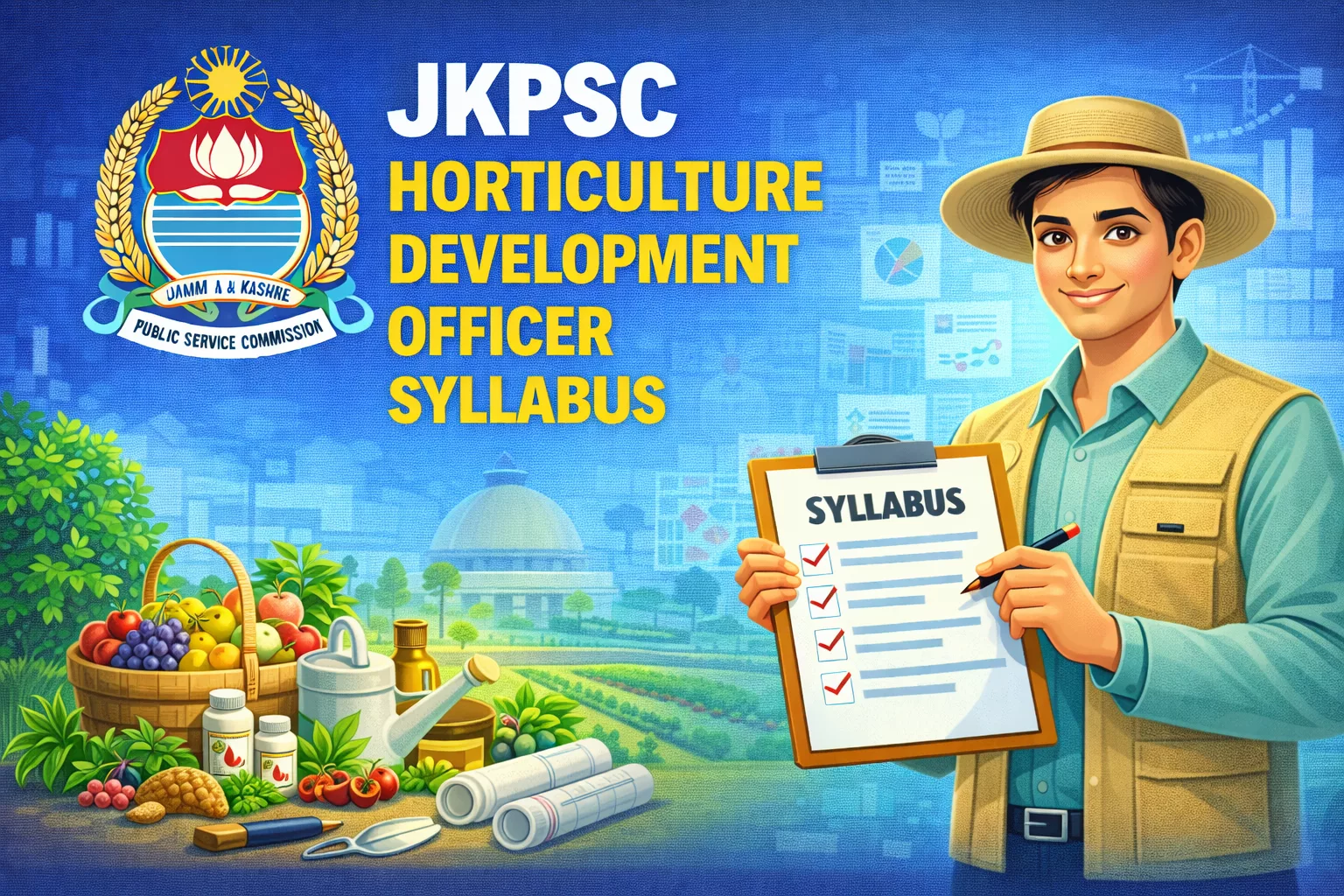
JKPSC Horticulture Development Officer (HDO) Syllabus 2026: Official Guide
Contents
The Jammu and Kashmir Public Service Commission (JKPSC) conducts recruitment for the position of Horticulture Development Officer (HDO) within the Horticulture Department. This role is fundamental to the state’s agrarian economy, particularly in the production, management, and export of temperate and sub-tropical fruit crops.
This guide provides a structured breakdown of the official syllabus to ensure a comprehensive preparation strategy for aspirants.
JKPSC HDO Exam Overview
The selection process is centered on a Written Examination (MCQ Type) that assesses the candidate’s technical expertise across the broad spectrum of horticultural sciences.
| Feature | Details |
| Examining Body | Jammu and Kashmir Public Service Commission (JKPSC) |
| Post Name | Horticulture Development Officer (HDO) |
| Academic Level | Post-Graduate Degree Level (Horticulture) |
| Core Focus | Fruit Science, Soil Management, and Post-Harvest Technology |
Detailed Subject-Wise Syllabus Breakdown
The syllabus is divided into key domains that reflect the diverse responsibilities of an HDO.
1. Introduction & Basic Concepts
- Horticulture Crops: Background, scope, and importance. Focus on the origin, distribution, and classification of horticultural crops .
- Nutritive Values: Area and production under different fruit crops.
- Commercial Varieties: Knowledge of major species, rootstocks, and commercial varieties of apple, pear, peach, apricot, plum, cherry, walnut, almond, mango, and citrus .
2. Soil & Nutritional Management
- Soil Requirements: Types of soil, pH management, and soil testing.
- Nutrient Management: Essential micro and macro nutrients, fertilizer requirements, and integrated nutrient management .
- Bio-fertilizers: Classification and role in crop production.
### 3. Nursery Management & Propagation
- Propagation Techniques: Sexual, asexual, and vegetative methods.
- Micro-propagation: Use of plant growth regulators (PGRs) in multiplication.
- Protected Cultivation: Green house technology, mist chambers, and poly-houses.
- Regulatory Acts: Deep study of the J&K Fruit Nurseries (Licensing) Act, 1987.
4. Production Technology & Plant Physiology
- Orchard Management: Planning, layout, and planting densities, including High Density Plantation (HDP).
- Physiology of Flowering: Pollination, fruit set, and bearing habits.
- Water Management: Drip irrigation, micro-irrigation systems, and fertigation .
- Rejuvenation: Strategies for old and senile orchards.
5. Plant Protection (Pest & Disease Management)
- Pathology: Etiology and integrated management of fungal, bacterial, and viral diseases in crops like apple (scab), walnut, and mango .
- Entomology: Integrated management of insect pests, including the use of bio-control agents.
- Regulatory Laws: Knowledge of the Insecticides Act, 1968 and Rules 1971.
6. Post-Harvest Management & Marketing
- Maturity Indices: Indicators for harvesting temperate and sub-tropical fruits.
- Storage & Packaging: Cold storage, vacuum packaging, and pre-cooling treatments .
- Preservation Industry: Principles of canning, bottling, and juice preparation .
- Food Safety: Food Safety Standards (FSSAI) regulations, labeling, and licensing .
Miscellaneous & Allied Sciences
- Vegetable Science: Principles of vegetable production and commercial varieties .
- Floriculture: Production technology of aesthetic flowers and IPR issues .
- Plantation & Spices: Cultivation of saffron, ginger, turmeric, and medicinal plants like Belladonna and Lavender .
High-Yield Preparation Strategy
- Focus on J&K Specifics: Prioritize the J&K Fruit Nurseries Act and temperate fruit crops like apple and walnut which are central to the region’s economy.
- Integrated Pest Management (IPM): Understand the integration of cultural, physical, and chemical methods as listed in the protection module.
- Maturity & Harvest: Memorize specific maturity indicators and post-harvest physiological changes to handle clinical-style questions.
Download Official JKPSC Horticulture Development Officer (HDO) Syllabus
Frequently Asked Questions (FAQs)
Yes. The syllabus includes the principles, components, and importance of organic farming within the production technology module.
The syllabus specifically mentions Nano-pesticides under the Plant Protection module and remote sensing methods for pest surveillance .
There is a dedicated section on Extension Methods, teaching aids, and the role of Farmer Producer Organisations (FPOs) .