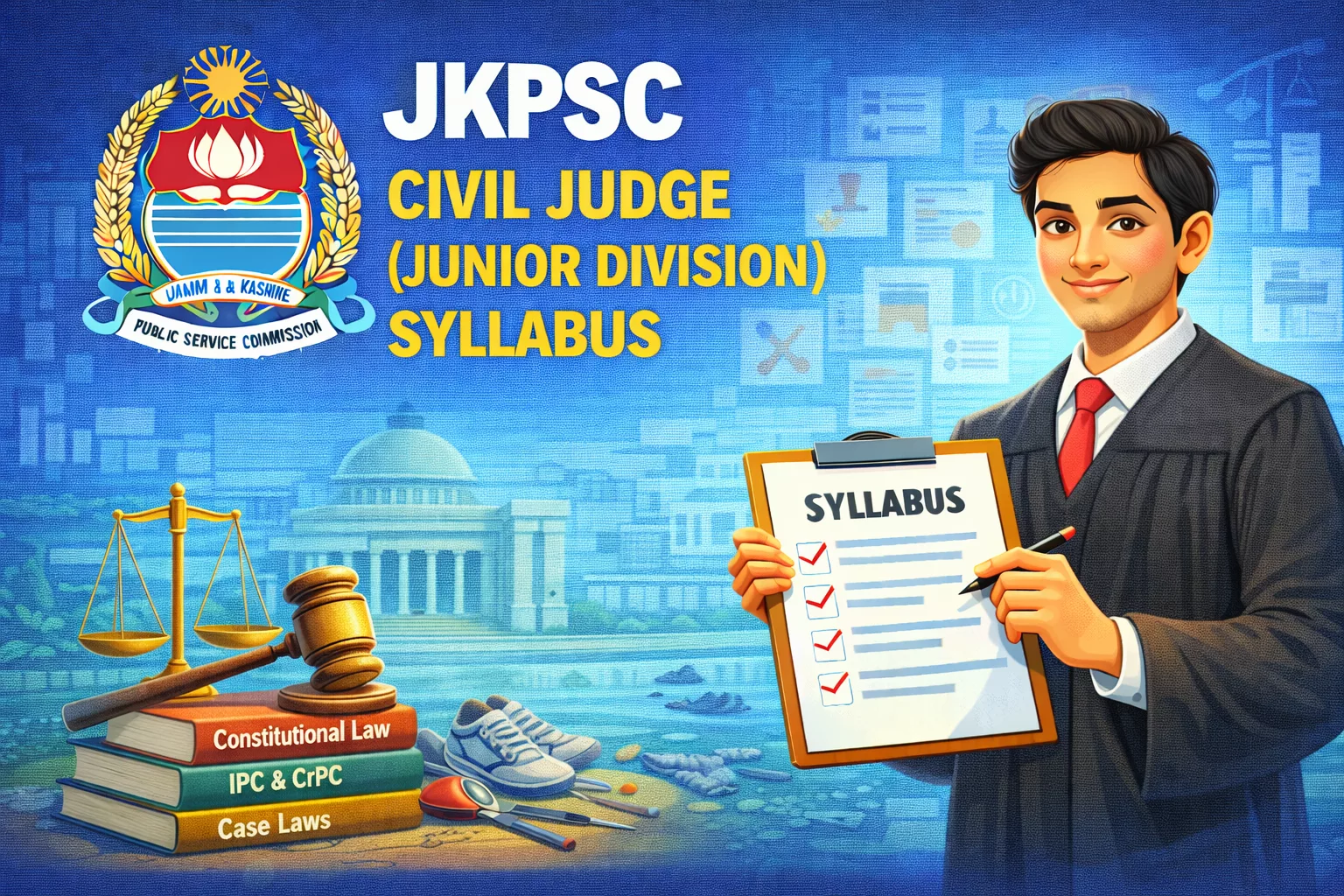
JKPSC Civil Judge (Junior Division) Syllabus & Exam Pattern
Contents
The J&K Civil Service (Judicial) examination is the gateway for legal professionals to join the Subordinate Judiciary as a Civil Judge (Junior Division). This high-stakes recruitment, conducted by the Jammu and Kashmir Public Service Commission (JKPSC), assesses candidates through a three-stage process: Preliminary Examination, Main Examination, and a comprehensive Medical Evaluation.
The 2025 syllabus features a significant update: the integration of the new Indian criminal laws—BNS, BNSS, and BSA—replacing the older IPC, CrPC, and Evidence Act.
I. Preliminary Examination (Objective Type)
The Preliminary stage acts as a screening test consisting of two papers. Each paper carries 225 marks with a duration of 2 hours.
Paper-A (225 Marks)
- General Knowledge
- Indian Constitutional Law
- The Bharatiya Nagarik Suraksha Sanhita (BNSS), 2023
- The Bharatiya Sakshya Adhiniyam (BSA), 2023
- The Bharatiya Nyaya Sanhita (BNS), 2023
- The Limitation Act, 1963
Paper-B (225 Marks)
- General Financial Rules, 2017
- J&K Service Regulation, 1956 (Chapters III to XIII, XXII, and XXIII)
- Rules and Orders for Subordinate Courts and High Court Circular Orders
- The Code of Civil Procedure, 1908
- The Registration Act, 1908
- The Transfer of Property Act, 1882
- The J&K Residential and Commercial Tenancy Act, 2012
II. Main Examination (Descriptive Type)
The Main examination consists of six compulsory papers and one optional paper (chosen from six available options). Each paper carries 100 marks and has a 3-hour duration.
Compulsory Papers
- Paper I: English Essay, Translation (English to Urdu/Hindi and vice versa), and Precis.
- Paper II: General Knowledge and Indian Constitutional Law.
- Paper III: New Criminal Laws (BNSS, BSA, and BNS, 2023).
- Paper IV: Financial Rules, J&K Service Regulations, and Court Rules/Orders.
- Paper V: CPC, Limitation Act, and Registration Act.
- Paper VI: Transfer of Property Act and J&K Tenancy Act.
Optional Papers (Select One)
Candidates must select one paper from the following list:
- Hindu Law & Mohamadan Law
- Law of Companies & Insurance Law
- Principles of Equity (including Trusts and Specific Relief)
- Indian Contract Act, 1872 & Law of Torts
- Suits Valuation, Court Fee, Indian Stamp, and Excise Acts
- Land Revenue Act & Land Acquisition/Rehabilitation Act, 2013
III. Medical Standards & Vision Requirements
To be fit for the Subordinate Judiciary, a candidate must possess good mental and bodily health.
| Vision Component | Requirement |
| Better Eye | V=6/6 |
| Worse Eye | V=6/12 |
| Spectacles | Allowed up to +/- 5.0 D (Conditions apply for Myopia/Astigmatism) |
| Colour Vision | Defects are noted but do not cause rejection |
- Hearing & Speech: Must be sound and without impediment.
- Physical Defects: Any condition likely to interfere with efficient duty performance may cause rejection.
- Remediable Defects: If a defect is curable by operation, the candidate may be informed to have it remedied for re-examination.
FAQs
No. The syllabus explicitly requires the new criminal laws: Bharatiya Nyaya Sanhita (BNS), Bharatiya Nagarik Suraksha Sanhita (BNSS), and Bharatiya Sakshya Adhiniyam (BSA).
Yes. Local acts like the J&K Service Regulation, 1956 and the J&K Residential and Commercial Tenancy Act, 2012 are part of both Prelims and Mains.
Yes. Paper I of the Main examination includes translation between English and Urdu or Hindi.
Yes. The opinion of the Board regarding a candidate’s fitness is final and cannot be questioned.
Official Resources
- Official Syllabus PDF: Download Here
- Governing Body: J&K Public Service Commission (JKPSC)