Haryana ADA Syllabus & Exam Pattern
Contents
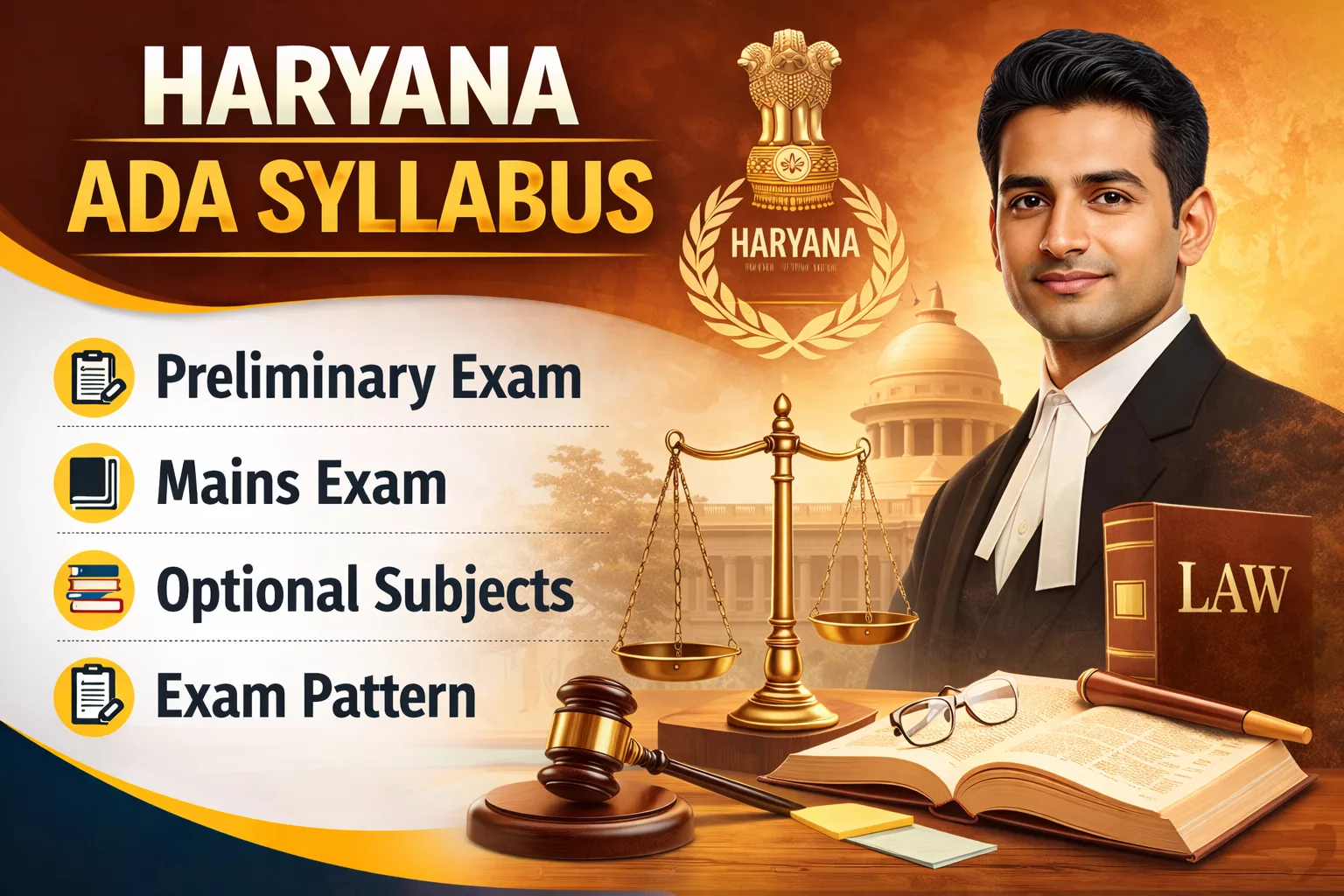
The Haryana Public Service Commission (HPSC) has officially released the syllabus and exam pattern for the Assistant District Attorney (ADA) recruitment exam. For candidates preparing for the Haryana ADA Exam 2026, understanding the comprehensive structure of the examination is the first step toward success. This detailed guide covers every aspect of the Haryana ADA Syllabus 2025 Out Direct Link to Download Syllabus PDF here, ensuring you have a thorough understanding of the subjects, marks distribution, and selection process.
To ensure a well-structured study plan, candidates must review both the screening test and the subject-knowledge test sections. The official syllabus lists specific topics under Civil Law, Criminal Law, General Awareness, and more, which are essential for effective preparation.
Official Website: hpsc.gov.in
Direct Link: Download HPSC ADA Syllabus PDF
Selection Process
The selection for the post of Assistant District Attorney involves a multi-stage process designed to test both general aptitude and specialized legal knowledge. Based on the official notification, the stages are:
- Screening Test: An initial qualifying examination to shortlist candidates for the main exam.
- Subject-Knowledge Test: A detailed examination focusing on Civil Law, Criminal Law, and other relevant subjects.
- Interview: The final stage to assess the candidate’s personality and suitability for the role.
Detailed Exam Pattern
Understanding the exam pattern is crucial for time management and strategy. The HPSC ADA exam consists of objective-type questions covering various subjects. Below is the detailed breakdown of the exam pattern:
| Component | Details |
|---|---|
| Conducting Authority | Haryana Public Service Commission (HPSC) |
| Post Name | Assistant District Attorney (ADA) |
| Total Questions | 100 |
| Total Marks | 100 |
| Duration | 2 Hours |
| Negative Marking | 1/4 Negative Mark (0.25 marks deducted for each wrong answer) |
Key Pattern Highlights:
- The exam is conducted in offline or online mode (as per HPSC notification).
- Each question carries 1 mark.
- The negative marking penalty is strict: 1/4 mark is deducted for every incorrect answer.
- Candidates must qualify in the Screening Test to be eligible for the Subject-Knowledge Test.
Comprehensive Subject-wise Syllabus
The Haryana ADA Syllabus 2026 is divided into distinct subjects covering legal provisions, general awareness, and mental ability. Below is the detailed topic-wise breakdown derived from the official source.
Civil Law
This section tests the candidate’s knowledge of procedural and substantive civil laws. Key topics include:
- Code of Civil Procedure (CPC): Principles of jurisdiction, pleadings, suits, and execution.
- Indian Evidence Act: Rules of evidence, relevancy, admissibility, and proof.
- Indian Contract Act: Formation, performance, and breach of contracts.
- Indian Partnership Act: Rights and duties of partners, formation of firms.
- Sale of Goods Act: Transfer of title, conditions, and warranties.
- Hindu Law: Marriage, adoption, succession, and maintenance.
- Mohammedan Law & Customary Law: Personal laws, inheritance, and customs applicable in Haryana.
Criminal Law
This section focuses on criminal jurisprudence and procedural laws:
- Indian Penal Code (IPC): General exceptions, offenses against the state, person, and property.
- Criminal Procedure Code (CrPC): Arrest, bail, trial procedures, and jurisdiction.
- Indian Evidence Act: Specific application in criminal cases, burden of proof, and witness examination.
General Awareness
Current affairs and static GK are vital for this section:
- Indian History: Ancient, medieval, and modern history with a focus on freedom struggle.
- Geography: Physical, economic, and human geography of India and the world.
- Polity: Indian Constitution, political system, and governance.
- Economics: Basic economic concepts, planning, and budget.
- Haryana Culture & GK Facts: History, geography, and current affairs specific to Haryana.
General Mental Ability
This section assesses logical and analytical skills:
- Logical Reasoning: Analogies, syllogisms, and logical sequences.
- Analytical Reasoning: Data sufficiency and pattern recognition.
- Decision Making: Problem-solving in realistic scenarios.
- Problem Solving: Arithmetic and analytical puzzles.
English
The English section tests comprehension abilities:
- Reading Comprehension: Passages followed by questions to test understanding, inference, and vocabulary.
Numerical Aptitude
This section covers basic mathematical skills:
- Basic Numeracy: Numbers, percentages, ratios, and averages (up to 12th standard level).
- Data Interpretation: Tables, graphs, and charts analysis.
Minimum Qualifying Marks
While the specific percentage for minimum qualifying marks is not explicitly detailed in the source content, candidates are generally required to secure marks above the cutoff determined by HPSC. It is recommended to check the official notification for category-wise qualifying marks.
Preparation Strategy
To excel in the HPSC ADA Exam 2026, candidates should adopt a structured approach:
- Understand the Exam Pattern: Review the syllabus and pattern to plan effectively.
- Create a Study Schedule: Allocate time for Civil Law, Criminal Law, and General subjects.
- Refer to Best Study Materials: Use recommended books for CPC, IPC, and Indian Evidence Act.
- Practice Regularly: Solve previous year papers and mock tests for Numerical Aptitude and Reasoning.
- Focus on Conceptual Clarity: Understand legal provisions rather than rote memorization.
- Improve Speed and Accuracy: Practice answering questions within the 2-hour time limit.
- Stay Updated with Current Affairs: Read newspapers for General Awareness and Haryana GK.
- Revision is Key: Regularly revise Civil and Criminal Law topics.
- Maintain a Healthy Lifestyle: Stay hydrated and take breaks to avoid burnout.
FAQs
The exam follows a 1/4 negative marking policy, meaning 0.25 marks are deducted for each incorrect answer.
There are a total of 100 questions in the exam, with a duration of 2 hours.
Civil Law includes Code of Civil Procedure, Indian Evidence Act, Indian Contract Act, Indian Partnership Act, Sale of Goods Act, Hindu Law, Mohammedan Law & Customary Law.
Yes, the General Awareness section includes Haryana Culture & GK Facts along with Indian History, Geography, Polity, and Economics.
Numerical Aptitude covers Basic Numeracy (10th to 12th standard) and Data Interpretation, contributing to the overall 100 marks.
Based on the source content, the English section primarily focuses on Reading Comprehension.
The selection involves three stages: Screening Test, Subject-Knowledge Test, and Interview.