KVS TGT Syllabus 2026: Exam Pattern, PDF & Topic-Wise Guide
Contents
- 1 KVS TGT Syllabus 2026: Quick Overview Table
- 2 KVS TGT Selection Process 2026
- 3 KVS TGT Exam Pattern 2026: Interactive Structure
- 4 Topic-Wise Detailed Syllabus for KVS TGT Syllabus 2026
- 5 Download KVS TGT Syllabus 2026 PDF
- 6 Preparation Master Tips for KVS TGT Syllabus 2026
- 7 Summary of Qualifying Marks (Expected)
- 8 FAQs
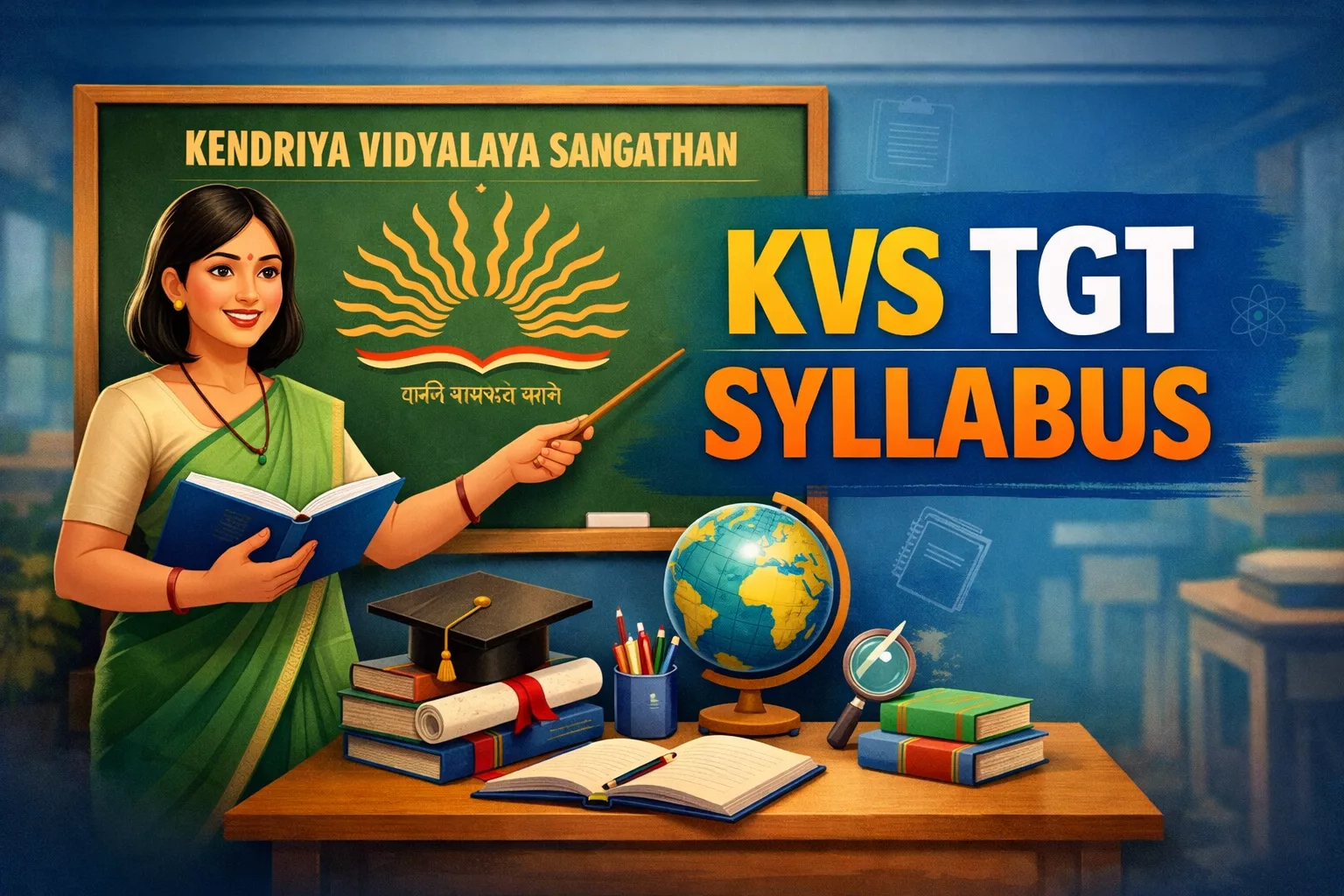
The Kendriya Vidyalaya Sangathan (KVS) recruitment for Trained Graduate Teachers (TGT) is one of the most sought-after opportunities for teaching aspirants in India. To crack this competitive exam, a strategic understanding of the KVS TGT Syllabus 2026 is non-negotiable. The exam is designed to test not just your subject knowledge but also your pedagogical understanding, reasoning ability, and general awareness. Unlike other exams, the KVS TGT pattern emphasises a balanced approach between general aptitude and educational leadership. With a total of 180 marks and a duration of 3 hours, candidates must master the entire syllabus to secure a high rank. This guide provides a deep dive into the official syllabus, the exam structure, and expert tips to help you ace the KVS TGT Syllabus 2026.
KVS TGT Syllabus 2026: Quick Overview Table
| Particulars | Details |
|---|---|
| Conducting Authority | Kendriya Vidyalaya Sangathan (KVS) |
| Post Name | Trained Graduate Teachers (TGT) |
| Selection Process | Written Test and Interview |
| Total Questions | 180 |
| Total Marks | 180 |
| Duration | 3 Hours (180 Minutes) |
| Negative Marking | No Negative Marking |
| Official Website | kvsangathan.nic.in |
KVS TGT Selection Process 2026
The recruitment drive for Trained Graduate Teachers involves a rigorous two-stage selection procedure. Understanding the weightage and nature of each stage is vital for preparation.
1. Written Examination
This is the first and most critical hurdle. The written test is an objective-type paper comprising 180 questions. Candidates qualifying in this test will be shortlisted for the interview stage based on their merit.
2. Interview
The interview carries significant weightage (usually 15% to 20% of the total selection criteria). It assesses the candidate’s teaching methodology, communication skills, and suitability for the role of a teacher in a reputed institution like KVS.
KVS TGT Exam Pattern 2026: Interactive Structure
The written examination is conducted in a single shift. There is no sectional cutoff, but candidates must secure an overall cutoff to qualify. Here is the detailed section-wise distribution of questions and marks.
| Subject Name | No. of Questions | Maximum Marks |
|---|---|---|
| General English | 30 | 30 |
| General Hindi | 30 | 30 |
| General Knowledge & Current Affairs | 30 | 30 |
| Reasoning Ability | 30 | 30 |
| Computer Literacy | 30 | 30 |
| Perspectives on Education & Leadership | 30 | 30 |
| Total | 180 | 180 |
Important Note on Negative Marking: As per the official guidelines, there is No Negative Marking for incorrect answers. This allows candidates to attempt all questions without the fear of losing marks, maximizing their scoring potential.
Topic-Wise Detailed Syllabus for KVS TGT Syllabus 2026
Here is the comprehensive breakdown of the KVS TGT Syllabus. Use this list to create your study checklist.
1. General Hindi (सामान्य हिंदी)
- भाषा औंर व्याकरण: भाषा का सामान्ए ज्ञान, संज्ञा एवं उसके भेद।
- पद विभाग: सर्वनाम, विशेषण, क्रिया, क्रियाविशेषण।
- वचन और लिंग: वचन (एकवचन/बहुवचन) और लिंग (पुल्लिंग/स्त्रीलिंग/नपुंसकलिंग)।
- उपसर्ग और प्रत्यय: शब्द निर्माण में उपसर्ग और प्रत्यय की भूमिका।
- वाक्य निर्माण: सरल, संयुक्त और मिश्रित वाक्यों का निर्माण।
- शब्द ज्ञान: पर्यायवाची, विपरीतार्थक, अनेकार्थक और समानार्थी शब्द।
- मुहावरे और लोकोक्तियाँ: प्रचलित मुहावरों और लोकोक्तियों का अर्थ और प्रयोग।
- अलंकार: शब्दालंकार और अर्थालंकार।
- सन्धि: स्वर-सन्धि, व्यंजन-सन्धि, यणादेश।
- तत्सम, तद्भव, देशज और विदेशी शब्द।
- समास: द्विगु, द्वंद्व, तत्पुरुष, कर्मधारय, बहुव्रीहि, षष्ठीतत्पुरुष।
- पद परिचय।
2. General English
- Parts of Speech: Nouns, Pronouns, Verbs, Adverbs, Adjectives, Prepositions, Conjunctions, Interjections.
- Tenses: Present, Past, Future Tenses and their appropriate forms.
- Articles: Definite and Indefinite Articles (A, An, The).
- Modals: Can, Could, May, Might, Should, Would, Must, Ought to.
- Voice: Active and Passive Voice conversion.
- Narration: Direct and Indirect Speech (Assertive, Imperative, Interrogative, Optative).
- Punctuation: Correct usage of full stops, commas, semicolons, colons, dashes, etc.
- Vocabulary: Synonyms, Antonyms, One-word substitution.
- Idioms & Phrases: Commonly used idioms and their meanings.
- Error Spotting & Sentence Improvement.
3. General Knowledge & Current Affairs
- History: Ancient, Medieval, and Modern Indian History (with special focus on the Freedom Struggle).
- Geography: Physical Geography of India and the World, Climate, Soil, Rivers, Mountains.
- Indian Polity & Constitution: Preamble, Fundamental Rights, Directive Principles, President, Parliament, Judiciary, Important Articles.
- Economics: National Income, Budget, Five-Year Plans, Banking, Inflation, Economic Terminology.
- General Science: Physics, Chemistry, and Biology basics (up to 10th standard level).
- Art & Culture: Indian dances, Music, Paintings, Monuments, Festivals.
- Current Events: National and International importance (last 6-12 months).
- Static GK: Capitals, Currencies, National Parks, Dams, Important Days, Awards.
- Scientific Research.
4. Reasoning Ability
- Verbal Reasoning: Analogy, Classification, Coding-Decoding, Series (Alpha-Numeric), Blood Relations, Direction Sense.
- Logical Reasoning: Syllogism, Statement & Conclusion, Statement & Assumption, Statement & Inference.
- Non-Verbal Reasoning: Mirror Image, Water Image, Figure Classification, Paper Folding & Cutting.
- Arrangement: Seating Arrangement (Linear/Circular), Puzzles, Ranking & Ordering.
- Arithmetical Reasoning: Problem on Ages, Clocks & Calendars, Mathematical Operations.
- Space Visualization: 3D figures, Cube & Dice.
5. Computer Literacy
- Computer Basics: History of Computers, Generations of Computers, Types of Computers (Super, Mainframe, Micro, etc.).
- Hardware & Software: Input/Output Devices, CPU, Memory (RAM/ROM), Operating Systems (Windows, Linux, MacOS).
- Internet & Web: Internet Basics, Browsers (Chrome, Firefox), Search Engines, Email, Social Networking Concepts, Cloud Computing basics.
- DBMS: Basic concepts of Databases and Management Systems.
- Abbreviations & Shortcuts: Common Computer Terms, MS Office shortcuts, Keyboard shortcuts.
- Storage Devices: Pen Drive, Hard Disk, CD/DVD, Floppy.
6. Perspectives on Education and Leadership
This section is crucial for the pedagogical aspect of the TGT role.
- Understanding the Learner:
- Concepts of Development and its relationship with learning.
- Principles of child development, influence of heredity & environment.
- Socialization processes: Piaget, Kohlberg, and Vygotsky.
- Adolescence problems and challenges.
- Understanding Teaching Learning:
- Learning theories: Behaviorism, Cognitivism, Constructivism.
- Teacher and Learner roles in the classroom.
- Lesson planning and curriculum transaction.
- ICT (Information and Communication Technology) in teaching-learning.
- Evaluation methods: Formative, Summative, CCE.
- Enhancing Teaching:
- Continuous reflection and feedback mechanisms.
- Classroom observation and peer learning.
- Learning Environment:
- Managing learner diversity, inclusion, and gender issues.
- Mental health and counseling in schools.
- Community as a resource for learning.
- School Leadership:
- Reflective practice for teachers.
- Goal setting and instructional planning.
- Partnerships with parents and community.
- Perspectives in Education:
- NEP 2020: Key features and implications for school education.
- RTE Act 2009: Right to Education provisions.
- Child Rights and Protection.
- Curriculum design and transaction.
Download KVS TGT Syllabus 2026 PDF
Candidates are advised to download the official syllabus PDF to keep a hard copy for offline reference. This ensures you do not miss any specific topic released by the authorities.
Click Here to Download KVS TGT Official Syllabus PDF
Preparation Master Tips for KVS TGT Syllabus 2026
- Leverage the No Negative Marking: Since there is no negative marking, ensure you attempt 100% of the questions. Use the process of elimination for tricky questions in Reasoning and English.
- Focus on Pedagogy (Education & Leadership): This section is often the game-changer. It is scoring and requires understanding of concepts rather than rote learning. Pay special attention to NEP 2020 and RTE Act.
- Master Computer Literacy: This section is generally easier than Reasoning. Focus on abbreviations, basic software terms, and internet concepts to secure full marks here.
- Current Affairs Strategy: Do not just read news; make notes on Government Schemes, Education-related news, and International events for the last 6 months.
- Time Management in Exam: The paper has 180 questions to be solved in 180 minutes. Ideally, spend no more than 1 minute per question. Prioritize sections you are strongest in first (e.g., Hindi/English if you are a native speaker).
Summary of Qualifying Marks (Expected)
While the official cutoff varies every year based on the difficulty level and number of applicants, candidates generally need to secure the following minimum percentages to qualify for the interview round:
- General / EWS / Ex-Servicemen: 40% Marks
- OBC (NCL): 35% Marks
- SC / ST / PwBD: 35% Marks
FAQs
No, there is no negative marking for incorrect answers in the KVS TGT written examination.
The exam duration is 3 hours (180 minutes) for 180 questions.
There are six sections: General English, General Hindi, GK & Current Affairs, Reasoning Ability, Computer Literacy, and Perspectives on Education & Leadership.
Yes, the question paper is generally bilingual (English and Hindi) for most sections, except for the English Language section.
For the General TGT (like English, Hindi, Social Science), the syllabus is largely general aptitude based. However, candidates applying for specific TGT posts must refer to the detailed notification for subject-specific syllabus variations if any.
Yes, Computer Literacy is a mandatory section with 30 marks. Basic knowledge of computers is essential to score well.
This section carries 30 marks and is crucial as it tests the pedagogical understanding required for a teaching role.
While the exact date is subject to official announcement, KVS typically releases recruitment notifications in the last quarter of the year or early next year. Keep checking the official website.
Yes, candidates shortlisted from the written test must appear for the interview round to finalize their selection.