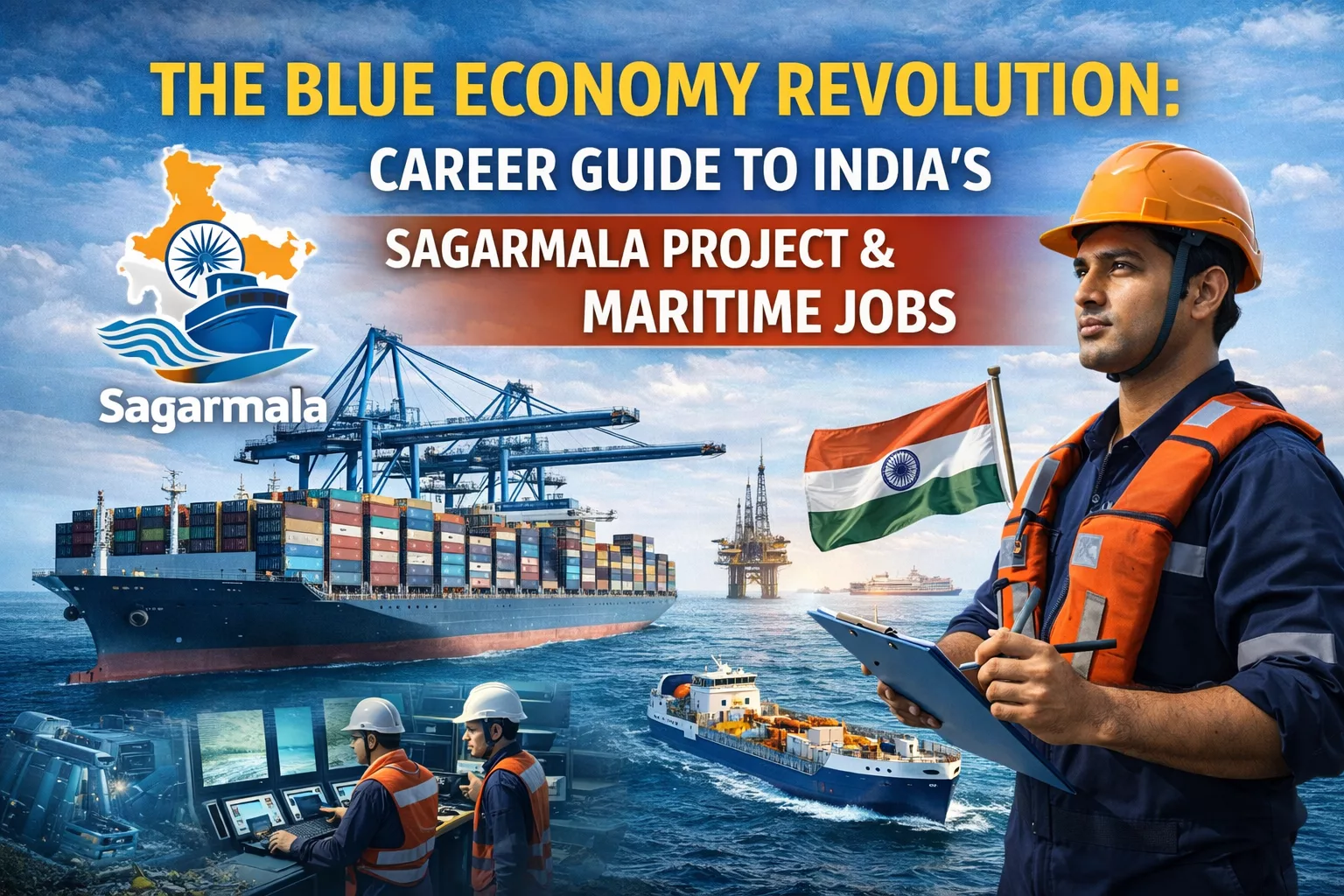
The Blue Economy Revolution: Career Guide to India’s Sagarmala Project & Maritime Jobs (2026)
Contents
- 1 1. The Macro-Economic Engine: The Sagarmala Project
- 2 2. Core Career Verticals in the Blue Economy
- 3 3. The Private Sector Powerhouses: Where the Jobs Are
- 4 4. Educational Pathways & Institutional Rules
- 5 5. Standard Annual Recruitment Cycles
- 6 6. Future-Proofing: Skills for 2030
- 7 Frequently Asked Questions (FAQs)
India is no longer just a land-based economy; it is a maritime powerhouse in the making. With a coastline stretching over 7,500 km and a strategic location spanning across the world’s busiest shipping lanes, the “Blue Economy” has transitioned from a buzzword to a national priority.
For the modern job seeker, this represents a structural shift. Through the Sagarmala Project, the Indian government is investing billions into port modernisation, coastal community development, and maritime logistics. This blueprint explores the recruitment ecosystem emerging from the deep blue.
1. The Macro-Economic Engine: The Sagarmala Project
The Sagarmala Project is the cornerstone of India’s maritime vision. Its goal is to reduce logistics costs and propel port-led industrialization. For aspirants, this isn’t just about ships; it’s about the infrastructure that supports them.
Key Pillars of Recruitment under Sagarmala:
- Port Modernization: Upgrading existing ports to “Smart Ports” requires experts in automation, IoT, and heavy machinery.
- Port Connectivity: Building new railways and roads specifically for freight, creating roles in civil engineering and supply chain management.
- Port-Linked Industrialization: Developing Maritime Clusters and Coastal Economic Zones (CEZs) which house manufacturing units.
2. Core Career Verticals in the Blue Economy
The recruitment landscape is divided into three distinct yet overlapping sectors.
A. Coastal & Marine Engineering
As India builds massive transshipment hubs (like Vizhinjam and Vadhavan), the demand for technical expertise has skyrocketed.
- Roles: Coastal Engineers, Dredging Experts, Marine Surveyors, and Structural Designers.
- Key Skills: Hydrographic surveying, underwater construction, and EIA (Environmental Impact Assessment).
B. Logistics & Supply Chain Management
Efficient ports are useless without efficient evacuation of cargo.
- Roles: Port Operations Managers, Freight Forwarders, Customs House Agents (CHAs), and Warehouse Strategists.
- Key Skills: Multimodal transport planning and digital documentation (Blockchain in logistics).
C. Maritime Sustainability & Renewable Energy
With the push for “Green Ports,” a new niche has emerged focused on offshore wind energy and marine conservation.
- Roles: Offshore Wind Technicians, Marine Biologists, and Carbon Credit Analysts.
Also Read: Engineering Jobs
3. The Private Sector Powerhouses: Where the Jobs Are
While the government provides the framework, the private sector drives the volume of recruitment. Major players are expanding their offshore and coastal footprints.
| Company | Key Focus Areas | Typical Recruitment Profiles |
| L&T (Larsen & Toubro) | Defense Shipbuilding, Modular Fabrication, Offshore Platforms. | Marine Engineers, Procurement Specialists, Project Managers. |
| Adani Ports & SEZ | Port Operations, Dredging, Logistics Parks. | Terminal Managers, Crane Operators, Data Analysts. |
| Reliance Offshore | Oil & Gas exploration, Subsea Infrastructure. | Subsea Engineers, ROV Pilots, Geotechnical Experts. |
| Jindal Infrastructure | Coastal Shipping and Port-led manufacturing. | Logistics Coordinators, Chartering Managers. |
4. Educational Pathways & Institutional Rules
To enter the Blue Economy, specific certifications and degrees are often mandatory due to the hazardous and technical nature of the work.
Recommended Qualifications:
- B.Tech in Marine Engineering / Naval Architecture: The gold standard for technical roles.
- MBA in Port & Shipping Management: Essential for the commercial side of the Blue Economy.
- Certifications: GMDSS (Global Maritime Distress and Safety System) or STCW (Standards of Training, Certification, and Watchkeeping) for those heading out to sea.
Top Institutions:
- Indian Maritime University (IMU) – Multiple campuses.
- IIT Madras (Department of Ocean Engineering).
- Tolani Maritime Institute.
5. Standard Annual Recruitment Cycles
Unlike general IT or sales jobs, Maritime and Blue Economy roles often follow specific cycles:
- Public Sector (PSUs): Companies like Shipping Corporation of India (SCI), Mazagon Dock, and Cochin Shipyard typically release notifications in Q1 (January–March) and Q3 (July–September).
- Graduate Trainee Programs: Major private firms like Maersk or Adani often conduct campus recruitment between November and February.
- Lateral Entry: High-demand roles in dredging and coastal engineering are recruited year-round based on project commencement dates.
6. Future-Proofing: Skills for 2030
The Blue Economy is becoming “Digital & Green.” To remain relevant, aspirants should focus on:
- Maritime Informatics: Understanding how AI predicts shipping delays and optimizes fuel.
- Coastal Protection Tech: Expertise in building sea walls and eco-friendly breakwaters as sea levels rise.
- Hydrographic Data Analysis: Using sonar and satellite imagery to map the ocean floor.
Frequently Asked Questions (FAQs)
No. While engineering is a core pillar, the Blue Economy requires logistics experts, environmental scientists, lawyers specializing in Maritime Law, and data analysts.
Entry-level roles typically start at ₹5–8 LPA. Senior roles in private firms like L&T or Adani for specialized offshore projects can exceed ₹25–40 LPA.
By creating permanent infrastructure like Multi-Modal Logistics Parks (MMLPs), the project ensures long-term operational roles that are less susceptible to market volatility than pure export-import trading.
Absolutely. The government has introduced several initiatives to increase female participation in both “on-shore” (port management, logistics) and “off-shore” (navigation, marine engineering) roles.
Professional Disclaimer: Recruitment cycles and eligibility criteria are subject to change based on institutional policies. Always refer to the official gazettes of the Ministry of Ports, Shipping, and Waterways for the most current data.