HPSC PGT Computer Science Syllabus 2026: Exam Pattern & Topics
Contents
- 1 Quick Overview Table
- 2 Selection Process
- 3 HPSC PGT Computer Science Exam Pattern 2026
- 4 Topic-Wise Detailed Syllabus 2026
- 4.1 1. Computer Fundamentals
- 4.2 2. Programming Concepts
- 4.3 3. Data Structures
- 4.4 4. Database Management System (DBMS)
- 4.5 5. Computer Networks
- 4.6 6. Software Engineering
- 4.7 7. Web Technologies
- 4.8 8. Operating System (OS)
- 4.9 9. Computer Architecture
- 4.10 10. Theory of Computation
- 4.11 11. Cyber Security
- 4.12 12. Artificial Intelligence (AI)
- 4.13 13. Cloud Computing
- 4.14 14. Teaching Aptitude
- 5 Download HPSC PGT Computer Science Syllabus PDF 2026
- 6 Preparation Master Tips
- 7 Summary of Minimum Qualifying Marks
- 8 FAQs
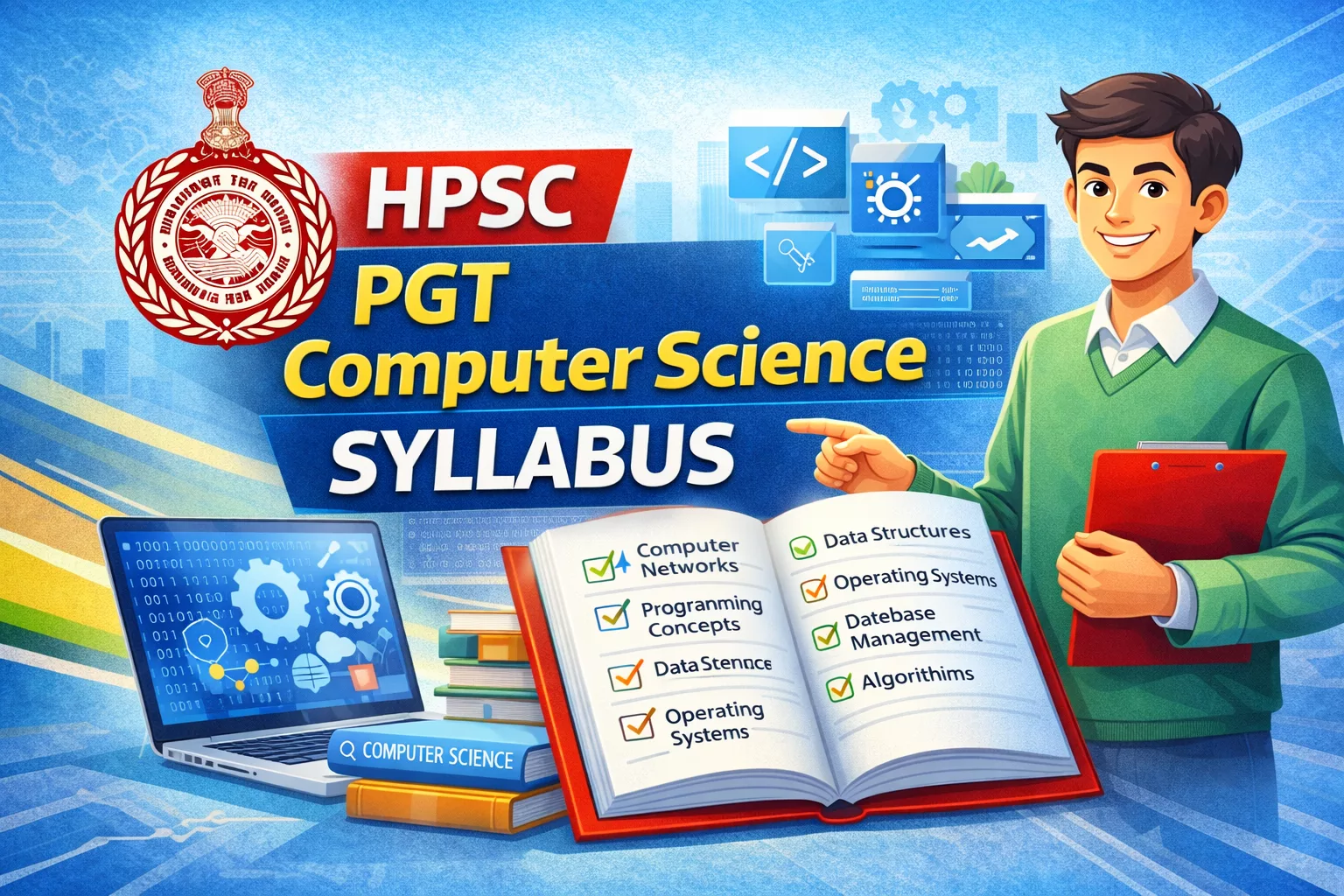
The Haryana Public Service Commission (HPSC) is set to conduct the recruitment for Post Graduate Teachers (PGT) in Computer Science. For candidates aspiring to secure a teaching position in Haryana’s government schools, understanding the HPSC PGT Computer Science Syllabus 2026 is the foundational step toward success. The exam demands a strong command over theoretical concepts and practical applications ranging from basic programming to advanced Artificial Intelligence. This comprehensive guide details the updated Syllabus 2026, the Exam Pattern, and strategic preparation tips to help you ace the selection process.
Quick Overview Table
| Feature | Details |
|---|---|
| Exam Name | HPSC PGT Computer Science Recruitment |
| Conducting Body | Haryana Public Service Commission (HPSC) |
| Post Name | Post Graduate Teacher (PGT) Computer Science |
| Selection Process | Screening Test, Subject Knowledge Test, Interview |
| Total Marks | 140 (Screening Test) |
| Total Questions | 140 (Screening Test) |
| Official Website | hpsc.gov.in |
Selection Process
The HPSC PGT selection procedure is rigorous and divided into three distinct stages. Clearing each stage is mandatory to progress to the next.
- Screening Test (Objective Type): This is the first qualifying stage. It is conducted to shortlist candidates for the Subject Knowledge Test. It usually carries 140 marks and serves as a filter.
- Subject Knowledge Test (Descriptive/Objective): Candidates who qualify in the screening test appear for this test. This exam specifically evaluates the depth of your Computer Science knowledge. The marks obtained here are crucial for the final merit list.
- Interview: The final stage assesses the candidate’s teaching aptitude, communication skills, and overall suitability for the role of a teacher.
HPSC PGT Computer Science Exam Pattern 2026
The HPSC PGT Computer Science Exam Pattern for the screening test is designed to test the candidate’s speed and accuracy across various domains. Here is the detailed breakdown:
| Subject/Section | No. of Questions | Maximum Marks |
|---|---|---|
| Reasoning | 20 | 20 |
| General Awareness | 20 | 20 |
| English | 20 | 20 |
| Hindi | 20 | 20 |
| Computer Science Subject | 60 | 60 |
| Total | 140 | 140 |
Negative Marking Rules
- Screening Test: There is a provision for 0.25 marks (1/4th) deduction for every incorrect answer.
- Subject Knowledge Test: Candidates must check the specific notification for the Subject Knowledge Test regarding negative marking, as it varies by cycle.
Topic-Wise Detailed Syllabus 2026
To master the HPSC PGT Computer Science Syllabus, candidates must cover the following core areas. The syllabus covers everything from fundamental concepts to modern technologies.
1. Computer Fundamentals
- Basics of Computers, Evolution, and Generations.
- Input & Output Devices (Working, Classification, and Protocols).
- Number Systems (Binary, Octal, Hexadecimal, Conversions, and Arithmetic).
- Memory (Primary and Secondary, RAM, ROM, Cache, Virtual Memory).
- Operating Systems (Types, Functions, Kernel, Batch Processing, Multiprogramming).
2. Programming Concepts
- Languages: C, C++, Java, Python (Syntax, Structure, and Features).
- OOPs Concepts: Object, Class, Inheritance, Polymorphism, Encapsulation, Abstraction.
- Data Types, Variables, Constants, and Operators (Arithmetic, Relational, Logical).
- Control Structures: Loops (For, While, Do-While), If-Else, Switch Case.
- Functions, Arrays, and String Manipulations.
3. Data Structures
- Linear Data Structures: Arrays, Linked Lists (Singly, Doubly, Circular), Stacks, Queues (Circular, Priority, Double Ended).
- Non-Linear Data Structures: Trees (Binary, BST, AVL), Graphs (Traversal, Spanning Trees).
- Searching Algorithms: Linear Search, Binary Search.
- Sorting Algorithms: Bubble Sort, Insertion Sort, Selection Sort, Merge Sort, Quick Sort.
4. Database Management System (DBMS)
- DBMS Concepts: RDBMS, Data Models, Schema, Keys.
- SQL: DDL, DML, DCL, Queries (SELECT, UPDATE, DELETE, INSERT), Joins.
- Normalization: 1NF, 2NF, 3NF, BCNF.
- ER Model: Entities, Attributes, Relationships.
- Transactions: ACID Properties, Concurrency Control.
5. Computer Networks
- Models: OSI Layers, TCP/IP Model.
- IP Addressing: IPv4, IPv6, Subnetting, CIDR.
- Switching Techniques: Circuit, Packet, Message.
- Network Devices: Hub, Switch, Router, Gateway, Bridge.
- Protocols: HTTP, FTP, SMTP, DNS, DHCP, TCP, UDP.
6. Software Engineering
- Software Development Life Cycle (SDLC).
- Models: Waterfall, Iterative, Spiral, V-Model, Agile (Scrum).
- Requirements Analysis and Specifications.
- Software Testing: Black Box, White Box, Unit, Integration, System, UAT.
- Software Maintenance.
7. Web Technologies
- HTML: Tags, Forms, Tables, Semantic Elements.
- CSS: Selectors, Box Model, Flexbox, Grid, Media Queries.
- JavaScript: Basics, DOM Manipulation, Events, Validation.
- Web Architecture: Client-Server Model, HTTP Methods, Web Hosting.
8. Operating System (OS)
- Process Management: Process States, PCB, Threads, Context Switching.
- CPU Scheduling: FCFS, SJF, Priority, Round Robin.
- Memory Management: Partitioning, Paging, Segmentation.
- Deadlocks: Conditions, Prevention, Avoidance (Banker’s Algorithm), Detection.
- File Systems and Management.
9. Computer Architecture
- CPU Organization: Fetch-Decode-Execute Cycle, CISC vs RISC.
- Memory Hierarchy: Registers, Cache, Main Memory, Secondary Storage.
- I/O Systems: Interrupts, DMA, Polling.
- ALU (Arithmetic Logic Unit) and Control Unit.
- Registers: Accumulator, Program Counter, Instruction Register.
10. Theory of Computation
- Finite Automata: DFA, NFA, Conversion.
- Regular Expressions and Regular Languages.
- Context-Free Grammars and Languages.
- Turing Machines and Computability.
- Pumping Lemma.
11. Cyber Security
- Basics of Cyber Security, Threats, and Vulnerabilities.
- Types of Attacks: Phishing, Malware, Ransomware, DDoS, SQL Injection.
- Cryptography: Symmetric, Asymmetric, Hashing, Digital Signatures.
- Network Security: Firewalls, IDS (Intrusion Detection System), IPS.
- Network Security Protocols.
12. Artificial Intelligence (AI)
- Introduction to AI and its applications.
- Machine Learning Basics: Supervised, Unsupervised, Reinforcement Learning.
- Neural Networks and Deep Learning Basics.
- Natural Language Processing (NLP).
13. Cloud Computing
- Basics of Cloud Computing and Architecture.
- Deployment Models: Public, Private, Hybrid, Community Cloud.
- Virtualization Technology.
- Services Models: IaaS (Infrastructure as a Service), PaaS (Platform as a Service), SaaS (Software as a Service).
14. Teaching Aptitude
- Pedagogy: Teaching methods, Instructional strategies.
- Educational Psychology: Learning theories (Piaget, Vygotsky).
- Evaluation Techniques: Formative, Summative, Assessment tools.
- Classroom Management and Communication.
Download HPSC PGT Computer Science Syllabus PDF 2026
Candidates are advised to download the official syllabus PDF to keep a hard copy for reference during their preparation.
Click Here to Download HPSC PGT Computer Science Syllabus PDF
Preparation Master Tips
- Analyze the Subject Weightage: The Screening Test has 60 marks for the subject. Prioritize high-yield topics like Data Structures, DBMS, and Operating Systems as they form the core of Computer Science.
- Code Daily: For the Subject Knowledge Test and Interview, theoretical knowledge isn’t enough. Implement algorithms in C++ or Python to understand the logic deeply.
- Master the Basics of OOPs: Almost every programming question in the HPSC exam revolves around OOPs concepts. Ensure you can explain Inheritance and Polymorphism with real-world examples.
- Previous Year Papers: While the syllabus is updated, the core Computer Science topics remain consistent. Solve previous HPSC PGT Computer Science papers to understand the question pattern.
- Time Management: The screening test has 140 questions in 120 minutes. Practice mock tests strictly adhering to this time limit to improve your speed.
Summary of Minimum Qualifying Marks
As per standard HPSC regulations, candidates belonging to the General Category typically need to secure a minimum of 40% marks in the Screening Test to qualify for the Subject Knowledge Test. However, this may vary based on the official notification for 2026. Reserved category candidates (SC/BC/ESM) usually have a relaxation of 5% (35%).
FAQs
The selection involves three stages: A Screening Test (Objective), a Subject Knowledge Test (Descriptive/Objective), and an Interview.
Yes, there is a negative marking of 0.25 marks for every wrong answer in the Screening Test.
The Screening Test covers Reasoning, General Awareness, English, Hindi, and Computer Science (Core Subject).
There are usually 60 questions specifically from the Computer Science subject.
The syllabus is comprehensive, covering undergraduate-level topics. However, with systematic preparation focusing on OOPs, DBMS, and Data Structures, it is manageable.
The total duration for the exam is 2 Hours.
HPSC generally sets an overall cut-off, but candidates are advised to secure good marks in the Computer Science section to ensure selection for the Subject Knowledge Test.
While specific books vary, standard references like “Computer Science” by R. K. Jain or “Object Oriented Programming with C++” by E. Balagurusamy are highly recommended.