JKPSC Medical Officer (Homeopathy) Syllabus & Exam Pattern 2026
Contents
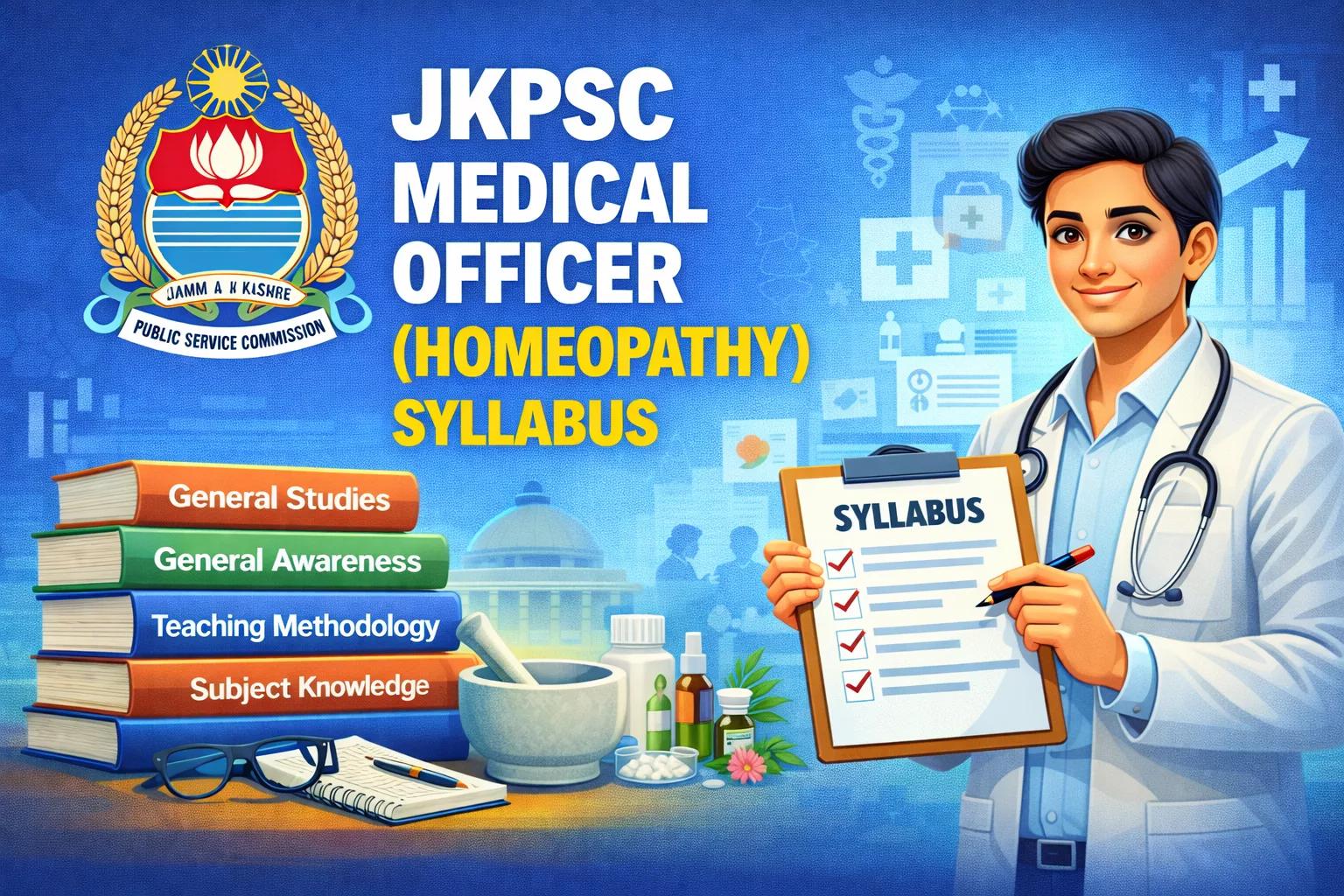
The Jammu and Kashmir Public Service Commission (JKPSC) conducts the recruitment for Medical Officer (Homeopathy) within the Health & Medical Education Department. This role is a prestigious Gazetted-level position, requiring a profound understanding of both clinical medical sciences and the core principles of Homeopathy.
This guide provides a comprehensive breakdown of the official syllabus, exam pattern, and institutional requirements for aspirants aiming to serve in the J&K healthcare ecosystem.
JKPSC Medical Officer (Homeopathy) Exam Overview
The selection process is primarily driven by a Written Test (MCQ Type) designed to assess the candidate’s proficiency across the undergraduate BHMS curriculum.
| Feature | Details |
| Examining Body | Jammu and Kashmir Public Service Commission (JKPSC) |
| Post Name | Medical Officer (Homeopathy) |
| Department | Health & Medical Education Department, J&K |
| Test Format | Multiple Choice Questions (MCQ) |
| Academic Level | Degree Level (Bachelor of Homoeopathic Medicine and Surgery) |
Detailed Subject-Wise Syllabus Breakdown
The syllabus is divided into foundational medical sciences and specialized Homeopathic subjects.
1. Foundational Medical Sciences
These subjects form the bedrock of the clinical examination, ensuring Medical Officers possess a standard medical knowledge base.
- Anatomy: Includes General Anatomy (cell biology, genetics), Developmental Anatomy (Embryology), and Regional Anatomy (Head, Neck, Thorax, Abdomen, and Extremities).
- Physiology: Covers General Physiology, Hematology, Cardiovascular, Respiratory, Digestive, Renal, and Endocrine systems, along with the Central Nervous System and Special Senses.
- Bio-Chemistry: Focuses on the metabolism of Carbohydrates, Lipids, and Proteins, as well as Enzymes, Vitamins, and Minerals.
- Pathology & Microbiology: General pathology (cell injury, inflammation), Systemic pathology, Immunology, Bacteriology, Virology, and Parasitology.
- Forensic Medicine & Toxicology: Personal identification, Autopsy procedures, Sexual offences, and clinical toxicology (Corrosives, Irritants, Neurotics, and Cardiac poisons).
2. Core Homeopathic Subjects
These modules are critical for the specialized practice of Homeopathy and carry significant weight in the competitive exam.
- Organon of Medicine & Philosophy: Concepts of Health, Disease, and Cure; Hahnemannian Philosophy; Miasmatic diagnosis; and Case Taking.
- Homoeopathic Pharmacy: History and Pharmacopoeia; drug sources; potentization; posology; and prescription writing.
- Homoeopathic Materia Medica: Study of 100+ remedies ranging from Aconitum napellus to Zincum metallicum, including polychrests, nosodes, and rare medicines .
3. Clinical & Allied Sciences
- Surgery: General surgical principles, fluid balance, infections, and systemic surgery (ENT, Ophthalmology, and Orthopedics).
- Gynaecology & Obstetrics: Fundamentals of reproduction, antenatal care, normal and abnormal labor, and disorders of the female genital tract.
Essential Homeopathic Medicines for Study
The JKPSC syllabus specifically lists numerous medicines for detailed study. Candidates should focus on the “Drug Picture,” keynotes, and clinical applications of:
- Vegetable Kingdom: Belladonna, Nux Vomica, Pulsatilla, Lycopodium.
- Mineral Kingdom: Arsenicum Album, Sulphur, Calcarea Carb, Natrum Mur.
- Animal Kingdom & Nosodes: Lachesis, Tarentula, Psorinum, Medorrhinum.
Download the official syllabus for the post of Medical Officer (Homeopathy)
Preparation Strategy for Aspirants
- Standard Textbook Alignment: Use standard texts like Allen’s Keynotes for Materia Medica and Boericke’s Repertory for clinical correlations.
- Organon Mastery: Focus on the Aphorisms. High-scoring candidates often memorize the essence of key aphorisms related to chronic diseases and case taking.
- Anatomy & Physiology Diagrams: Since these subjects are extensive, use visual aids to remember regional anatomy and physiological pathways.4. Practice MCQs: Solve previous years’ JKPSC Medical Officer papers to understand the “tilt” of questions—whether they are more clinical or philosophy-oriented.
Frequently Asked Questions (FAQs)
Generally, a Bachelor of Homoeopathic Medicine and Surgery (BHMS) from a recognized university and registration with the J&K Medical Council is mandatory.
Yes, typically JKPSC follows a negative marking system where 0.25 marks are deducted for every wrong answer.
The official notification primarily emphasizes professional subjects; however, staying updated with J&K’s current health schemes and tribal healthcare initiatives is recommended for the interview stage.
Also Read: JKPSC Medical Officer (Ayurvedic) Syllabus