KVS PRT Syllabus 2026: Complete Exam Pattern & Topic List
Contents
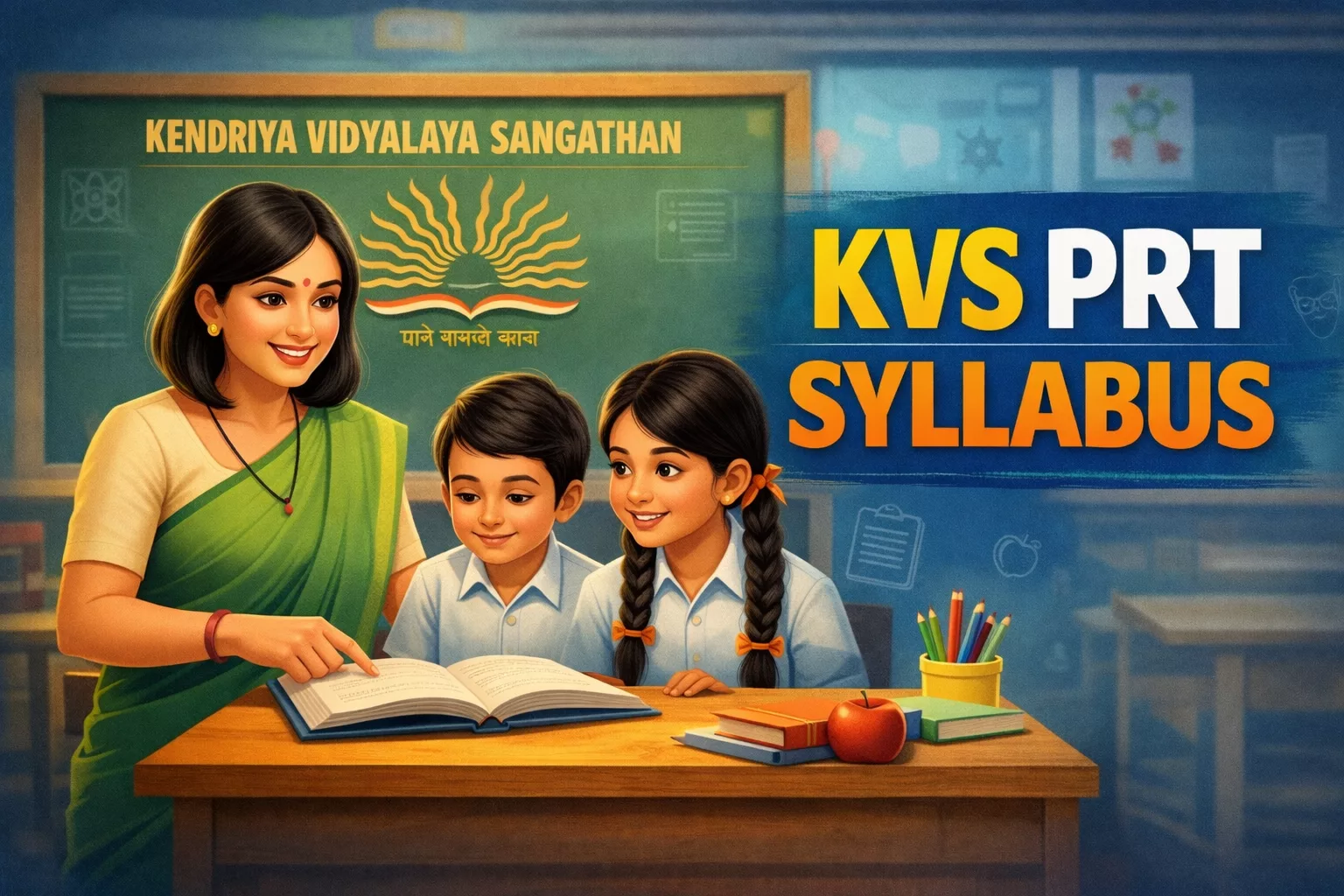
Preparing for the KVS PRT Syllabus 2026 requires a strategic approach and a deep understanding of the exam framework. The Kendriya Vidyalaya Sangathan (KVS) Primary Teacher (PRT) recruitment is one of the most sought-after teaching positions in India. With the Syllabus 2026 expected to align closely with previous years, candidates must master the Exam Pattern and specific topics to secure a high rank. This guide provides a 360-degree view of the syllabus, ensuring you have the definitive resource for your preparation journey.
Quick Overview Table
| Feature | Details |
|---|---|
| Exam Name | KVS PRT Recruitment 2026 |
| Conducting Authority | Central Board of Secondary Education (CBSE) |
| Post Name | Primary Teacher (PRT) |
| Selection Process | Written Examination, Demo Teaching (PCT), Interview |
| Total Marks | 180 |
| Number of Questions | 180 |
| Duration | 180 Minutes (3 Hours) |
| Negative Marking | No Negative Marking |
| Official Website | kvsangathan.nic.in |
Selection Process
The KVS PRT Syllabus 2026 is designed to filter the best candidates through a rigorous three-stage selection process. Understanding each stage is crucial for targeted preparation.
- Written Examination: The first stage is a Computer Based Test (CBT) or Offline Mode (depending on final notification) covering General English, Hindi, GK, Reasoning, Computer, and Pedagogy. It serves as a screening test.
- Demo Teaching (Professional Competency Test): Candidates who qualify the written exam must deliver a demo lesson. This tests classroom management, teaching methodology, and subject delivery.
- Interview: The final stage assesses personality, communication skills, and overall suitability for the teaching profession.
Interactive-style Exam Pattern
The written examination for the KVS PRT Syllabus 2026 consists of 180 questions totaling 180 marks. The detailed subject-wise distribution is as follows:
| Subject/Section Name | Number of Questions | Maximum Marks | Duration |
|---|---|---|---|
| General English | 20 | 20 | 180 Minutes |
| General Hindi | 20 | 20 | |
| General Awareness & Current Affairs | 20 | 20 | |
| Reasoning Ability | 20 | 20 | |
| Computer Literacy | 10 | 10 | |
| Perspectives on Education and Leadership | 90 | 90 | |
| Total | 180 | 180 | 180 Minutes |
Negative Marking: There is no negative marking in the KVS PRT written examination, allowing candidates to attempt all questions without penalty.
Topic-Wise Detailed Syllabus
Below is the comprehensive KVS PRT Syllabus 2026 broken down by subject. Each topic listed is critical for scoring high marks.
1. General English
This section tests basic proficiency in the English language.
- Vocabulary, Grammar, and Comprehension: Fundamental rules of grammar and usage.
- Synonyms and Antonyms: Identifying words with similar or opposite meanings.
- Spotting Errors and Sentence Improvement: Identifying grammatical errors and correcting sentences.
- Fill in the Blanks & Cloze Test: Contextual usage of words.
2. General Hindi
This section assesses proficiency in the Hindi language.
- शब्द सामर्थ्य और शब्दावली (Vocabulary): Synonyms, Antonyms, and word meanings.
- पठन कौशल और समझ (Reading Comprehension): Understanding passages and answering questions.
- व्याकरण और भाषा का प्रयोग (Grammar): Sentence correction, idioms, and proverbs.
3. General Awareness & Current Affairs
This section covers static GK and recent events.
- Indian History: Ancient, Medieval, and Modern History of India.
- Geography: Physical and political geography of India and the world.
- Polity: Indian Constitution, governance, and political system.
- Arts and Culture: Indian heritage, dance, music, and literature.
- Economy: Basic economic concepts and Indian economy.
- Awards and Sports: Recent national and international awards, trophies, and sports events.
- Current Events: National and international current affairs.
4. Reasoning Ability
This section tests logical and analytical skills.
- Analogies and Puzzles: Similarities, differences, and logical puzzles.
- Series Completion: Number and letter series.
- Direction Sense: Navigational logic and distances.
- Blood Relation: Family tree logic.
- Odd One Out: Identifying the dissimilar item.
- Verbal and Non-Verbal Reasoning: Visual and logical analysis.
5. Computer Literacy
This section tests basic IT knowledge.
- Basics of Computers and Operating Systems: Hardware, software, and OS functions.
- MS Office Applications: Word, Excel, and PowerPoint usage.
- Internet Usage: Browsing, searching, and downloading.
- Email Communication: Composing and managing emails.
- File Management: Creating, saving, and organizing files.
- Digital Security and Cyber Awareness: Cybercrimes, passwords, and safety measures.
6. Perspectives on Education and Leadership
This is the highest-weightage section in the KVS PRT Syllabus 2026.
- Child Development and Pedagogy: Growth, development, and theories of learning (Piaget, Vygotsky, Kohlberg).
- Inclusive Education: Addressing diverse learners and children with special needs.
- Classroom Management: Discipline, motivation, and teaching aids.
- Learning Theories: Behaviorist, Cognitivist, and Constructivist approaches.
- Assessment Methods: Formative and summative evaluation.
- Leadership and School Organization: School structure and educational administration.
- Educational Technology: Use of technology in teaching-learning.
Download KVS PRT Syllabus 2026 PDF
Aspirants can access the detailed KVS PRT Syllabus 2026 PDF to get a printable overview of all topics essential for the exam.
Click Here – KVS PRT Syllabus PDF
Preparation Master Tips
To excel in the KVS PRT Syllabus 2026, implement these high-value strategies:
- Master the Pedagogy Section: Since 90 marks are dedicated to Perspectives on Education, prioritize NCERT Education psychology chapters and previous year question papers.
- Daily Current Affairs Ritual: Dedicate 30 minutes daily to reading newspapers and monthly magazines for the General Awareness section.
- Computer Literacy Practical: Don’t just read theory; practice MS Office shortcuts and basic internet operations on a PC.
- Speed and Accuracy: With 180 questions in 180 minutes, time management is key. Practice mock tests strictly timed for 180 minutes.
- Language Proficiency: For English and Hindi, focus on grammar rules and vocabulary building through daily reading.
Summary of Minimum Qualifying Marks
While the official cutoff varies every year based on category and difficulty level, candidates generally need to score a minimum percentage to qualify for the Demo Teaching round. Based on previous trends:
- General/OBC/EWS: 40% to 50% aggregate marks.
- SC/ST/PwBD: 35% to 40% aggregate marks.
Note: Meeting the minimum qualifying marks does not guarantee selection; final merit is based on combined scores of Written Exam, Demo Teaching, and Interview.
FAQs
The exam consists of 180 multiple-choice questions for 180 marks with a duration of 3 hours. There is no negative marking.
No, there is no negative marking for incorrect answers in the KVS PRT written examination.
The “Perspectives on Education and Leadership” section carries the highest weightage of 90 marks out of 180 total marks.
Major changes are unlikely, but candidates should always check the official notification for any updates in topics or exam pattern
The selection involves a Written Examination, followed by a Demo Teaching (Professional Competency Test) and an Interview.
You can download the official PDF from the KVS official website kvsangathan.nic.in under the recruitment section.
Candidates must have Senior Secondary (10+2) with 50% marks and a 2-year Diploma in Elementary Education (D.El.Ed) or equivalent.
Recommended books include NCERT textbooks for General Awareness, Arihant’s Pedagogy books, and previous year’s KVS question banks.
Yes, Computer Literacy is a specific section in the written exam, covering basics of computers, MS Office, and internet safety
The total duration of the exam is 180 minutes (3 hours) with no sectional time limits.