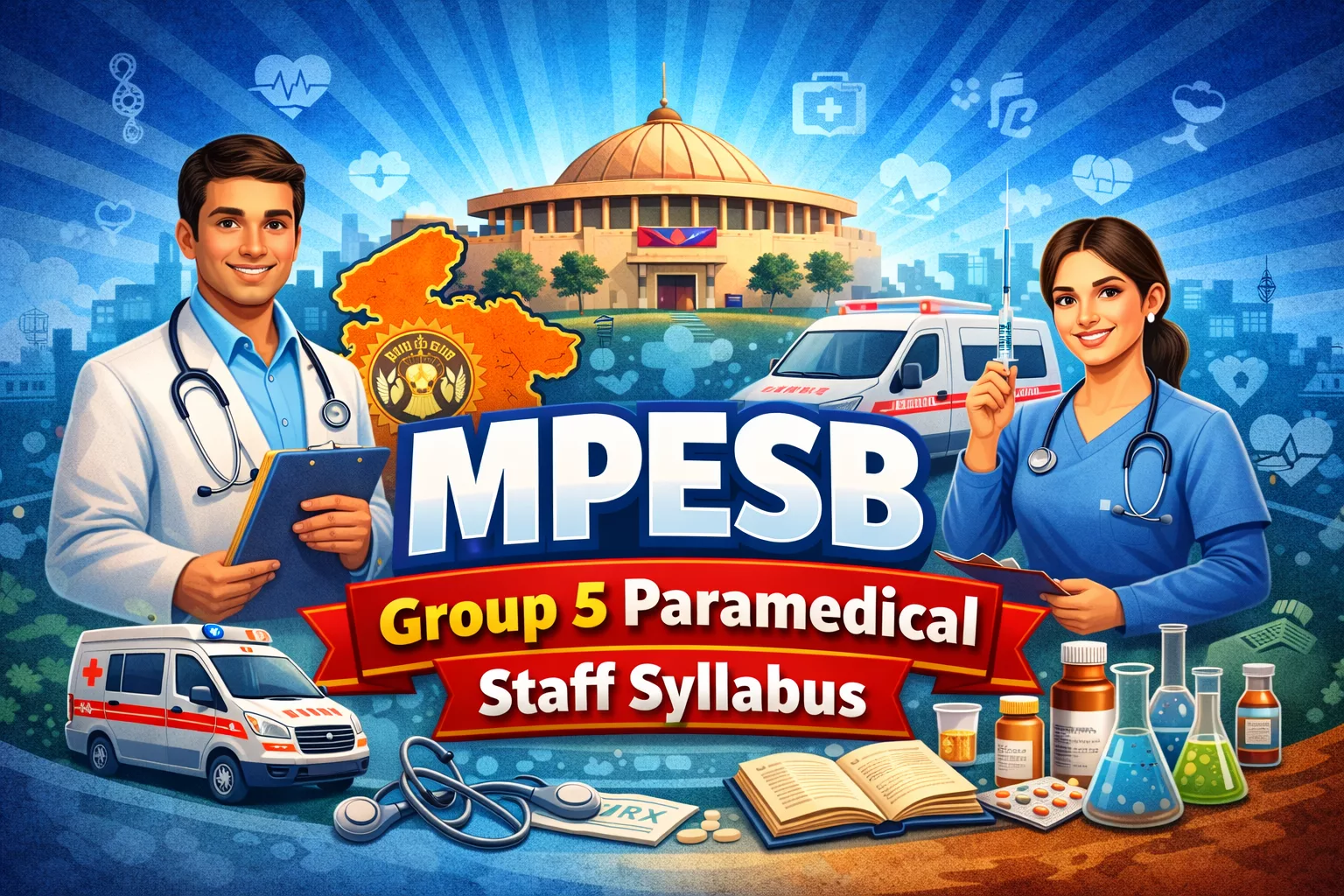
MPESB Group 5 Paramedical Staff Syllabus 2026: Complete Guide & Exam Pattern
Contents
The Madhya Pradesh Employees Selection Board (MPESB) has released the official syllabus and exam pattern for the Group 5 Paramedical Staff recruitment. This recruitment drive is a significant opportunity for candidates seeking government jobs in the medical sector in Madhya Pradesh, with 752 vacancies available. Understanding the detailed syllabus is the first step towards a successful preparation strategy.
Whether you are applying for Nursing, Pharmacist, Lab Technician, or other technical posts, the exam follows a standardized structure covering General Subjects and Technical/Professional subjects. This guide breaks down every aspect of the exam to help you prepare effectively.
Official Syllabus PDF Download
Aspirants are advised to download the official syllabus and notification for future reference. You can access the detailed PDF from the official MPESB portal.
Click Here to Download MPESB Group 5 Paramedical Staff Syllabus PDF
MPESB Group 5 Selection Process
The selection for Group 5 Paramedical Staff posts involves a multi-stage process designed to test the candidate’s knowledge and suitability for the role. Based on the official notification, the stages are:
- Written Examination: The primary screening test consisting of 100 objective-type questions.
- Document Verification: Candidates who qualify the written exam must produce original documents for verification.
- Medical Examination: Final selection is subject to the candidate meeting the required medical standards.
Detailed Exam Pattern
The MPESB Group 5 exam is a computer-based test (CBT) or written examination comprising two parts: Part A (General Subjects) and Part B (Technical/Professional Subjects). There is no negative marking in this exam, which allows candidates to attempt all questions without the fear of losing marks.
| Parameter | Details |
|---|---|
| Total Questions | 100 |
| Total Marks | 100 |
| Duration | 2 Hours (120 Minutes) |
| Negative Marking | No Negative Marking |
| Exam Mode | Written/Online (CBT) |
Section-wise Distribution
The exam generally consists of two major parts. Part A is common for all posts, while Part B is specific to the technical role applied for.
- Part A: General Subjects (General English, General Hindi, General Mathematics, General Science, General Knowledge, Reasoning & General Intelligence).
- Part B: Technical/Professional Subjects (Nursing, Pharmacy, Lab Technology, etc.).
Comprehensive Subject-wise Syllabus
Part A: General Subjects (For All Posts)
1. General English
- Grammar: Error detection, sentence improvement, active and passive voice, direct and indirect speech.
- Vocabulary: Synonyms, antonyms, and word meanings.
- Comprehension: Reading passages to answer questions.
- Sentence Arrangement: Jumbling of sentences to form a coherent paragraph.
2. General Hindi
- Vocabulary: Synonyms (Shabd Milap), Antonyms (Virudh Shabd), and Idioms and Phrases (Muhavare).
- Grammar: Sabdh (Nouns), Kriya (Verbs), Visheshan (Adjectives), and sentence construction.
- Language Mechanics: Sandhi (joining of words), plural forms (Vachan), and error correction.
3. General Mathematics
- Arithmetic: Simplification, Average, Percentage, Profit & Loss, Simple and Compound Interest.
- Mensuration: Area and Volume of geometric shapes.
- Algebra & Ratio: Ratio & Proportion, Time-Speed-Distance.
- Data Interpretation: Analysis of tables, bar graphs, and pie charts.
4. General Science
- Physics: Laws of Motion, Work, Energy, Power, Sound, Light, and Electricity.
- Chemistry: Acids, Bases, and Salts, Elements, Compounds, Chemical Reactions.
- Biology: Human Anatomy (Bones, Muscles, Nervous System), Physiology, Plant and Animal Kingdom basics.
5. General Knowledge
- Geography & History: Indian History, Madhya Pradesh Geography, and History.
- Civics: Indian Constitution, Political System, Governance.
- Current Affairs: National and International events, Sports, Awards, Summits.
- MP Specifics: Tourism, Wildlife, Government Schemes, Famous Personalities (Politics, Sports, Art, Literature).
6. Reasoning & General Intelligence
- Verbal Reasoning: Coding-Decoding, Analogy, Series (Number & Letter), Classification.
- Non-Verbal Reasoning: Pattern Recognition, Figure Series.
- Logical Thinking: Puzzles, Blood Relations, Direction Sense.
Part B: Technical/Professional Subjects (Post Specific)
1. Nursing
- Medical-Surgical Nursing: Anatomy, Physiology, Biochemistry, Surgical Nursing, and Critical Care.
- Specialized Nursing: Pediatric Nursing (Child Health), Midwifery (Obstetrical Nursing).
- Mental Health: Psychiatric Nursing, Psychology, and Sociology.
- Community Health: Community Health Nursing, Health Education, Epidemiology.
- Administration: Nursing Administration, Research Methodology, and Ethics.
2. Pharmacist
- Pharmaceutics: Dispensing Pharmacy, Hospital Pharmacy, Community Pharmacy, Pharmaceutical Techniques.
- Chemistry: Pharmaceutical Chemistry, Pharmaceutical Jurisprudence (Laws and Acts).
- Pharmacology: Drug actions, Toxicology, Clinical Pathology.
- Health Education: Public Health, Patient Counseling.
3. Lab Technician
- Pathology: Hematology (Blood), Biochemistry, Microbiology, Serology, Clinical Pathology.
- Tissue Studies: Histology (Tissue preparation and examination).
- Banking & Collection: Blood Banking, Specimen Collection methods.
- Safety: Bio-waste Management, Infection Control, and Safety Protocols.
4. Radiography / OT Technician / Other Technical Posts
- Anatomy & Physiology: Basic understanding of human body systems.
- Techniques: Radiographic Techniques, Radiation Safety, Imaging Procedures.
- Surgical Care: Surgical Instrument Handling, Pre- and Post-operative Care, OT Procedures.
- Safety: Infection Control protocols, Sterilization techniques.
Minimum Qualifying Marks
While the specific cut-off varies based on categories (General, SC/ST/OBC), candidates must secure a minimum passing percentage in the written examination to be eligible for the Document Verification stage. Typically, the requirement is:
- General / Unreserved: 45% – 50% Marks.
- Reserved Categories (SC/ST/OBC): 40% – 45% Marks.
Note: Exact qualifying marks will be specified in the official notification.
Preparation Strategy & Tips
To ace the MPESB Group 5 exam, candidates should adopt a structured approach. Here are tailored tips based on the exam pattern:
- Understand the Syllabus First: Before opening books, read the entire syllabus (both Part A and Part B) to know exactly what topics are covered.
- Focus on High-Weightage Topics: Since there is no negative marking, prioritize areas where you are strongest to maximize your score in the 2-hour duration.
- Balance General & Technical Studies: Allocate specific time slots for General Knowledge/Maths and your core technical subject (Nursing/Pharmacy/Lab). Do not neglect Part A.
- Practice Previous Year Questions (PYQs): Solving previous MPESB/MP Vyapam Group 5 papers will help you understand the question pattern and difficulty level.
- Time Management: With 100 questions in 120 minutes, you have roughly 1 minute per question. Practice mock tests to improve speed.
- Revision: Keep the last week solely for revision of formulas, dates, and technical terms.
FAQs: MPESB Group 5 Paramedical Staff
No, as per the official notification, there is no negative marking for incorrect answers in the written examination.
The exam duration is 2 hours (120 minutes) for 100 questions.
No, Part A (General Subjects) which includes English, Hindi, GK, Math, Science, and Reasoning is common for all posts. Only Part B (Technical Subjects) differs.
While the exact split isn’t defined in the overview, the exam pattern typically distributes 100 questions between Part A and Part B. Candidates should expect a significant portion related to their specific discipline (Nursing, Lab Tech, etc.) to demonstrate professional competency.
The exam is generally conducted as a Computer Based Test (CBT), though the notification designates it as a “Written Examination.” Candidates should prepare for both objective-type computer-based testing and traditional OMR sheet-based exams.
The Lab Technician syllabus under Part B covers Hematology, Biochemistry, Microbiology, Serology, Histology, Clinical Pathology, Blood Banking, and Waste Management.
Yes, the General Knowledge section specifically includes topics on Madhya Pradesh Geography, History, Government Schemes, and Wildlife, so focus on state-specific details.