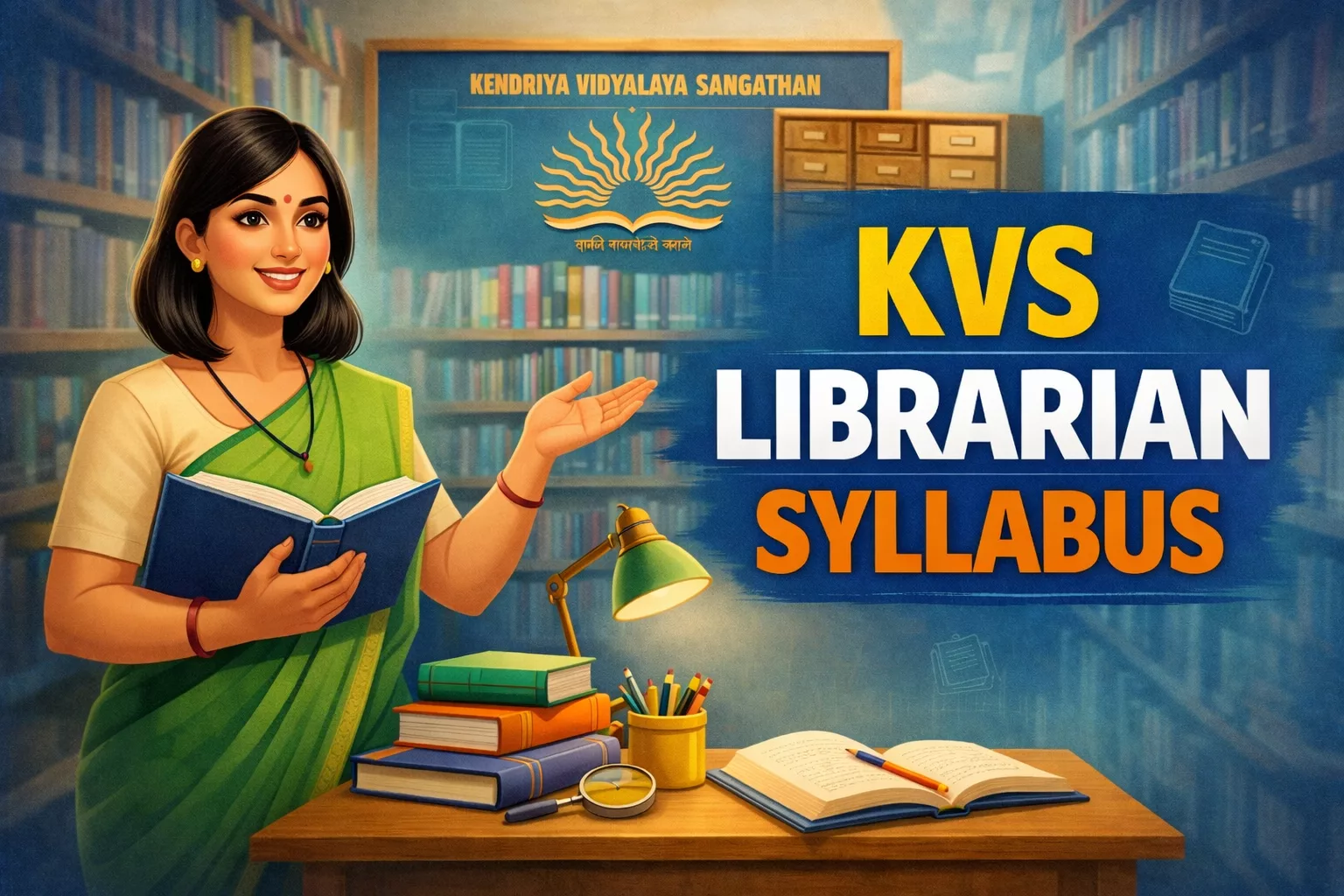
KVS Librarian Syllabus 2026: Exam Pattern, PDF & Preparation Tips
Contents
- 1 Quick Overview Table: KVS Librarian Recruitment 2026
- 2 KVS Librarian Selection Process 2026
- 3 Detailed KVS Librarian Exam Pattern 2026
- 4 KVS Librarian Syllabus 2026: Topic-Wise Breakdown
- 5 Download KVS Librarian Syllabus PDF
- 6 Preparation Master Tips for KVS Librarian 2026
- 7 Summary of Minimum Qualifying Marks
- 8 Competitive Advantage FAQs
The Kendriya Vidyalaya Sangathan (KVS), under the administrative control of the Central Board of Secondary Education (CBSE), has released the official notification and syllabus for the Librarian recruitment exam. With 147 vacancies announced, this is a significant opportunity for library science professionals. To crack this competitive exam, a deep understanding of the KVS Librarian Syllabus 2026 and the multi-tiered exam pattern is non-negotiable. This guide provides a 360-degree analysis of the syllabus, ensuring you have the definitive roadmap for success.
Quick Overview Table: KVS Librarian Recruitment 2026
| Particulars | Details |
|---|---|
| Exam Name | KVS Librarian Recruitment |
| Conducting Authority | Central Board of Secondary Education (CBSE) |
| Selection Process | Tier 1 (Screening) → Tier 2 (Main) → Interview |
| Official Website | kvsangathan.nic.in |
| PDF Link | Download Syllabus PDF |
KVS Librarian Selection Process 2026
The recruitment involves a rigorous three-stage process designed to filter the most competent candidates. It is crucial to clear each stage to proceed to the next.
1. Tier 1: Objective Type Screening Test
This is the first hurdle. It serves as a screening test to shortlist candidates for the Main examination. The paper will consist of General English, General Hindi, General Knowledge, Reasoning, and Computer Literacy.
2. Tier 2: Subjective/Descriptive Type Main Exam
Candidates who qualify in Tier 1 will appear for Tier 2. This exam specifically tests your core Library & Information Science knowledge. It requires in-depth conceptual clarity and descriptive writing skills.
3. Interview
The final stage assesses your personality, communication skills, and suitability for the role of a Librarian in a reputed institution like KVS.
Detailed KVS Librarian Exam Pattern 2026
Understanding the marking scheme and time allocation is vital for strategy. Here is the comprehensive exam pattern for both tiers.
Tier 1 Exam Pattern
| Subject/Section | No. of Questions | Max Marks |
|---|---|---|
| General English | 20 | 60 |
| General Hindi | 20 | 60 |
| General Knowledge & Current Affairs | 20 | 60 |
| Reasoning Ability | 20 | 60 |
| Computer Literacy | 20 | 60 |
| Total | 100 | 300 |
Duration: 2 Hours
Negative Marking: Yes, 1/4th mark will be deducted for every wrong answer.
Tier 2 Exam Pattern
| Subject | No. of Questions | Max Marks |
|---|---|---|
| Library & Information Science (Core Subject) | 70 | 100 |
| Total | 70 | 100 |
Duration: 2.5 Hours (150 Minutes)
Marking Scheme: Details regarding negative marking for Tier 2 are usually specified in the detailed notification.
KVS Librarian Syllabus 2026: Topic-Wise Breakdown
The syllabus is divided into two parts: General Studies (Tier 1) and Professional Knowledge (Tier 2). Below is the exhaustive list of topics you must cover.
Part 1: General Studies (Tier 1 Syllabus)
1. General English
- Grammar: Subject-verb agreement, Tenses, Articles, Active and Passive Voice.
- Vocabulary: Synonyms, Antonyms, Idioms and Phrases, Adverbs.
- Comprehension: Unseen passages and comprehension-based questions.
- Usage: Fill in the blanks, Sentence rearrangement, Error correction.
2. General Hindi
- Synonyms and Antonyms (Shabd Vivaran).
- Sandhi and Samas.
- Tenses (Kaal) and Sentence formation (Vakya Banav).
- Other important language topics including Muhavare and Lokoktiyan.
3. General Knowledge & Current Affairs
- Polity: Indian Constitution, Fundamental Rights, Parliament.
- Geography: Indian Geography (Physical, Economic, Human).
- Economy: Economic terminologies, Budget highlights, Five-Year Plans.
- General Awareness: Important days, Books and Authors, Awards and Honors.
- Science: Science and technology updates, General Science basics.
- Current Affairs: National and International events (last 6-12 months).
4. Reasoning Ability
- Verbal Reasoning: Series (Alpha-Numeric), Coding-Decoding, Blood Relations.
- Logical Deduction: Arguments, Statements and Conclusions.
- Non-Verbal Reasoning: Spatial visualization, Patterns.
- Arrangement: Seating arrangement, Puzzles.
5. Computer Literacy
- Fundamentals: Generations of computers, Hardware and Software basics, Memory/Storage concepts.
- Operating System: Basics of OS, Shortcuts.
- Internet & Networking: Web technologies, Social networking, Internet protocols.
- Abbreviations: Common computer-related abbreviations.
Part 2: Professional Knowledge (Tier 2 Syllabus)
1. Foundation of Library & Information Science
- Library as a Social Institution.
- National Library Policy.
- Library Laws and Acts.
- Five Laws of Library Science (Ranganathan).
- Library Associations (National and International).
2. Knowledge Organization, Information Processing & Retrieval
- Cataloguing: Principles, Types (Primary, Secondary), Standards (AACR2, RDA).
- Classification: Dewey Decimal Classification (DDC), Colon Classification (CC).
- Indexing: PRECIS, Chain Indexing.
- Abstracting and Documentation.
- Bibliographic forms and standards.
3. Information Technology (Basics)
- Library Automation (ILS/LMS).
- Digital Libraries and Initiatives (NDL, DELNET).
- Database Management Systems (DBMS).
- Networking in Libraries (LAN, WAN, MAN).
- Search Engines and Boolean Operators.
4. Management of Libraries & Information Centres
- Library Planning and Building Design.
- Human Resource Management (HRM).
- Financial Management and Budgeting.
- Stock Verification and Weeding out policies.
- Library Legislation and Acts (Public Library Act).
5. Information Sources & Services
- Reference Services: Referral Service, Information Retrieval.
- Information Sources: Primary, Secondary, and Tertiary sources.
- Types of Documents: Encyclopedias, Dictionaries, Atlases, Yearbooks.
- Current Awareness Services (CAS) and Selective Dissemination of Information (SDI).
- Bibliographic services.
6. Library Users
- User Education and Orientation.
- User Studies and Surveys.
- Reading Habits and Types of Users (Children, Adults, Scholars).
- User Psychology.
Download KVS Librarian Syllabus PDF
Aspirants are advised to keep a copy of the official syllabus for reference. Click the link below to access the official notification containing the detailed syllabus.
Click Here to Download KVS Librarian Syllabus PDF
Preparation Master Tips for KVS Librarian 2026
- Analyze the Weightage: Since Tier 1 has equal distribution (20 questions each), do not ignore General Hindi or Computer Literacy, as these are often scoring areas.
- Focus on Core LIS Subjects: Tier 2 is the game-changer. Deeply study Ranganathan’s Five Laws, Cataloguing rules, and Classification Schemes (DDC/CC). Use standard textbooks like Library Science with Digital Concepts or RRKumar.
- Current Affairs Strategy: Dedicate 30 minutes daily to newspapers for Current Affairs and Static GK (Books and Authors, Important Days).
- Mock Tests & Previous Papers: Solving previous years’ KVS PGT/TGT or CTET Library papers will help you understand the question pattern and improve speed (since there is negative marking).
- Time Management in Tier 2: The Tier 2 exam is 2.5 hours for 70 questions. This implies subjective/descriptive answers. Practice writing detailed answers within a time limit.
Summary of Minimum Qualifying Marks
While the specific cut-off varies every year based on vacancies and competition, candidates generally need to secure the following minimum marks to be eligible for the next stage (subject to official notification rules):
- General/EWS/OBC: 40% to 50% aggregate.
- SC/ST/PwBD: 35% aggregate.
Competitive Advantage FAQs
The Tier 1 syllabus comprises five sections: General English, General Hindi, General Knowledge & Current Affairs, Reasoning Ability, and Computer Literacy. Each section carries 20 questions.
Yes, as per the official pattern, there is a negative marking of 1/4th mark for every incorrect answer in Tier 1.
There are two objective-type written tests: Tier 1 (Screening) and Tier 2 (Main). This is followed by an Interview.
The questions (except for English and Hindi language sections) are generally available in both English and Hindi languages.
Candidates are allotted 2.5 hours (150 minutes) to complete the Tier 2 examination.
Standard Library Science textbooks by authors like R.K. Sharma or M. Kumar covering core concepts like Cataloguing, Classification, and Management are recommended.
Yes, candidates qualifying Tier 2 will be called for an interview, which carries weightage in the final merit list.
The exam is typically conducted in Offline (OMR Sheet) or Online (CBT) mode depending on the number of applicants. Refer to the admit card for specifics.