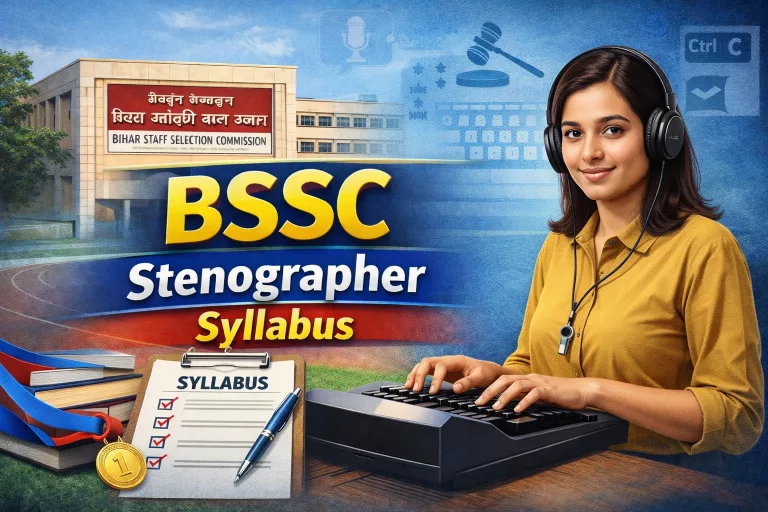
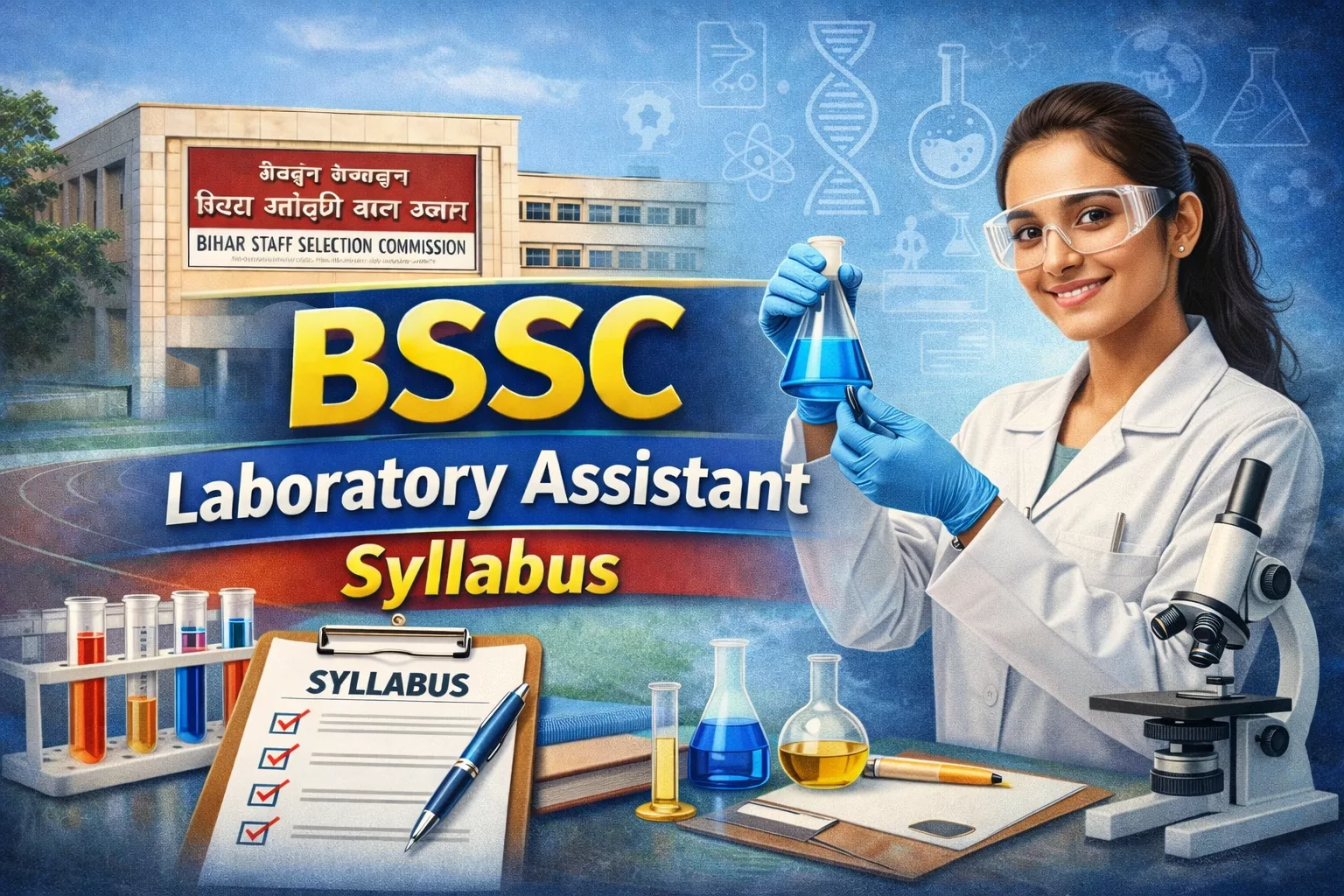
BSSC Laboratory Assistant Syllabus 2026: Exam Pattern & Topics
Contents
- 1 Quick Overview Table: BSSC Laboratory Assistant 2026
- 2 Selection Process for BSSC Laboratory Assistant
- 3 Interactive-style Exam Pattern 2026
- 4 Topic-Wise Detailed BSSC Laboratory Assistant Syllabus 2026
- 5 Download BSSC Laboratory Assistant Syllabus PDF 2026
- 6 Preparation Master Tips for BSSC Laboratory Assistant 2026
- 7 Summary of Minimum Qualifying Marks
- 8 FAQs
Looking for the BSSC Laboratory Assistant Syllabus 2026? You have come to the right place. The Bihar Staff Selection Commission (BSSC) is expected to release the official notification for the Laboratory Assistant recruitment soon. To crack this competitive exam, a deep understanding of the syllabus and exam pattern is the first step toward success.
The BSSC Laboratory Assistant Syllabus 2026 defines the scope of the recruitment examination for aspiring lab technicians in Bihar. It encompasses a wide range of topics from General Knowledge and Science to specific Technical Subjects related to laboratory procedures. Understanding the Syllabus 2026 in detail allows candidates to prioritize topics, manage time effectively, and focus on high-yield areas. This comprehensive guide covers every aspect of the Exam Pattern, subject-wise breakdown, and preparation strategies to help you secure a government job in the health department.
Quick Overview Table: BSSC Laboratory Assistant 2026
Before diving into the detailed topics, here is a snapshot of the key details regarding the recruitment process. (Based on the previous cycle and expected trends).
| Particulars | Details |
|---|---|
| Recruitment Body | Bihar Staff Selection Commission (BSSC) |
| Post Name | Laboratory Assistant |
| Mode of Application | Online |
| Selection Process | Prelims & Mains |
| Total Marks | 600 |
| Official Website | bssc.bihar.gov.in |
Selection Process for BSSC Laboratory Assistant
The selection mechanism is designed to test a candidate’s general awareness, mental ability, and domain-specific knowledge. The process generally involves two written stages:
- Preliminary Examination: This is a screening test consisting of objective-type questions. It is qualifying in nature but crucial for shortlisting candidates for the Mains.
- Mains Examination: Candidates who clear the Prelims appear for the Mains, which is usually descriptive in nature (though pattern may vary, the source mentions a question-based pattern). This stage carries higher weightage in the final merit list.
Interactive-style Exam Pattern 2026
To master the BSSC Laboratory Assistant Syllabus, you must understand the marking scheme and time management. Based on the provided source data, here is the detailed exam structure:
| Subject/Section Name | No. of Questions | Max Marks | Duration |
|---|---|---|---|
| General Knowledge | 30-40 (Approx) | 120 | 2 Hours (120 Minutes) |
| General Science | 30-40 (Approx) | 120 | |
| Mathematics | 30-40 (Approx) | 120 | |
| Reasoning Ability | 30-40 (Approx) | 120 | |
| Technical Subject | 40-50 (Approx) | 120 | |
| Total | 150 | 600 | 2 Hours |
Negative Marking Rules
It is vital to avoid blind guessing. As per the source material:
- 1 mark will be deducted for every incorrect answer.
- Unattempted questions usually carry no penalty.
Topic-Wise Detailed BSSC Laboratory Assistant Syllabus 2026
The following breakdown is the core of your preparation strategy. We have expanded the source topics into actionable sub-topics to ensure 100% coverage.
1. General Knowledge
This section tests your awareness of the world around you, with a special emphasis on Bihar.
- Current Affairs: National & International events, Sports, Awards, Summits, Important Dates.
- Indian History: Ancient, Medieval, and Modern History; Freedom Struggle.
- Indian Geography: Physical Geography, Rivers, Mountains, Climate.
- Indian Polity: Constitution, Fundamental Rights, Parliament, Panchayati Raj.
- Indian Economy: Five-Year Plans, GDP, Banking, Taxes.
- Environment & Ecology: Pollution, Climate Change, Conservation.
- General Science: Everyday science phenomena.
- Bihar-specific GK: History, Culture, Geography, Economy of Bihar.
2. General Science
This section is crucial for a Laboratory Assistant role as it forms the base of technical knowledge.
- Physics:
- Units and Dimensions
- Linear & Circular Motion
- Work, Power, and Energy
- Heat and Thermodynamics
- Light (Reflection & Refraction)
- Sound and Waves
- Electricity and Magnetism
- Chemistry:
- Elements, Compounds, and Mixtures
- Acids, Bases, and Salts
- Chemical Reactions and Equations
- Periodic Table
- Carbon and its Compounds
- Biology:
- Cell Structure and Functions
- Human Tissues and Organs
- Human Systems (Respiratory, Circulatory, Nervous, etc.)
- Microorganisms (Bacteria, Viruses, Fungi)
- Diseases and Prevention
- Plant and Animal Kingdom Basics
3. Mathematics
Focus on calculation speed and accuracy.
- Number System (LCM, HCF, Divisibility)
- Percentages
- Ratio and Proportion
- Simple and Compound Interest
- Profit and Loss
- Time, Speed, and Distance
- Time and Work
- Averages
- Mensuration (2D and 3D figures)
- Algebra (Basic Equations, Polynomials)
- Geometry (Lines, Angles, Triangles, Circles)
4. Reasoning Ability
Aptitude and logical thinking are tested here.
- Verbal Reasoning: Coding-Decoding, Series (Number/Alphabet), Analogy, Classification.
- Non-Verbal Reasoning: Pattern Completion, Figure Series.
- Analytical Logic: Blood Relations, Direction Sense Test, Sitting Arrangement.
- Logical Deduction: Venn Diagrams, Syllogism, Statement & Conclusion.
5. Technical Subject (Lab Assistant Related)
This is the specialist section that determines your rank. It covers practical lab knowledge.
- Basic Laboratory Techniques: Pouring, Mixing, Heating, Filtration, Decantation.
- Chemistry Laboratory Procedures: Preparation of standard solutions, Titration basics.
- Handling Laboratory Equipment: Microscope, Centrifuge, Test tubes, Beakers, Pipettes, Burettes.
- Safety and Precautions: Handling chemicals, Fire safety, First Aid, Disposal of waste.
- Sample Collection & Preservation: Methods for collecting blood, urine, stool samples; preservation techniques.
- Basic Microbiology: Staining techniques (Gram staining), Culture methods.
- pH Measurement: Using pH paper and pH meter.
- Reagent Preparation: Standard reagents used in pathology/chemistry.
- Sterilization Methods: Autoclaving, boiling, chemical disinfection.
- Glassware Cleaning and Maintenance: Washing, drying, and storing lab glassware.
Download BSSC Laboratory Assistant Syllabus PDF 2026
Candidates are advised to keep a physical and digital copy of the syllabus for tracking their progress.
Click Here – Download Official BSSC Syllabus PDF
Preparation Master Tips for BSSC Laboratory Assistant 2026
To maximize your score in the BSSC Laboratory Assistant Syllabus 2026, implement these advanced strategies:
- Master the Technical Syllabus First: Since you are applying for a Lab Assistant role, the Technical Subject (worth ~120 marks) is your differentiator. Prioritize understanding practical lab scenarios over rote memorization.
- Static GK + Bihar Focus: For the GK section, create a dedicated notebook for “Bihar Specific Facts” (History, Rivers, Census data). This gives you an edge over non-local candidates.
- Science Formula Sheet: Physics and Chemistry in this exam are usually at the 10th/12th grade level. Create a one-page formula sheet for quick revision.
- Mock Tests & Negative Marking Strategy: Since there is a -1 mark penalty, practice sectional mocks. Learn to skip questions where you are less than 50% sure.
- Visual Learning for Biology: Use diagrams to learn Human Systems and Cell structures. Visual memory lasts longer for biology-heavy questions.
Summary of Minimum Qualifying Marks
While the official cut-off for 2026 will be released with the result, candidates generally need to secure:
- General/UR: 40% – 45% aggregate marks.
- BC/EBC: 36% – 38% aggregate marks.
- SC/ST: 32% – 35% aggregate marks.
Note: Qualifying marks do not guarantee a job; the final selection depends on the merit list based on performance in Mains.
FAQs
Here are the most frequently asked questions regarding the BSSC Laboratory Assistant Exam 2026.
Based on the source, the selection process involves Prelims and Mains. While the preliminary exam is objective, the Mains pattern (Descriptive vs Objective) should be verified in the official notification.
The technical subject is generally of a Diploma/ITI level or Class 12 Biology/Chemistry level. It focuses heavily on practical laboratory applications.
No, usually, the negative marking is uniform across the paper. 1 mark is deducted for every wrong answer regardless of the section.
There is no specific limit on the number of attempts provided you are within the age limit (typically 18-37 years for males and 40 for females in Bihar).
Yes, the question paper is generally available in both Hindi and English languages.
The source material indicates a written Prelims and Mains. There is no mention of a separate practical skill test, but the written technical paper covers practical knowledge.
The Mains exam duration is typically longer than Prelims, often 2 hours per paper, but candidates must wait for the official notification for exact timings.
Yes, candidates with relevant educational qualifications (like 10+2 with Science or Diploma) are eligible. Check the detailed educational qualification in the official notification.
It is usually of moderate difficulty, covering basic concepts of Physics, Chemistry, and Biology taught up to the high school level.
The salary falls under Pay Level 2 or 3 of the 7th Pay Commission, roughly between Rs 21,000 to Rs 40,000 per month depending on the post and grade pay.