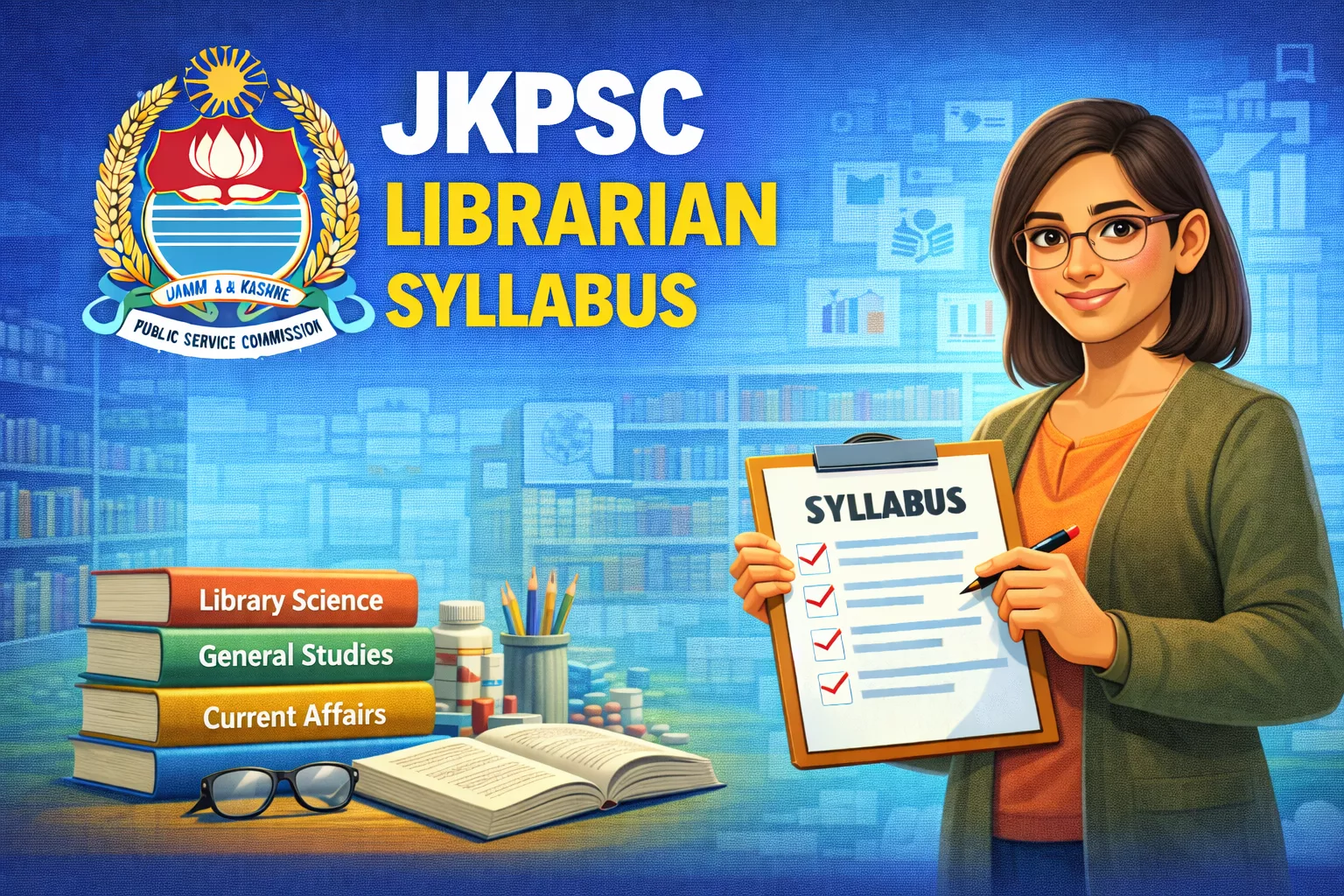
JKPSC Librarian Syllabus: A Guide for Higher Education Aspirants
Contents
The JKPSC Librarian position within the Higher Education Department is a critical faculty-equivalent role. Librarians in this sector are no longer just “keepers of books” but are Knowledge Managers who bridge the gap between traditional academic resources and the digital information explosion.
This guide provides a structured breakdown of the official syllabus, focusing on the evolution of library science from physical stacks to virtual gateways.
Recruitment Context: The Academic Librarian
Recruitment for this post is handled by the Jammu and Kashmir Public Service Commission (JKPSC). Unlike administrative roles, a Librarian in the Higher Education Department must master Information Science, research methodologies, and the technical infrastructure of digital libraries to support students and faculty.
Detailed Syllabus Breakdown
1. Information Science & Legal Framework (Unit I)
This foundation unit treats information as a vital commodity for socio-economic development and planning.
- Information Society: The transition from industrial to knowledge-based societies.
- Legislative Knowledge: Mastery of the Right to Information (RTI) Act, IT Act, and Intellectual Property Rights (IPR).
- Academic Integrity: Understanding Plagiarism and the Delivery of Books and Newspapers (Public Libraries) Act.
2. Library Ecosystem & Policy (Unit II & III)
These units cover the institutional landscape of libraries in India.
- Institutional Growth: The pivotal roles of the UGC (University Grants Commission) and RRRLF (Raja Rammohun Roy Library Foundation).
- The Five Laws: Deep application of Ranganathan’s Five Laws of Library Science.
- Professional Bodies: Familiarity with Library Associations at both National and International levels.
- Resource Sharing: Modern concepts of library networking and legislation in India.
3. Information Sources & Knowledge Organization (Unit IV & V)
This core technical area focuses on how information is categorized and retrieved.
- E-Resources: Managing digital assets including e-books, e-journals, databases, and web portals.
- Classification & Cataloguing: Technical proficiency in DDC (Dewey Decimal Classification) and AACR-2 (Anglo-American Cataloguing Rules).
- Vocabulary Control: Use of Thesauri and Subject Headings for efficient indexing.
4. ICT & Digital Transformation (Unit VI)
The modern librarian must be a technologist. This unit covers the digital shift:
- Automation: Transitioning from manual ledgers to automated library management systems.
- Digital vs. Virtual Libraries: Understanding the nuances of stored digital objects versus purely online access environments.
- Digitization: The process of converting physical collections into searchable digital formats.
5. Management & Research (Unit VII & VIII)
Administrative and academic skills required for senior roles.
- Operations: Collection development, financial management, and human resource management.
- Infrastructure: Planning library buildings and essential infrastructure.
- Quality Control: Total Quality Management (TQM) and performance evaluation of library services.
- Research Metrics: Using Library Metrics, research design, and conducting user studies to improve education services.
Core Competency Overview
| Domain | Focus | Key Requirement |
| Technical | Classification & Cataloguing | Mastery of DDC and AACR-2. |
| Technological | ICT & Automation | Proficiency in library software and networking. |
| Legal | Acts & Ethics | Understanding RTI, IT Act, and Plagiarism rules. |
| Academic | Research & Metrics | Ability to conduct user studies and evaluate services. |
FAQs
The syllabus specifically highlights the Dewey Decimal Classification (DDC) for knowledge organization.
Yes. A significant portion of the syllabus (Unit VI) is dedicated to ICT applications, Library Automation, and the management of E-resources.
Yes. Candidates must understand the roles of the UGC and the RRRLF in the development of Indian libraries.
Yes. You are expected to know the Right to Information Act, IT Act, and laws governing the delivery of books to libraries.
Official Resources
- Official Syllabus PDF: Download from JKPSC
- Issuing Authority: Jammu and Kashmir Public Service Commission (JKPSC)