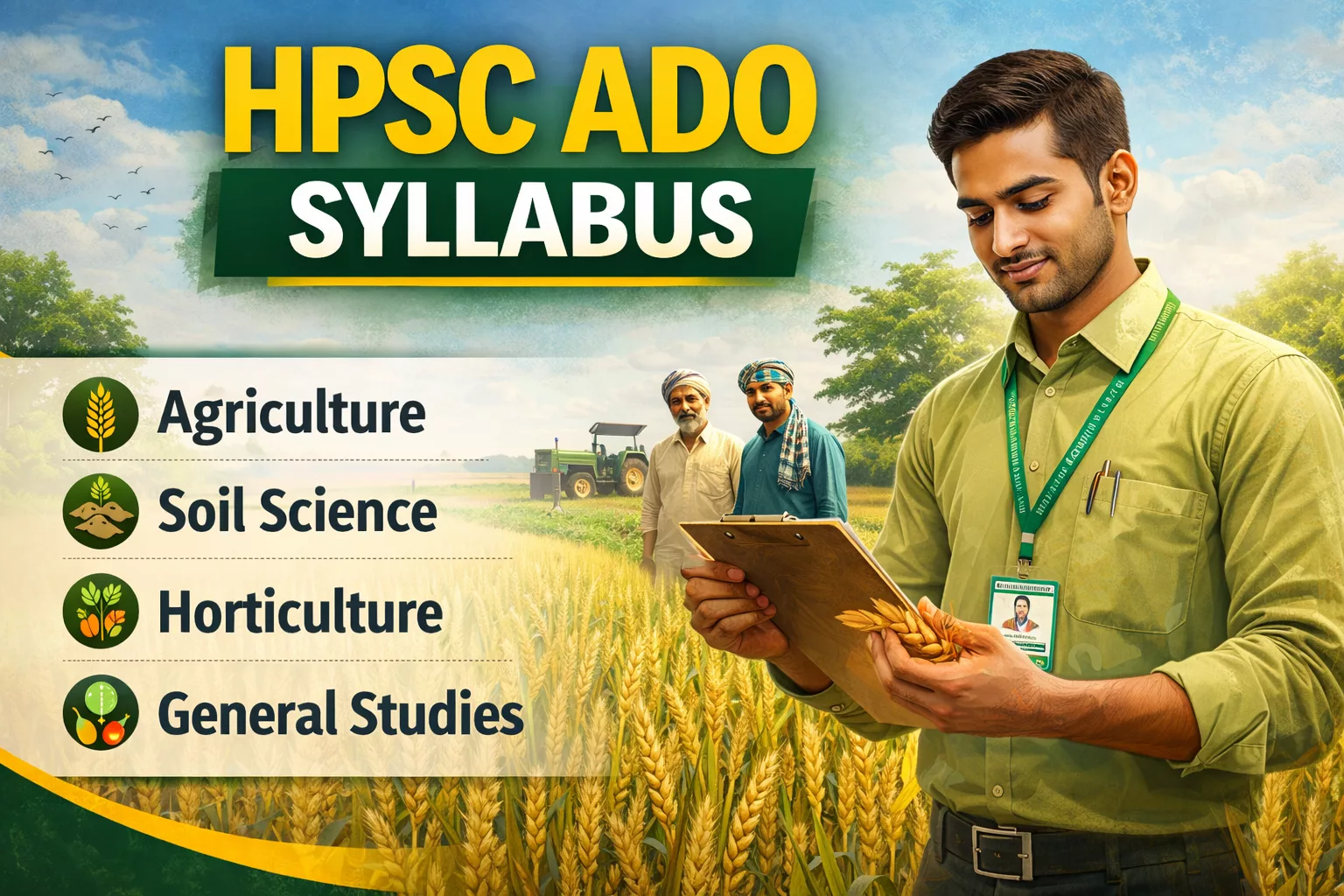
HPSC ADO Syllabus & Exam Pattern 2026: Detailed Guide & Topics
Contents
- 1 About HPSC ADO Exam
- 2 Selection Process
- 3 Detailed Exam Pattern
- 4 Comprehensive Subject-wise Syllabus
- 4.1 1. Ecology and Environment
- 4.2 2. Agronomy and Cropping Systems
- 4.3 3. Forestry
- 4.4 4. Weed Science
- 4.5 5. Soil Science and Nutrient Management
- 4.6 6. Soil Conservation and Water Management
- 4.7 7. Farm Management and Agricultural Economics
- 4.8 8. Agricultural Extension
- 4.9 9. Plant Breeding and Genetics
- 4.10 10. Seed Technology and IPR
- 4.11 11. Plant Physiology
- 4.12 12. Horticulture
- 5 Minimum Qualifying Marks
- 6 Preparation Strategy
- 7 FAQs
In today’s competitive job market, securing a government job is a dream for many. If you aspire to work in the Agriculture Development Officer (ADO) role under the Haryana Public Service Commission (HPSC), you must be well-prepared. Understanding the HPSC ADO syllabus and exam pattern is the first step towards achieving your goal. This comprehensive guide will provide you with all the information you need to succeed in this highly sought-after examination.
The HPSC ADO exam is a gateway to a promising career in the agricultural sector of Haryana. To crack this exam, you need a well-structured plan and a thorough understanding of the syllabus and exam pattern.
Official Notification & Syllabus PDF
Candidates are advised to download the official syllabus and notification for future reference. Click the link below to download the PDF:
| Download Link |
|---|
| Download HPSC ADO Syllabus & Exam Pattern 2026 PDF |
About HPSC ADO Exam
The Haryana Public Service Commission conducts the Agriculture Development Officer (ADO) examination to recruit eligible candidates for the ADO position. This examination aims to assess candidates’ knowledge and skills in the field of agriculture.
Exam Overview
| Organization Name | Haryana Public Service Commission (HPSC) |
| Post Name | Agriculture Development Officer |
| Category | Syllabus |
| Job Location | Haryana |
| Official Site | hpsc.gov.in |
Selection Process
Based on the provided source content, the selection process for the HPSC ADO examination involves a written examination designed to test the candidate’s agricultural knowledge. While the source primarily details the written exam pattern, the standard recruitment flow typically includes:
- Written Examination (Single Paper): The primary stage of the selection process.
- Interview/Skill Test: May be conducted depending on the final recruitment rules (not explicitly detailed in source but standard for HPSC Group B posts).
Detailed Exam Pattern
Below is the detailed HPSC Agriculture Development Officer Exam Pattern. The exam is objective in nature.
HPSC ADO Written Exam Structure
| Post Name | No. of Questions | Maximum Marks |
|---|---|---|
| Agricultural Development Officer (Administrative Cadre) (Group-B) | 100 | 100 |
| Duration of Paper: 2 Hours | ||
Key Examination Details
- Total Marks: 100
- Total Questions: 100
- Duration: 2 Hours (120 Minutes)
- Negative Marking: As per the FAQ section, there is a negative marking of 1/4th (0.25 marks) for every incorrect answer.
Comprehensive Subject-wise Syllabus
The HPSC ADO Syllabus covers a wide range of topics in agriculture and allied sciences. Below is the detailed breakdown of topics derived from the official source.
1. Ecology and Environment
- Ecology and its relevance to man
- Natural resources, their sustainable management and conservation
- Physical and social environment as factors of crop distribution and production
- Agro ecology
- Cropping pattern as indicators of environments
- Environmental pollution and associated hazards to crops, animals, and humans
- Climate change-international conventions and global initiatives
- Greenhouse effect and global warming
- Advance tools for ecosystem analysis: Remote Sensing (RS) and Geographic Information Systems (GIS)
2. Agronomy and Cropping Systems
- Cropping patterns in different agro-climatic zones of the country
- Impact of high yielding and short-duration varieties on shifts in cropping patterns
- Concepts of various cropping and farming systems
- Organic and Precision farming
- Package of practices for the production of important cereals, pulses, oil seeds, fibers, sugar, commercial and fodder crops
3. Forestry
- Important features and scope of various types of forestry plantations such as social forestry, agro-forestry, and natural forests
- Propagation of forest plants
- Forest products
- Agro-forestry and value addition
- Conservation of forest flora and fauna
4. Weed Science
- Weeds, their characteristics, dissemination, and association with various crops
- Their multiplications
- Cultural, biological, and chemical control of weeds
5. Soil Science and Nutrient Management
- Soil: physical, chemical, and biological properties
- Processes and factors of soil formation
- Soils of India
- Mineral and organic constituents of soils and their role in maintaining soil productivity
- Essential plant nutrients and other beneficial elements in soils and plants
- Principles of soil fertility, soil testing and fertilizer recommendations
- Integrated nutrient management
- Biofertilizers
- Losses of nitrogen in the soil
- Nitrogen-use efficiency in submerged rice soils
- Nitrogen fixation in soils
- Efficient phosphorus and potassium use
- Problem soils and their reclamation
- Soil factors affecting greenhouse gas emission
6. Soil Conservation and Water Management
- Soil conservation, integrated watershed management
- Soil erosion and its management
- Dry land agriculture and its problems
- Technology for stabilizing agriculture production in rainfed areas
- Water use efficiency in relation to crop production
- Criteria for scheduling irrigations
- Ways and means of reducing run-off losses of irrigation water
- Rain water harvesting
- Drip and sprinkler irrigation
- Drainage of waterlogged soils
- Quality of irrigation water
- Effect of industrial effluents on soil and water pollution
- Irrigation projects in India
7. Farm Management and Agricultural Economics
- Farm management: scope, importance and characteristics
- Farm planning
- Optimum resource use and budgeting
- Economics of different types of farming systems
- Marketing management strategies for development
- Market intelligence
- Price fluctuations and their cost
- Role of co-operatives in agricultural economy
- Types and systems of farming and factors affecting them
- Agricultural price policy
- Crop insurance
8. Agricultural Extension
- Agricultural extension, its importance and role
- Methods of evaluation of extension programs
- Socio-economic survey and status of big, small, and marginal farmers and landless agricultural laborers
- Training programs for extension workers
- Role of Krishi Vigyan Kendra’s (KVK) in the dissemination of Agricultural technologies
- Non-Government Organisation (NGO) and self-help group approach for rural development
9. Plant Breeding and Genetics
- Cell structure, function, and cell cycle
- Synthesis, structure, and function of genetic material
- Laws of heredity
- Chromosome structure, chromosomal aberrations, linkage and cross-over, and their significance in recombination breeding
- Polyploidy, euploids, and aneuploids
- Mutation and their role in crop improvement
- Heritability, sterility and incompatibility, classification and their application in crop improvement
- History of plant breeding
- Modes of reproduction, selfing, and crossing techniques
- Origin, evolution, and domestication of crop plants, the center of origin
- Law of homologous series
- Crop genetic resources-conservation and utilization
- Application of principles of plant breeding, improvement of crop plants
- Molecular markers and their application in plant improvement
- Pure-line selection, pedigree, mass, and recurrent selections
- Combining ability and its significance in plant breeding
- Heterosis and its exploitation
- Somatic hybridization
- Breeding for disease and pest resistance
- Role of interspecific and alien crop plants
10. Seed Technology and IPR
- Seed production and processing technologies
- Seed certification, Seed testing and storage
- DNA finger printing and seed registration
- Role of public and private sectors in seed production and marketing
- Intellectual Property Rights (IPR) issues, WTO issues, and its impact on Agriculture
11. Plant Physiology
- Principles of Plant Physiology with reference to plant nutrition
- Absorption, translocation, and metabolism of nutrients
- Soil-water-plant relationship
- Enzymes and plant pigments
- Photosynthesis-modern concepts and factors affecting the process
- Aerobic and anaerobic respiration
- C3, C4, and CAM mechanisms
- Carbohydrate, protein, and fat metabolism
- Growth and development
- Photoperiodism and vernalization
- Plant growth substances and their role in crop production
- Physiology of seed development and germination
- Dormancy
- Stress-physiology: drought, salt, and water stress
12. Horticulture
- Major fruits, plantation crops, vegetables, spices, and flower crops
- Package practices of major horticultural crops
- Protected cultivation and high-tech horticulture
- Post-harvest technology and value addition of fruits and vegetables
- Landscaping and commercial floriculture
- Medicinal and aromatic plants
- Role of fruits and vegetables in human nutrition
Minimum Qualifying Marks
Note: While the specific qualifying marks for 2026 are not detailed in the source text provided, HPSC typically sets category-wise minimum marks. Candidates should refer to the official notification for exact percentages.
Preparation Strategy
To excel in the HPSC ADO exam, candidates must adopt a strategic approach:
- Focus on Core Subjects: As per the syllabus, heavy emphasis is placed on Agronomy, Soil Science, and Plant Physiology. Dedicate maximum time to these topics.
- Study Environment & Ecology: The syllabus specifically mentions “Climate change,” “GIS,” and “Sustainable management,” which are crucial for scoring.
- Practice Previous Papers: Since the pattern is standard (100 questions, 100 marks), practicing similar patterns helps in time management.
- Negative Marking Management: Remember the penalty is 1/4th. Avoid guessing unless you are 100% sure to minimize score deduction.
- Current Affairs in Agriculture: Keep an eye on government schemes, KVK initiatives, and WTO issues related to agriculture, as these are part of the syllabus.
FAQs
Yes, there is a negative marking of 1/4th of the marks assigned to each question. For every incorrect answer, 0.25 marks will be deducted.
The HPSC ADO Exam will be conducted for a total of 100 Marks.
The duration of the paper is 2 hours (120 minutes).
Yes, the syllabus explicitly mentions “Advance tools for ecosystem analysis-Remote Sensing (Rs) and Geographic Information Systems (GIS)” under the Ecology section.
Yes, the role of Krishi Vigyan Kendras (KVK) in the dissemination of Agricultural technologies is a specific topic under the Agricultural Extension section.
The provided syllabus focuses on national and general agricultural concepts (e.g., Soils of India, Irrigation projects in India). However, candidates should be prepared for state-specific questions in the general awareness section if applicable to the recruitment rules.
A total of 100 questions are asked in the objective type paper.