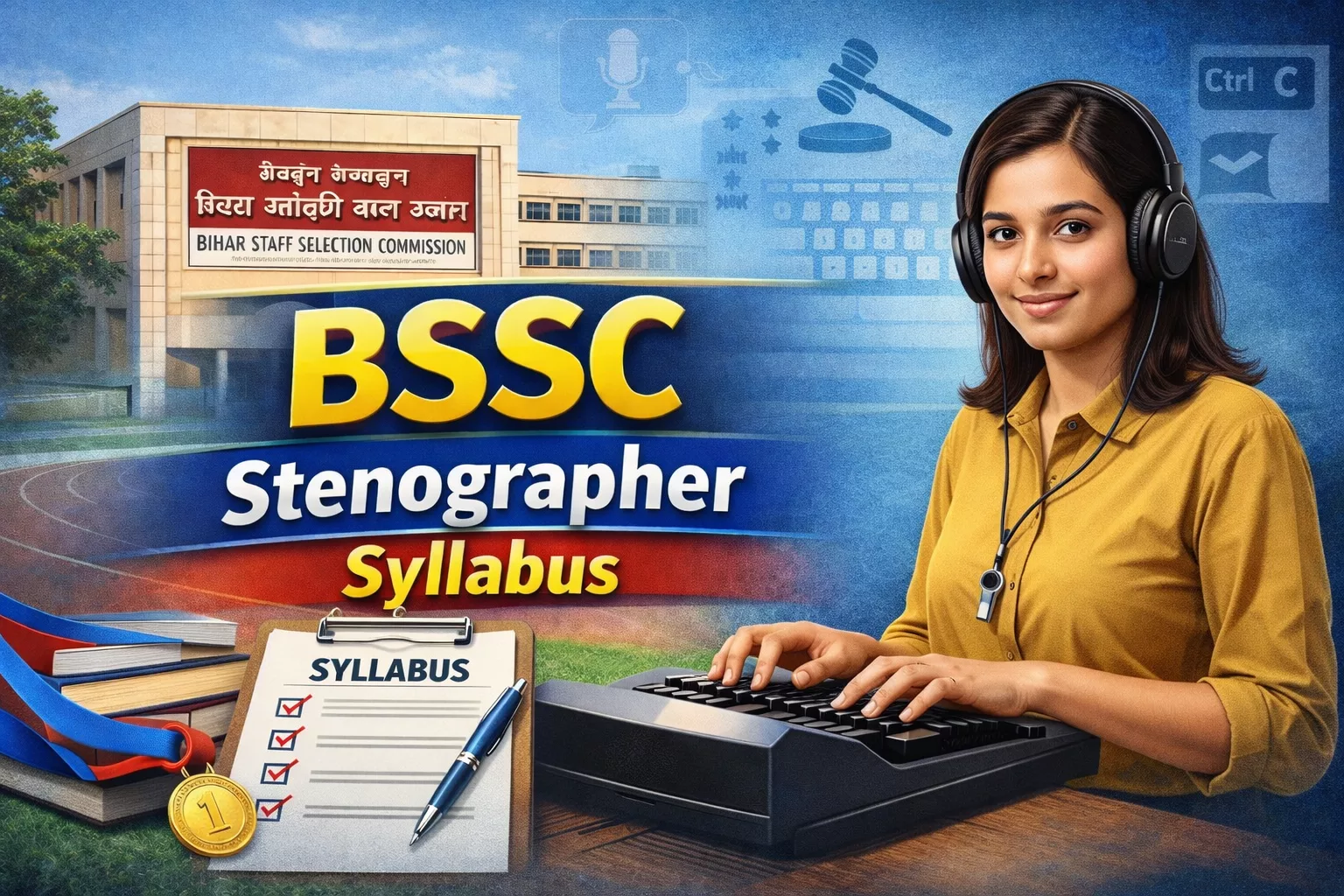
BSSC Stenographer Syllabus 2026: Exam Pattern, PDF & Preparation
Contents
- 1 Quick Overview: BSSC Stenographer 2026
- 2 Selection Process for BSSC Stenographer
- 3 BSSC Stenographer Exam Pattern 2026
- 4 Detailed Topic-Wise BSSC Stenographer Syllabus 2026
- 5 Download BSSC Stenographer Syllabus PDF 2026
- 6 Preparation Master Tips for BSSC Stenographer 2026
- 7 Summary of Minimum Qualifying Marks
- 8 FAQs
Are you gearing up for the Bihar Staff Selection Commission (BSSC) Stenographer recruitment? The first step to acing this competitive exam is mastering the BSSC Stenographer Syllabus 2026. With a total of 600 marks and a rigorous selection process involving a Written Exam and a Skill Test, strategic preparation is non-negotiable. This comprehensive guide breaks down the Syllabus 2026 and Exam Pattern to help you build a focused study plan and maximize your score.
Quick Overview: BSSC Stenographer 2026
Before diving into the topics, let’s look at the essential details of the recruitment drive. This table provides a snapshot of the exam structure and requirements.
| Particulars | Details |
|---|---|
| Exam Name | BSSC Stenographer Recruitment |
| Conducting Authority | Bihar Staff Selection Commission (BSSC) |
| Selection Process | Written Exam + Skill Test |
| Total Marks | 600 |
| Total Questions | 150 |
| Duration | 2 Hours 15 Minutes |
| Official Website | bssc.bihar.gov.in |
Selection Process for BSSC Stenographer
The recruitment process is designed to filter the best candidates through two major stages. Understanding the weightage of each stage is crucial for prioritizing your preparation.
- Stage 1: Written Examination (Objective Type): This is the screening stage. Candidates must secure a minimum qualifying mark to move to the next round. The questions will cover General Studies, General Science & Mathematics, and Comprehension/Reasoning.
- Stage 2: Skill Test (Stenography): Qualified candidates from the written exam will undergo a skill test. This usually involves taking dictation in Hindi/English and transcribing it on a computer within a specified time limit. This stage is qualifying in nature but performance is critical for the final merit list.
BSSC Stenographer Exam Pattern 2026
The written examination is the backbone of your selection. It is an objective-type test with multiple-choice questions (MCQs). Refer to the detailed pattern below:
| Subject/Section Name | No. of Questions | Maximum Marks |
|---|---|---|
| General Studies | 50 | 200 |
| General Science & Mathematics | 50 | 200 |
| Comprehension, Logical Reasoning & Mental Ability | 50 | 200 |
| Total | 150 | 600 |
Negative Marking Rules
Important: The BSSC applies a strict negative marking scheme. For every incorrect answer, 1 mark will be deducted. Therefore, accuracy is as important as speed.
Detailed Topic-Wise BSSC Stenographer Syllabus 2026
To crack the exam, you must study specific topics within each subject. Here is the exhaustive BSSC Stenographer Syllabus broken down for you.
1. General Studies
This section tests your awareness of the world around you, with a special focus on Bihar and India.
- History: Ancient, Medieval, and Modern Indian History with a specific focus on the History of Bihar.
- Polity & Economy: Indian Constitution, Political System, Panchayati Raj, and Indian Economy with Bihar-specific economic plans.
- Geography: Physical Geography of India and Bihar, Rivers, Soil, Climate, and Agriculture.
- Indian National Movement: The Freedom Struggle with an emphasis on Bihar’s contribution (e.g., Quit India Movement).
- Environment & GK: Current Affairs (National & International), Environmental issues, and General Knowledge of Bihar and neighboring states.
2. General Science & Mathematics
This section is a blend of conceptual science and numerical aptitude.
General Science
- Physics: Basic principles of Physics, Units and Measurements, Motion, Energy, Light, Sound, Electricity, and Magnetism.
- Chemistry: Elements, Compounds, Acids, Bases, Chemical Reactions, and Basics of Organic Chemistry.
- Biology: Human Body, Nutrition, Diseases, Plant and Animal Kingdom, Ecosystems, and Environmental Studies.
Mathematics (Matric / 10th Level)
- Algebra: Sets, Quadratic Equations, Logarithms, Polynomials, Linear Equations.
- Trigonometry: Trigonometric Ratios, Identities, Heights and Distances.
- Geometry & Mensuration: Lines, Angles, Triangles, Circles, 3D Geometry (Surface Area and Volume).
- Calculus: Differentiation and Integration (Basic concepts).
- Statistics & Probability: Mean, Median, Mode, Probability theorems, Data Interpretation.
- Arithmetic: Number System, Percentages, Profit & Loss, Simple & Compound Interest, Ratio & Proportion, Time & Work.
3. Comprehension, Logical Reasoning & Mental Ability
This section tests your cognitive skills and language proficiency.
English/Hindi Comprehension
- Passages to read and answer questions.
- Synonyms and Antonyms.
- Error Spotting and Sentence Correction.
Logical Reasoning & Mental Ability
- Series: Number Series, Alphabet Series, and Mixed Series.
- Puzzles & Seating Arrangements: Linear and Circular arrangements.
- Coding-Decoding: Symbol and Letter based coding.
- Verbal & Analytical Reasoning: Statements and Assumptions, Cause and Effect, Arguments.
- Non-Verbal Reasoning: Mirror Images, Paper Folding, Figure Classification.
- Mental Ability: Venn Diagrams, Blood Relations, Direction Sense Test, Decision Making.
Download BSSC Stenographer Syllabus PDF 2026
We understand the need for a portable version of the syllabus. You can download the official detailed syllabus PDF directly from the BSSC portal to keep on your device for offline study.
Click Here to Download Official BSSC Stenographer Syllabus PDF
Preparation Master Tips for BSSC Stenographer 2026
Simply knowing the syllabus isn’t enough; you need a strategy. Here are high-value tips tailored to the BSSC Stenographer Syllabus:
- Master the 10th Level Math: Since the Mathematics section is up to the 10th standard level, focus on speed and accuracy. Use short tricks for Arithmetic topics like Interest and Ratios.
- Bihar Special is Key: Don’t ignore the Bihar-specific focus in History, Geography, and Economy. A significant portion of the General Studies section is derived from Bihar’s context.
- Practice Comprehension Daily: The Reasoning and Comprehension section has 50 questions. Daily reading of newspapers (Hindi/English) will improve your reading speed and vocabulary simultaneously.
- Solve Mock Tests with Negative Marking: Since 1 mark is deducted for every wrong answer, practice with mock tests that simulate this penalty. Learn the art of skipping questions you are unsure of.
- Revise Science Concepts: Physics and Biology require conceptual clarity. Do not just memorize; understand the ‘why’ behind the facts to tackle tricky questions.
Summary of Minimum Qualifying Marks
While the exact cut-off varies every year based on the difficulty level and number of applicants, candidates usually need to secure the following minimum percentages to be eligible for the Skill Test (subject to category relaxation):
- General / EWS: 30% Marks
- BC / EBC / Women: 28.5% Marks
- SC / ST: 27% Marks
FAQs
No, the written exam is general in nature. The specific Stenography Skill Test is conducted separately for candidates who qualify in the written exam.
There are three main sections: General Studies, General Science & Mathematics, and Comprehension/Logical Reasoning.
Yes, the questions (except the English/Hindi comprehension part) are generally available in both Hindi and English.
The total duration is 2 hours and 15 minutes (135 minutes).
The Skill Test is generally qualifying in nature, but final selection is based on the merit of the written exam subject to qualifying the skill test.
The official notification does not strictly specify sectional cut-offs, but it is safe to prepare with balanced scores in all sections.
The level of Mathematics is strictly up to the Matriculation (10th Standard) level.
1 mark is deducted for every incorrect answer.