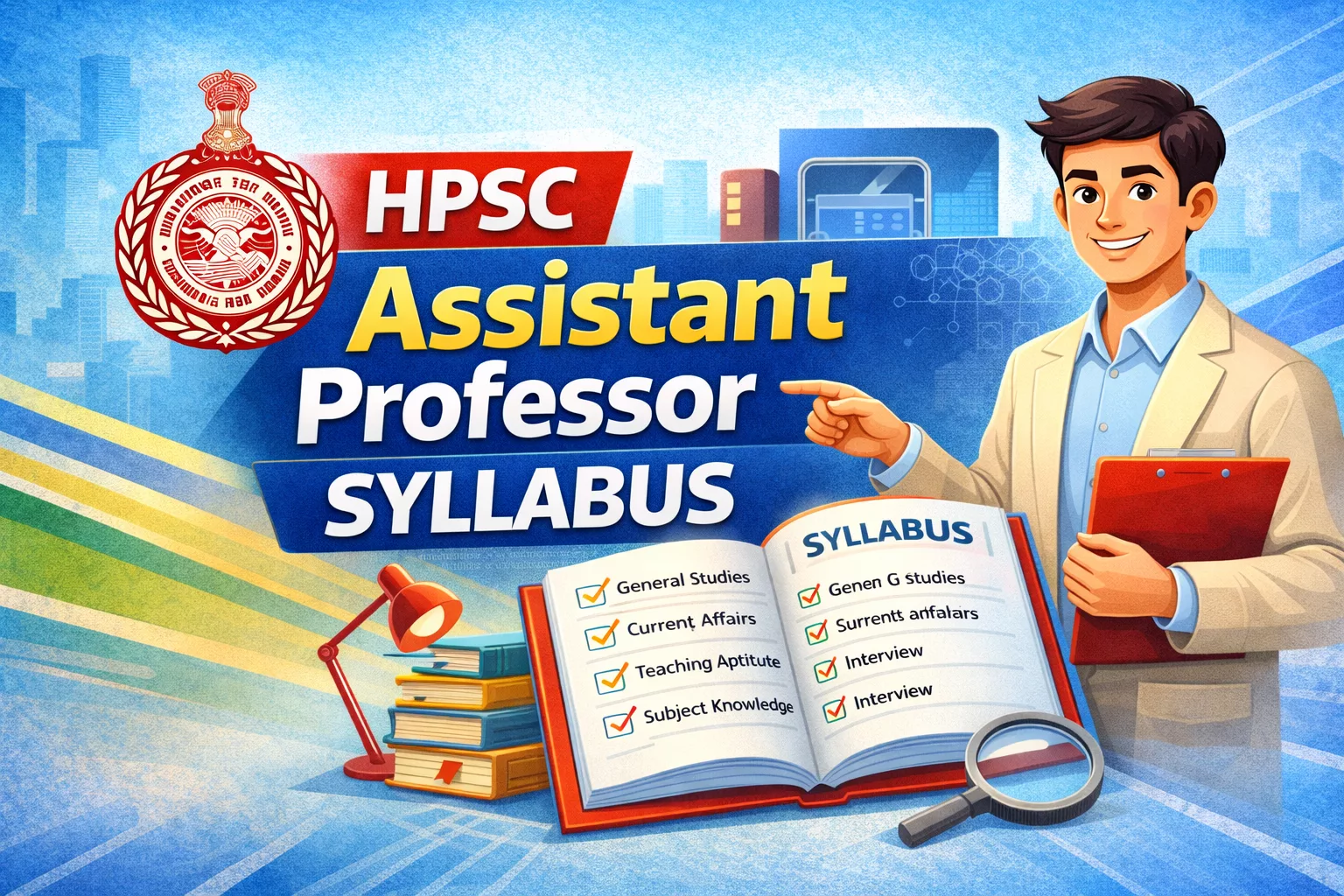
HPSC Assistant Professor Syllabus: Pattern & Topics
Contents
The HPSC Assistant Professor Syllabus 2026 is the ultimate roadmap for aspirants targeting faculty positions in Haryana’s government colleges. As the Haryana Public Service Commission (HPSC) prepares to release the notification for the upcoming recruitment cycle, understanding the Syllabus 2026 and the rigorous Exam Pattern is non-negotiable for success. This guide provides an authoritative breakdown of the screening tests, subject knowledge assessments, and interview protocols, ensuring you are equipped with a 10x superior preparation strategy that surpasses all competitors.
Quick Overview Table
| Feature | Details |
|---|---|
| Exam Name | HPSC Assistant Professor Recruitment 2026 |
| Conducting Authority | Haryana Public Service Commission (HPSC) |
| Post Name | Assistant Professor |
| Selection Process | Screening Test, Subject Knowledge Test, Interview, Document Verification |
| Total Marks | Screening (25% Weightage) + Subject Knowledge (87.5% Weightage) |
| Official Website | hpsc.gov.in |
| PDF Link | Download Syllabus PDF |
Selection Process
The recruitment process for the HPSC Assistant Professor Syllabus 2026 is designed to filter the most knowledgeable and capable candidates through a multi-stage approach:
- Screening Test: A qualifying objective-type test to shortlist candidates for the mains. This is mandatory for all applicants except those exempted as per UGC norms.
- Subject Knowledge Test: A descriptive written examination that carries the maximum weightage in the final merit list. This tests the core academic depth of the candidate.
- Interview: A personality assessment to evaluate teaching aptitude, research potential, and communication skills.
- Document Verification: Final validation of educational qualifications and category certificates.
Interactive-style Exam Pattern
Understanding the marking scheme and time management is critical. The HPSC Assistant Professor Exam Pattern is divided into two primary papers.
| Paper Name | Question Type | Total Questions/Marks | Weightage | Duration |
|---|---|---|---|---|
| Screening Test | Objective (MCQs) | 100 Questions | 25% of Total Marks | 2 Hours |
| Subject Knowledge Test | Descriptive | 150 Marks | 87.5% of Total Marks | 3 Hours |
Negative Marking: There is a penalty of 1/4th mark for every incorrect answer in the Screening Test. No marks are deducted for unattempted questions.
Topic-Wise Detailed Syllabus
This section breaks down the HPSC Assistant Professor Syllabus 2026 into granular topics. Use this to structure your study plan.
General Studies
This section is common across all streams for the Screening Test. It tests general awareness and current affairs.
- History & Heritage: Ancient, Medieval, and Modern Indian History; Heritage and Arts.
- Geography: Physical and Economic Geography of India.
- Polity & Economy: Indian Politics (Constitution, Panchayati Raj) and Indian Economy.
- General Science: Developments in Science and Technology, Communication, and Space.
- Current Affairs: Awards and Honors, Books and Authors, Defence System, Currencies.
- Organizations: International and National Organizations.
Chemistry
The syllabus covers physical, organic, inorganic, and interdisciplinary chemistry topics.
- Physical Chemistry:
- Quantum Mechanics (Hydrogen Atom, Angular Momentum).
- Variational and Perturbational Methods.
- Chemical Thermodynamics, Phase and Statistical Thermodynamics.
- Chemical and Electrochemical Equilibria, Kinetics, Catalysis.
- Solids and Colloids, Surface Phenomena, Data Analysis.
- Inorganic Chemistry:
- Atomic Structure, Chemical Bonding, Group Theory, Spectroscopy.
- Periodicity, Acid-Base Concepts.
- Main Group Elements, Transition and Inner Transition Elements.
- Organometallics, Metal Clusters, Bioinorganic Chemistry, Nuclear Chemistry.
- Organic Chemistry:
- Stereochemistry, Reaction Mechanisms, Aromaticity.
- Pericyclic Reactions, Named Reactions, Photochemistry.
- Free Radical Reactions, Oxidation-Reduction, Reagents.
- Natural Products, Heterocyclic Compounds.
- Interdisciplinary Topics:
- Nanoscience, Green and Medicinal Chemistry.
- Supramolecular and Environmental Chemistry.
Commerce
The syllabus integrates theoretical and practical aspects of commerce and business administration.
- Business Environment: Economic, Legal, Technological, Social, and Cultural Environment.
- Accounting & Finance:
- Financial, Management, and Cost Accounting.
- Financial Statement Analysis.
- Financial Planning, Investment Decisions, Capital Structure, Cost of Capital.
- Economics: Micro and Macroeconomics, Demand & Supply, Market Structures.
- Statistics: Data Analysis, Probability, Regression, Correlation.
- Management:
- Principles of Management, Organizational Behavior.
- Strategic and Human Resource Management.
- Marketing: Marketing and Consumer Behavior.
Computer Science
A comprehensive technical syllabus covering core CS concepts and modern technologies.
- Digital Logic & Architecture: Number Representation, Logic Families, Sequential Circuits, CPU and Memory Organization.
- Programming & Databases:
- Programming Languages (C, OOP).
- RDBMS, SQL, Query Optimization.
- Theory & Algorithms:
- Data Structures, Discrete Structures, Graph Theory.
- Algorithm Design and Analysis.
- Systems & Networks:
- Networks and Data Communication, Routing, Security.
- System and Compiler Design, Operating Systems (Linux/Unix).
- Software Engineering: Software Engineering, Data Warehousing and Mining.
- Emerging Tech: Graphics, Web Engineering, AI and Machine Learning Fundamentals.
Geography
The syllabus covers physical, human, and technical geography with a focus on regional and environmental aspects.
- Physical Geography: Geomorphology, Climatology, Biogeography, Soil and Hydrology.
- Human Geography: Population, Settlement, Economic, Urban, Social and Cultural Geography.
- Technical Geography: Cartography, Remote Sensing, GIS, Quantitative and Statistical Techniques.
- Regional & Global Geography: Indian and Regional Geography (Continents), Geopolitical Issues.
- Environmental Geography: Climate Change, Sustainable Development, Urbanization, Natural Hazards, Disaster Management.
Download HPSC Assistant Professor Syllabus 2026 PDF
Aspirants can access the detailed HPSC Assistant Professor Syllabus PDF to get a clear overview of all the topics essential for the exam.
Click Here – HPSC Assistant Professor Syllabus PDF
Preparation Master Tips
- Strategic Weightage Analysis: Since the Subject Knowledge Test carries 87.5% weightage, allocate 70-80% of your study time to descriptive writing and core subject mastery, reserving the rest for the Screening Test.
- Master General Studies Quickly: For the Screening Test, focus on high-yield topics like Current Affairs and Indian Polity. Use monthly magazines for concise revision.
- Descriptive Answer Writing: For Computer Science and Commerce, practice diagram-based answers. For Chemistry and Geography, focus on case studies and reaction mechanisms.
- Previous Year Analysis: Although the pattern is fixed, analyze previous HPSC trends to identify frequently repeated topics in the Screening Test.
- Time Management: The 3-hour descriptive paper requires stamina. Practice full-length mock tests to build endurance and handwriting speed.
Summary of Minimum Qualifying Marks
While the specific cut-off varies by category and subject, candidates must secure the minimum qualifying marks as per UGC/HPSC regulations:
- Screening Test: Generally, candidates need to score 40-50% to qualify (relaxation for reserved categories).
- Subject Knowledge Test: Minimum marks are typically set at 40% for General and 35% for reserved categories in the descriptive paper.
FAQs
The exam consists of a Screening Test (Objective, 100 Questions) and a Subject Knowledge Test (Descriptive, 150 Marks). The final merit is based on the combined performance, with the descriptive paper carrying higher weightage.
Yes, there is a negative marking of 1/4th mark for every incorrect answer in the Screening Test.
You can download the official syllabus from the HPSC website at https://hpsc.gov.in/en-us/Syllabus.
The Screening Test is 2 hours long, while the Subject Knowledge Test is 3 hours long.
The Screening Test carries 25% weightage, and the Subject Knowledge Test carries 87.5% weightage in the final selection.
Key topics include Data Structures, Algorithms, Operating Systems, Database Management Systems, Computer Networks, and Artificial Intelligence fundamentals.
Yes, the interview is a mandatory stage after qualifying the written exams to assess teaching aptitude and personality.
Candidates must have a Master’s degree with at least 55% marks and qualify the NET/SET/SLET or hold a Ph.D. degree as per UGC regulations.