Quick High-Impact Takeaways
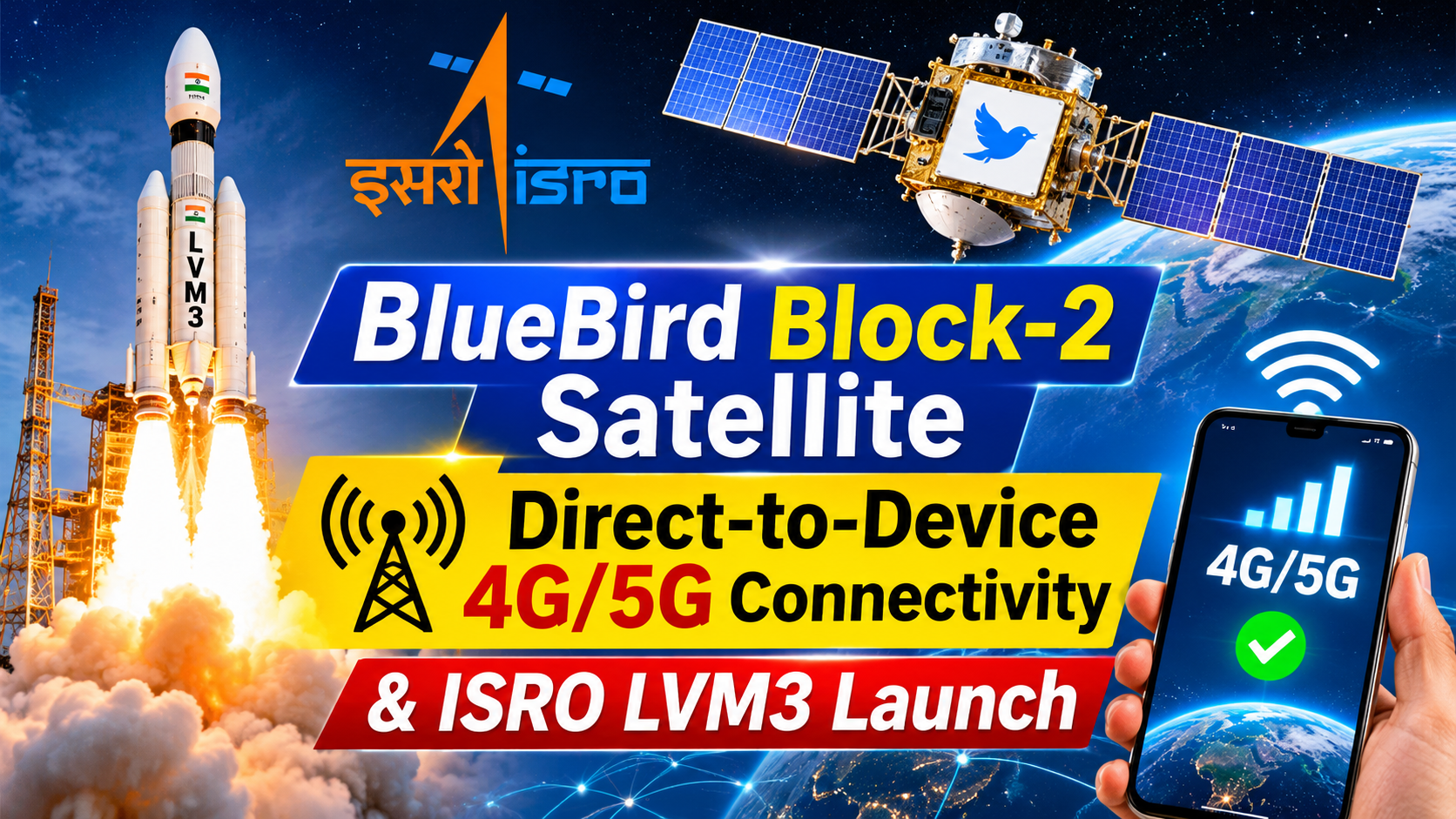
- BlueBird Block-2 is a US satellite scheduled for launch on 24 December 2025 aboard ISRO's LVM3-M6.
- It aims to provide direct 4G/5G connectivity to ordinary smartphones via satellite without terrestrial towers.
- At approximately 6,100 kg, it is the heaviest satellite ever launched from Indian soil (Satish Dhawan Space Centre, Sriharikota).
Key Exam Facts Matrix
| Parameter | Details |
|---|---|
| Satellite Name | BlueBird Block-2 |
| Country of Origin | USA |
| Launch Date | 24 December 2025 |
| Launch Vehicle | LVM3-M6 (ISRO) |
| Launch Site | Satish Dhawan Space Centre, Sriharikota |
| Approximate Weight | ~6,100 kg |
| Primary Objective | Direct 4G/5G connectivity to ordinary smartphones via satellite |
| Key Distinction | Heaviest satellite launched from Indian soil |
| Launch Agency | ISRO (India) |
1. Context & Background
The BlueBird Block-2 satellite, developed in the United States, represents the next generation of direct-to-device (D2D) satellite communication. Scheduled for launch on 24 December 2025 aboard ISRO's LVM3-M6 from the Satish Dhawan Space Centre, Sriharikota, the mission underscores India's growing role as a global launch hub for heavy commercial payloads. With a mass of approximately 6,100 kg, it is set to become the heaviest satellite launched from Indian soil.
2. Core Pillars & Mechanism
The core objective is to deliver standard 4G/5G mobile connectivity directly to unmodified smartphones via satellite, bypassing the need for terrestrial cell towers in remote or underserved regions. This Direct-to-Device (D2D) architecture leverages satellite constellations to extend mobile network coverage to oceans, deserts, and rural hinterlands where traditional infrastructure is economically unviable.
3. Critical Issues & Bottlenecks
Key challenges include spectrum coordination between satellite operators and national telecom regulators, potential interference with existing terrestrial 4G/5G bands, higher latency compared to ground networks, and the affordability of user services. Additionally, reliance on foreign satellite operators for critical communication infrastructure raises data sovereignty and national security considerations for India.
4. Balanced Way Forward & Policy Roadmaps
India should formulate a clear Direct-to-Satellite regulatory framework, allocate dedicated spectrum bands for satellite-to-mobile services, and incentivize domestic satellite communication constellations under the Indian Space Policy 2023. Strengthening ISRO's heavy-lift capacity through LVM3 upgrades will attract more international commercial launches, boosting revenue and strategic autonomy in space-based communications.
Model Practice Question (Prelims)
Q. Which of the following statements regarding the BlueBird Block-2 satellite is/are correct?
- A) It is scheduled to be launched by ISRO's LVM3-M6 from Sriharikota only
- B) It aims to provide direct 4G/5G connectivity to ordinary smartphones via satellite only
- C) Both A and B
- D) Neither A nor B
Correct Option: C
Explanation: Statement A is correct because BlueBird Block-2 is slated for launch on 24 December 2025 aboard ISRO's LVM3-M6 from the Satish Dhawan Space Centre, Sriharikota. Statement B is correct because its primary objective is to deliver direct 4G/5G connectivity to ordinary smartphones via satellite. Statement C is incorrect because, at approximately 6,100 kg, it is the heaviest—not the lightest—satellite launched from Indian soil.