P. V. Sindhu Elected President of IOA Athletes Commission 2026-30: Key Facts
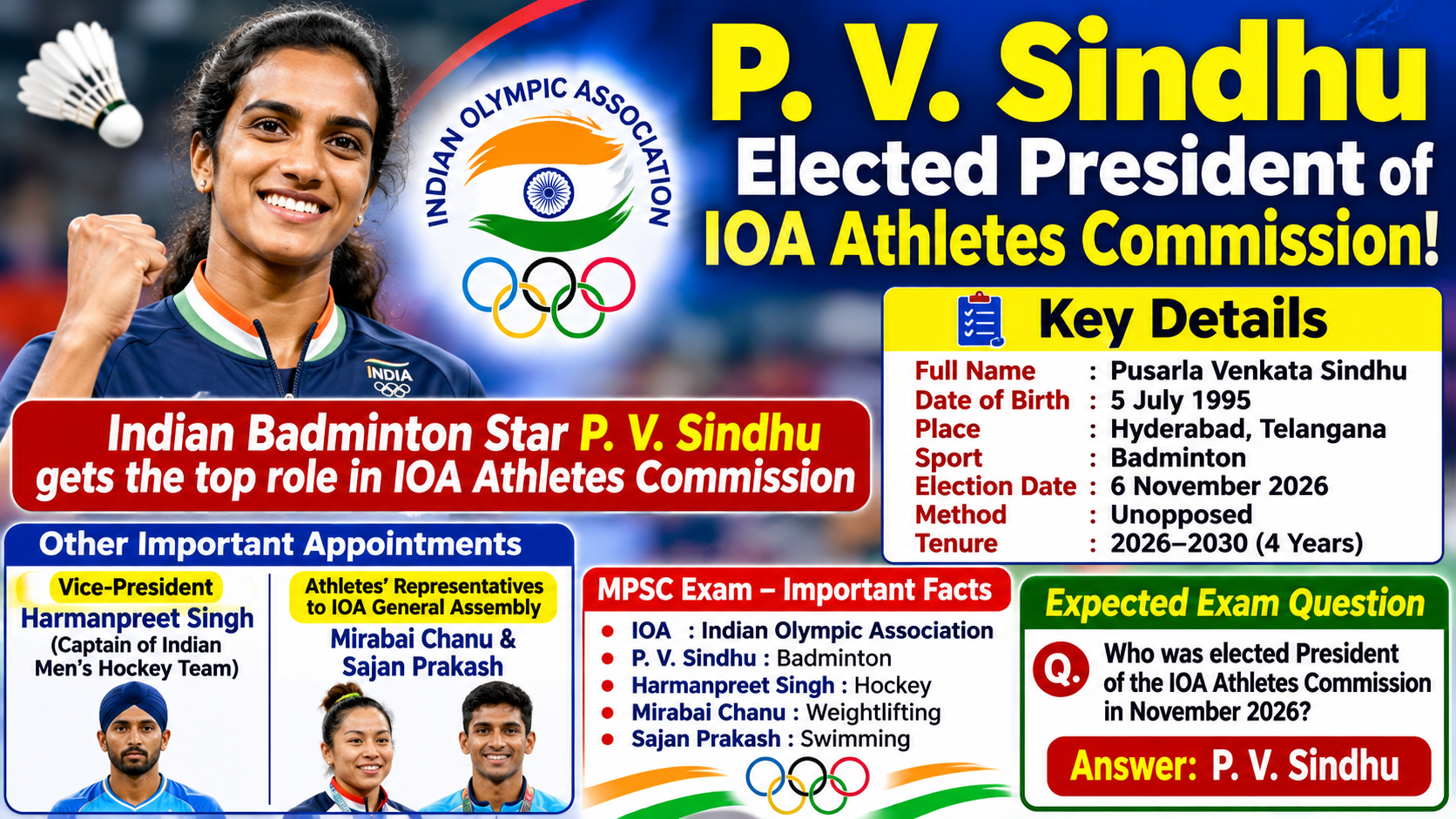
P. V. Sindhu elected unopposed as President of IOA Athletes Commission (2026-30). Get tenure, other appointments and exam facts.
Quick High-Impact Takeaways
- P. V. Sindhu (badminton) elected unopposed as President of the IOA Athletes Commission for the 2026-2030 tenure on 6 November 2026.
- Harmanpreet Singh (hockey) is Vice-President; Mirabai Chanu (weightlifting) and Sajan Prakash (swimming) are Athletes' Representatives to the IOA General Assembly.
- The IOA, founded in 1927 and headquartered in New Delhi, functions under the Ministry of Youth Affairs and Sports as the National Olympic Committee recognised by the IOC.
Key Exam Facts Matrix
| Parameter | Details |
|---|---|
| Body / Institution | Athletes Commission of the Indian Olympic Association (IOA) |
| Parent Organisation | Indian Olympic Association (IOA) - India's National Olympic Committee, founded 1927, HQ New Delhi, recognised by the International Olympic Committee (IOC) |
| Parent Ministry (Sports Governance in India) | Ministry of Youth Affairs and Sports, Government of India |
| Newly Elected President | Pusarla Venkata (P. V.) Sindhu - Indian badminton, born 5 July 1995, Hyderabad (Telangana) |
| Date of Election | 6 November 2026 (elected unopposed) |
| Tenure | 2026-2030 (4 years) |
| Vice-President | Harmanpreet Singh - Captain, Indian Men's Hockey Team |
| Athletes' Representatives to IOA General Assembly | Mirabai Chanu (weightlifting) and Sajan Prakash (swimming) |
| Sport Disciplines Linked to Appointments | Sindhu - Badminton; Harmanpreet Singh - Hockey; Mirabai Chanu - Weightlifting; Sajan Prakash - Swimming |
1. Context & Background
P. V. Sindhu, India's most decorated badminton player and an Olympic medallist, has been elected unopposed as President of the Athletes Commission of the Indian Olympic Association (IOA) for the term 2026-2030. The election was held on 6 November 2026. Alongside her, Harmanpreet Singh (captain of the Indian men's hockey team) was appointed Vice-President, while weightlifter Mirabai Chanu and swimmer Sajan Prakash were chosen as Athletes' Representatives to the IOA General Assembly.
The Athletes Commission is the statutory consultative body mandated within the Olympic Movement to represent the voice of sportspersons in policy-making, athlete welfare, anti-doping awareness, career transition and governance reforms. Its elevation of an active, high-profile athlete to the chair reflects the broader global trend of athlete-centric governance promoted by the Olympic Charter and the IOC's Athletes' Commission framework.
2. Institutional Framework & Core Pillars
The IOA is India's apex sports body and the National Olympic Committee (NOC) recognised by the International Olympic Committee. Founded in 1927 and headquartered in New Delhi, it functions under the broader oversight of the Ministry of Youth Affairs and Sports.
The key pillars of the Commission's mandate are:
- Athlete Representation: Channelising the concerns of sportspersons into IOA policy and General Assembly deliberations.
- Welfare and Career Development: Supporting post-retirement transition, education, and mental health of athletes.
- Governance and Ethics: Strengthening transparency, integrity, and compliance with IOC Olympic Charter norms.
- Grassroots to Podium Linkage: Feeding athlete experience into talent development and high-performance strategies.
The multi-disciplinary composition of the leadership slate - badminton, hockey, weightlifting, and swimming - ensures representation across Olympic sports rather than a concentration in any single discipline.
3. Critical Issues & Bottlenecks
- Limited Statutory Teeth: Athletes Commissions in many NOCs remain advisory, with restricted budgets and weak enforcement authority.
- Balancing Active Career and Governance: Sindhu and Harmanpreet Singh are active international athletes, creating potential conflicts between competitive commitments and institutional duties.
- Inclusion Gaps: Representation of para-athletes, women in decision-making roles, and athletes from smaller or lesser-funded sports remains uneven.
- Bureaucratic Dominance: In India, sports federations have historically been led by administrators and politicians, marginalising athlete voices.
- Institutional Continuity: Frequent transitions and election-related disputes in national federations can disrupt long-term athlete-centric reforms.
4. Balanced Way Forward & Policy Roadmaps
- Functional Empowerment: Give the Athletes Commission a defined charter, dedicated budget, and direct reporting access to the IOA Executive Council.
- Athlete-Olympian Integration: Systematically induct retired Olympians and international medallists into federation technical and governance committees.
- Code-Compliance Reforms: Align all national sports federations with the IOC Olympic Charter, the Sports Code, and the National Sports Development Code for transparent elections.
- Inclusive Representation: Mandate reservation for women athletes, para-athletes, and athletes from Olympic as well as non-Olympic disciplines.
- Athlete Welfare Infrastructure: Institutionalise education scholarships, insurance, and post-retirement placement programmes through the Ministry of Youth Affairs and Sports.
- Capacity Building: Provide governance, finance, and leadership training to athlete-commission members so that on-field excellence translates into administrative effectiveness.
A well-empowered Athletes Commission can bridge the historic gap between podium performance and policy-making, making Indian sports governance more participatory, transparent, and athlete-first.
Model Practice Question (Prelims)
**Q. Consider the following statements regarding the President of the IOA Athletes Commission elected in November 2026:
- P. V. Sindhu was elected unopposed as President of the Athletes Commission of the Indian Olympic Association for the term 2026-2030.
- Harmanpreet Singh was appointed Vice-President, while Mirabai Chanu and Sajan Prakash were elected Athletes' Representatives to the IOA General Assembly.
Which of the statements given above is/are correct?**
- A) 1 only
- B) 2 only
- C) Both 1 and 2
- D) Neither 1 nor 2
Correct Option: C
Explanation: Statement 1 is correct: P. V. Sindhu, the Indian badminton star born on 5 July 1995 in Hyderabad, was elected unopposed as President of the IOA Athletes Commission on 6 November 2026 for a four-year tenure of 2026-2030. Statement 2 is also correct: Harmanpreet Singh, captain of the Indian men's hockey team, became Vice-President, while weightlifter Mirabai Chanu and swimmer Sajan Prakash were selected as Athletes' Representatives to the IOA General Assembly. Since both statements are accurate, option C is the correct answer. As a memory aid, map each personality to their sport: Sindhu - badminton, Harmanpreet Singh - hockey, Mirabai Chanu - weightlifting, Sajan Prakash - swimming.