Torrent Power's Saidongar-I Pumped Storage Project: Capacity, Controversies & Way Forward
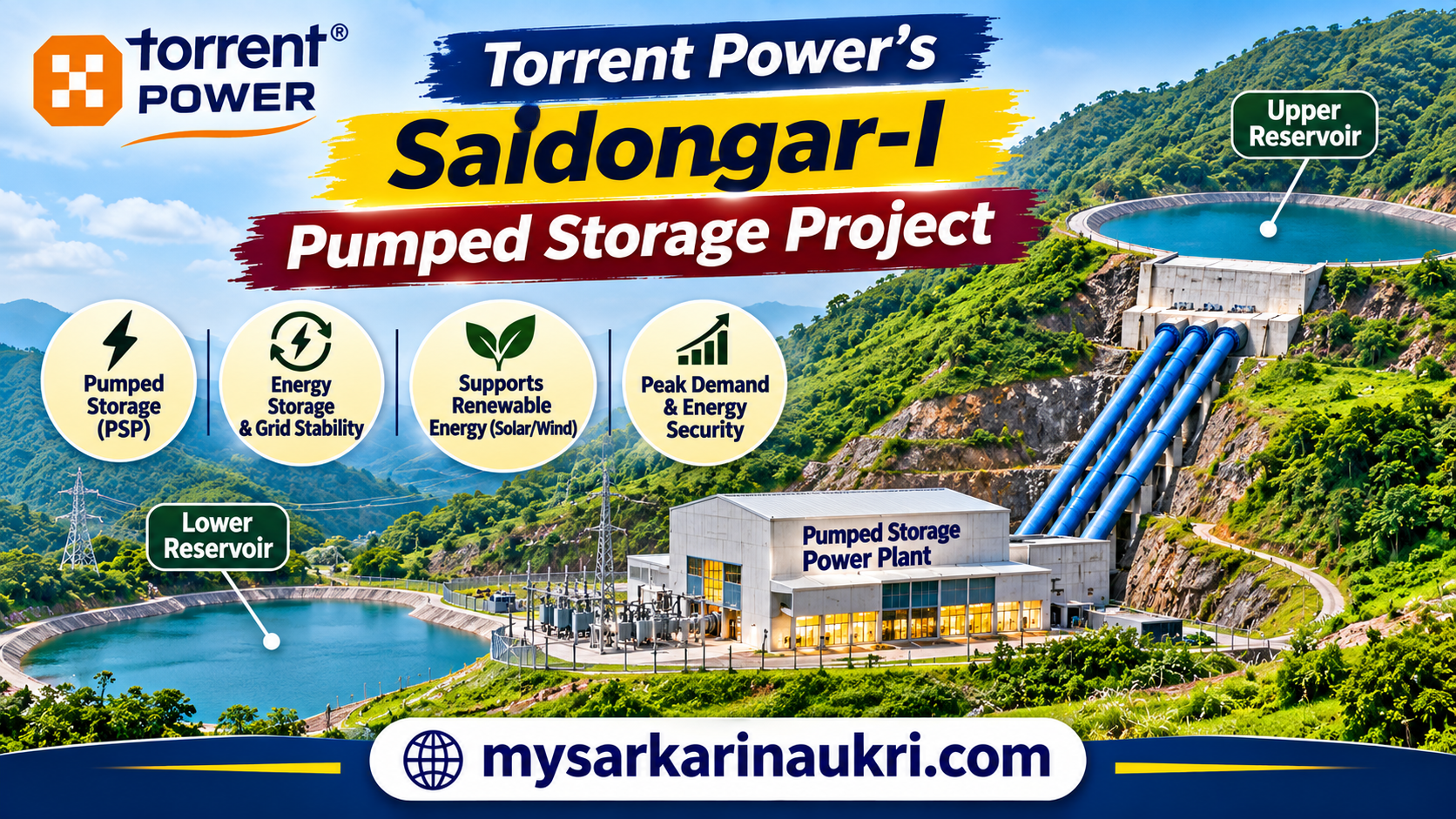
Exam‑oriented overview of Maharashtra’s 3 GW pumped storage project, environmental clearance, and key controversies.
Quick High-Impact Takeaways
- 3 GW pumped storage project by Torrent Power in Raigad’s Karjat, slated for 2026 with ₹13,505 cr investment.
- Environmental clearance granted in Jan 2026; forest clearance Stage‑I in Dec 2025, but faces local opposition over 233 ha forest diversion and 32,490 tree felling.
- Project aims to balance renewable surplus, enhance grid stability, and reduce thermal dependence; mitigation measures include 60,000 tree plantation and wildlife conservation plans.
Key Exam Facts Matrix
| Parameter | Details |
|---|---|
| Nodal Ministry | Ministry of Environment, Forests and Climate Change (MoEFCC) |
| Statutory / Constitutional Basis | Environment (Protection) Act, 1986; Forest (Conservation) Act, 1980; Electricity Act, 2003 |
| Key Objective / Target Year | Add 3,000 MW pumped storage capacity by 2026 to store renewable surplus and improve grid stability |
| Budgetary Outlay / Data | Approx. ₹13,505 crore; total project area ~377 ha; forest diversion ~233 ha; 32,490 trees to be felled |
| Location | Saidongar, Karjat taluka, Raigad district, Maharashtra |
| Developer | Torrent PSH 3 Private Limited (affiliated to Torrent Group) |
| Capacity | 3,000 MW (3 GW) |
| Environmental Clearance | 12 January 2026 |
| Forest Clearance (Stage‑I) | 31 December 2025 |
| Current Status | Works on tree felling temporarily halted (2 Nov 2026) following local protests; ~1,100 trees already felled |
1. Context & Background
The Saidongar‑I pumped storage project, developed by Torrent Power, is positioned as a strategic response to India’s growing renewable energy target and the need for grid‑level storage. With an installed capacity of 3 GW, it is among the largest pumped storage initiatives in the country. The project received environmental clearance from the MoEFCC in January 2026 and forest clearance (Stage‑I) in December 2025, reflecting procedural adherence. However, the scale of forest diversion (233 ha) and the felling of over 32,000 trees triggered widespread local and environmental opposition, leading to a temporary suspension of tree‑felling activities in early November 2026.
2. Core Pillars & Mechanism
- Technology: Open‑loop pumped storage hydropower using two reservoirs; surplus renewable electricity pumps water uphill, and during peak demand the water flows down through turbines.
- Energy Storage Role: Stores excess solar/wind generation, smooths demand‑supply mismatches, and enhances grid stability without additional thermal generation.
- Economic Rationale: ₹13,505 crore investment, creation of large‑scale employment, and contribution to Maharashtra’s renewable energy mix.
- Mitigation Measures Claimed: 60,000 tree plantation, compensatory afforestation on additional land, wildlife conservation plan, and comprehensive environmental management.
3. Critical Issues & Bottlenecks
- Environmental Impact: Massive forest loss and biodiversity disruption; concerns over compensatory afforestation effectiveness.
- Community Opposition: Dependence of local livelihoods on forest resources; perceived lack of transparent stakeholder consultation.
- Implementation Delays: Temporary halt of tree‑felling works; potential for prolonged legal challenges.
- Independent Verification: Need for third‑party assessment of mitigation plans and actual ecological outcomes.
- Policy Balance: Conflict between developmental imperatives and ecological conservation mandates under the Forest (Conservation) Act.
4. Balanced Way Forward & Policy Roadmaps
- Enhanced Stakeholder Engagement: Conduct structured Gram Sabha meetings, offer benefit‑sharing mechanisms, and incorporate local feedback into project design.
- Robust Environmental Safeguards: Mandate independent environmental impact assessment (EIA) audits, real‑time monitoring of tree plantation survival, and biodiversity offset projects.
- Phased Implementation: Defer non‑critical forest diversion until compensatory afforestation reaches maturity; adopt a “build‑back‑better” approach with native species.
- Policy Coordination: Align MoEFCC, Ministry of Power, and state electricity boards to streamline clearances and ensure coherent renewable‑storage strategies.
- Capacity‑Building: Invest in local skill development for operation and maintenance, creating a sustainable livelihood link for affected communities.
Model Practice Question (Prelims)
Q. Which of the following statements regarding the Saidongar‑I Pumped Storage Project is/are correct?
- A) Statement 1 only (The project is located in Raigad district.)
- B) Statement 2 only (It received environmental clearance in January 2026.)
- C) Both 1 and 2
- D) Neither 1 nor 2
Correct Option: C
Explanation: Both statements are correct. The project is situated in Saidongar, Karjat taluka, Raigad district, Maharashtra. It obtained environmental clearance from the Ministry of Environment, Forests and Climate Change on 12 January 2026 (MoEFCC file number). Hence option C (Both 1 and 2) is the right answer.